“Fish swim in the middle of this desert every summer, born from eggs that survive for months under scorching sand until the equatorial rains turn the dunes into a labyrinth of emerald pools.”
About Parque Nacional dos Lençóis Maranhenses
Maranhão’s coast was once the mouth of ancient river systems that spent ages depositing fine quartz silt into the Atlantic. Over the last six thousand years, the prevailing winds have pushed this sediment back inland, creating a massive field of moving dunes that currently covers over 150,000 hectares. Local communities known as 'caipiras' have adapted to this shifting world for centuries, moving their homes as the dunes encroach and fishing in the seasonal lagoons. The park was officially established in June 1981 to halt the expansion of eucalyptus plantations and to preserve the delicate balance of the restinga vegetation. In 2024, UNESCO recognized the site as a World Heritage landmark, cementing its status as a global geological anomaly where the desert effectively drowns in fresh water for half the year.
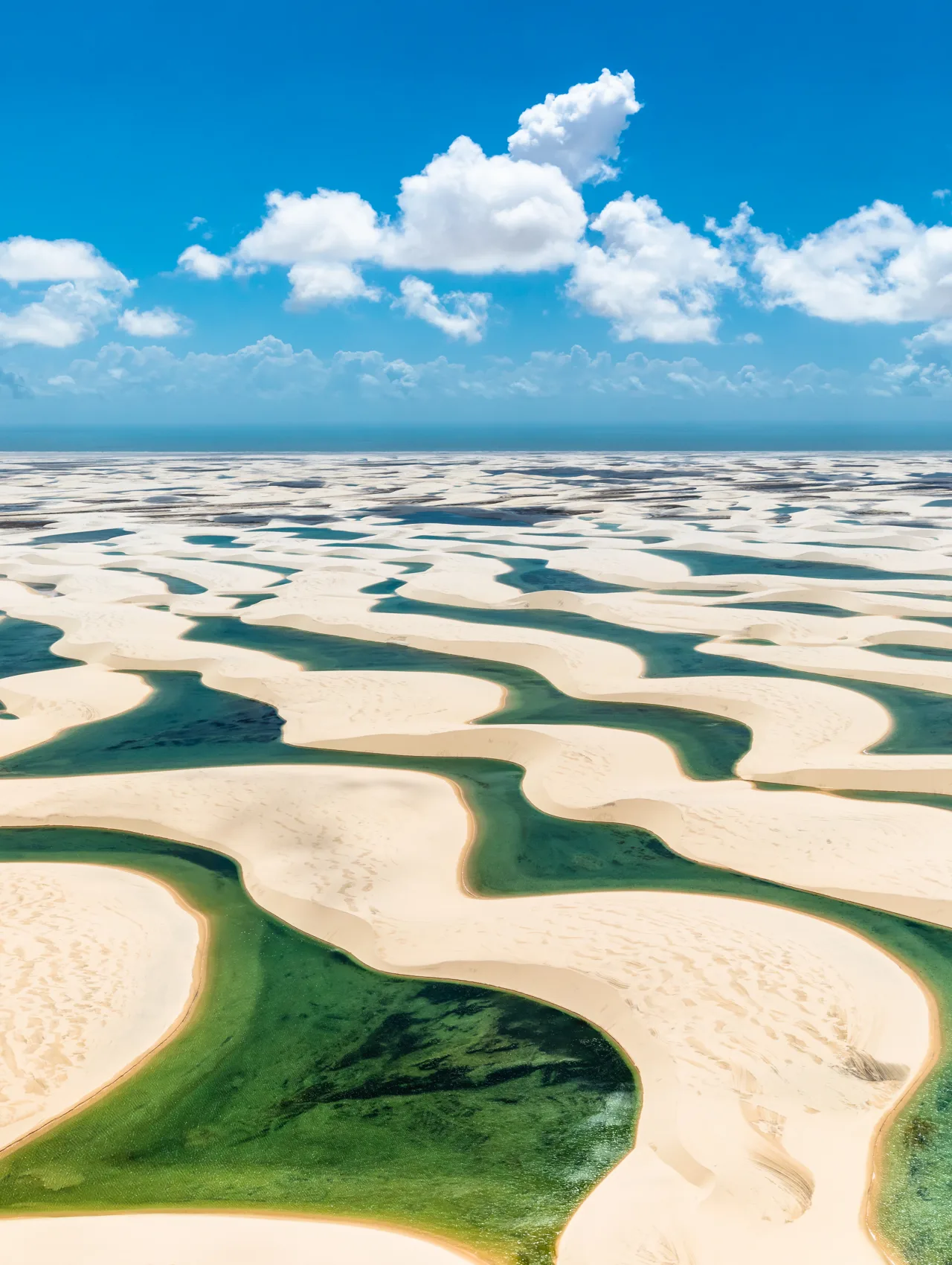
Rainwater trapped between rolling dunes
Rainwater trapped between rolling dunes of blindingly white quartz sand creates a landscape so surreal it is like a glitch in geography. From an aerial view, these pools look like turquoise silk sheets spread across a desert, hence the name Lençóis, which translates to bedsheets. Unlike the Sahara or the Atacama, this region receives enough annual rainfall to host a vibrant aquatic ecosystem despite the lack of visible vegetation. The sand here is remarkably cool to the touch, composed of ground-down silt carried from the interior by rivers and pushed back onto the coast by relentless Atlantic winds. Near the crest of a forty-meter dune, the horizon offers nothing but a rhythmic pattern of white peaks and emerald valleys stretching toward the sea.
Rainwater trapped between rolling dunes of blindingly white quartz sand creates a landscape so surreal it is like a glitch in geography.
Natural forces have conspired over millennia to trap
Natural forces have conspired over millennia to trap the Parnaíba and Mearim river sediments along this specific stretch of the Maranhão coastline. Every year, during the first half of the calendar, torrential equatorial rains fill the troughs between the dunes, creating thousands of temporary lagoons that can reach depths of three meters. Geologically, the park is a coastal desert, yet the impermeable rock layers beneath the sand prevent the water from draining away immediately. Fish and shrimp often appear in these seasonal ponds, having hatched from eggs buried deep in the damp sand or traveled through temporary channels during the height of the floods. Protected as a National Park since 1981, the area remains one of the few places on earth where the desert and the rainforest successfully negotiate a seasonal truce.
The silence of the dunes
The silence of the dunes is broken only by the steady whistle of the trade winds and the occasional splash of a traveler diving into a crystal-clear pool. The walk across the sand feels like navigating a giant, undulating sculpture where the texture changes from hard-packed ridges to soft, ankle-deep drifts. The detail that hits is how the water temperature shifts from tepid at the edges to a refreshing chill in the center, tasting surprisingly sweet for a place so close to the salt spray of the ocean. At sunset, the white quartz catches the fading light, turning shades of bruised purple and liquid gold that reflect perfectly in the still lagoons. Small villages like Atins provide a grounding reality to the dreamscape, where the smell of grilled shrimp and woodsmoke offers a sensory anchor after a day in the white void.
Journeys usually begin in the town of Barreirinhas
Journeys usually begin in the town of Barreirinhas, where modified 4x4 vehicles wait to ferry passengers across the Preguiças River by barge. The ride into the park is a bumpy, visceral introduction to the terrain, involving deep sandy ruts and thickets of scrub forest. For a more remote immersion, many choose to hike across the park over three or four days, sleeping in hammocks in tiny oases inhabited by local families who have lived among the dunes for generations. Arriving by light aircraft from São Luís provides the only way to grasp the scale of the park, revealing a repeating fractal of water and sand that seems to have no end.
Journeys usually begin in the town of Barreirinhas, where modified 4x4 vehicles wait to ferry passengers across the Preguiças River by barge.
The Experience
The glare of the sun on the quartz is so intense that you feel it even behind closed eyelids, yet the moment you step into a lagoon, the heat evaporates into a profound, liquid silence. The first thing you register is that the water in Lagoa Azul or Lagoa Bonita is so transparent that you can see the rippled patterns of the sand on the floor three meters below. During the peak of the day, the landscape loses its shadows and becomes a flat, white expanse, but as the sun dips, the dunes cast long, dramatic silhouettes that reveal the true height of the climbs. There is a specific smell here, a mix of dry mineral dust and the clean, vegetal scent of rainwater. Part of the fine sand find its way into every pocket and seam of your clothing, a persistent souvenir of the desert. The most striking realization is the absence of birds or insects in the deep interior of the dunes; it is just you, the wind, and a thousand temporary lakes.
Why It Matters
Lençóis Maranhenses is a rare example of a 'wet' desert, a place that defies the traditional classification of arid lands. It serves as a vital catchment area for the region’s water table and a unique laboratory for studying how life adapts to extreme seasonal changes. Humanly, it represents a landscape that cannot be conquered or permanently settled, only briefly visited and respected as the sand continues its slow, inevitable march inland.
Why Visit
Go because there is nowhere else on the planet where you can run down a mountain of white sand and plunge into a warm, freshwater lake. While the Sahara is a place of endurance, the Lençóis is a place of play. It offers a visual purity that resets your eyes, replacing the cluttered geometry of the city with the infinite, fluid curves of a world made entirely of two elements.
✦ Insider Tips
- 1
Opt for the sunrise trek from Atins to witness the dunes when the sand is cool and the light is soft enough to see the tiny tracks of beetles and lizards.
- 2
Bring a polarized lens for your glasses or camera to cut the blinding reflection of the white quartz and see the true color of the water.
- 3
Avoid the most famous lagoons during the weekend; ask your guide to take you to the 'secret' pools further toward the center of the park.
- 4
Pack a long-sleeved UV shirt rather than relying solely on sunscreen, as the wind and sand will quickly strip any lotion from your skin.
- 5
Stay overnight in the village of Santo Amaro for the shortest and most direct access to the largest, deepest lagoons in the entire park system.