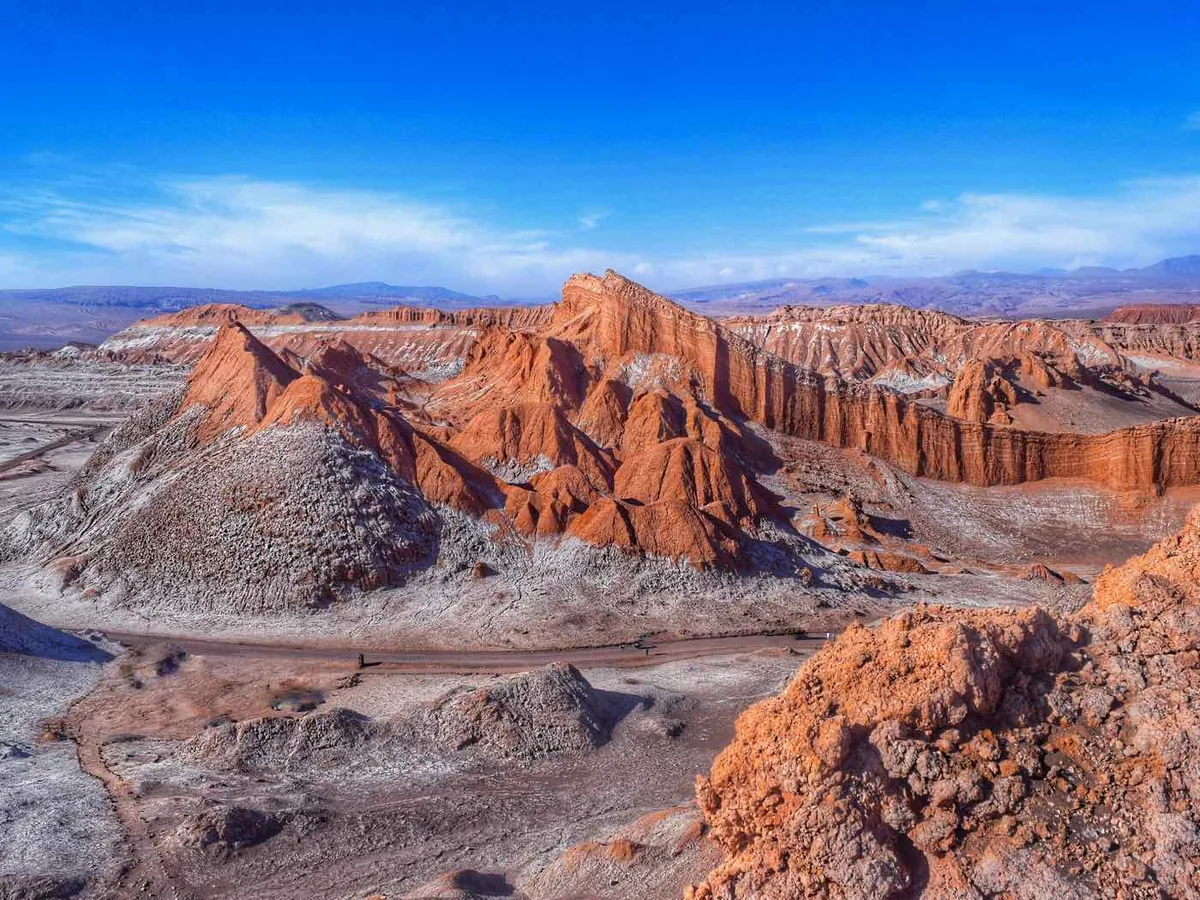
66 radio antennas spread across a plateau at 5,000 metres form a single telescope powerful enough to read a golf ball's surface from 15 kilometres away.
About ALMA Observatory
The concept for a large millimetre-wavelength array in the Atacama developed through the 1990s as radio astronomers in Europe, North America, and Japan independently identified the Chajnantor Plateau as the world's best site for this type of observation. The three programmes merged into a single international project in 2003, with construction contracts awarded to European and North American aerospace and engineering firms. Building at 5,000 metres required solutions to problems that did not exist in lower-altitude construction, the specialised transporters that move the antennas, the hyperbaric chambers for workers suffering altitude effects, the oxygen-supplemented control rooms. The antenna dishes themselves are polished to a surface smoothness of 25 micrometres, a quarter of a human hair's width, and must maintain that precision across temperature variations from minus 20 to plus 20 degrees Celsius. ALMA's first major scientific result, published in 2014, showed a protoplanetary disk around the young star HL Tauri with a resolution and detail that demonstrated the array's transformative capability. The image showed structures in a forming solar system 450 light-years away that had been theoretically predicted but never directly observed.
What ALMA Observatory actually is
The Atacama Large Millimeter/submillimeter Array sits on the Chajnantor Plateau at 5,058 metres above sea level in the Chilean Andes, the highest ground-based telescope array in the world. ALMA consists of 66 radio antennas, each 12 metres in diameter, weighing 100 tonnes, and positioned across a plateau roughly the size of metropolitan Santiago, that function together as a single instrument of unprecedented sensitivity. The array observes the universe at millimetre and submillimetre wavelengths, frequencies that pass through the dust clouds obscuring star-forming regions and allow astronomers to see planetary systems in formation. The site was chosen because the Atacama Plateau is the driest place on earth where the atmosphere is also stable, the combination of altitude and aridity reduces the water vapour that absorbs radio wavelengths to nearly zero, giving ALMA a window into the universe that no lower, wetter location on the planet could provide.
“The Atacama Large Millimeter/submillimeter Array sits on the Chajnantor Plateau at 5,058 metres above sea level in the Chilean Andes, the highest ground-based telescope array in the world.”
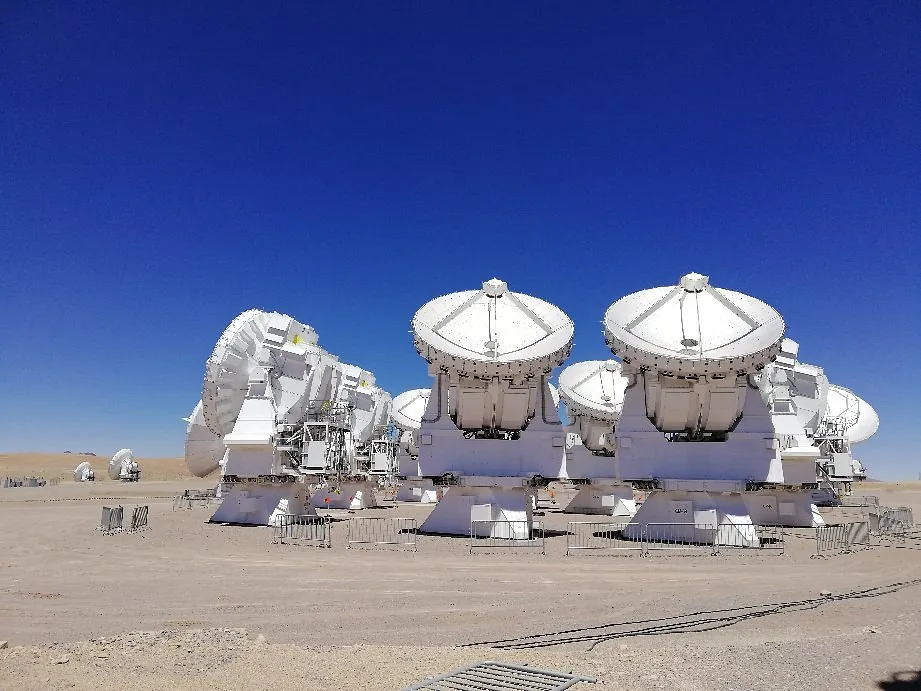
ALMA Observatory, Chile
The ALMA Operations Support Facility
The ALMA Operations Support Facility is 40 kilometres east of San Pedro de Atacama on the road to the Paso de Jama border crossing. Free Saturday and Sunday visits must be pre-registered online through the ALMA website, with registration opening on the first day of each month for the following month's visits. Transport to the OSF from San Pedro is available through registered operators listed on the ALMA website.
Why it matters
ALMA is an international partnership, the European Southern Observatory, the US National Radio Astronomy Observatory, the National Astronomical Observatory of Japan, and the Chilean national astronomy programme, representing a scientific consortium whose combined investment exceeded 1.4 billion US dollars. The project was approved in 2003; construction began in 2003 and was completed in 2013. The array entered partial scientific operation in 2011 while construction continued, producing its first major results, images of the protoplanetary disk around a distant star, within months. Chile hosts the array because Chajnantor is the best radio astronomy site on earth. The country has signed international agreements guaranteeing that 10% of ALMA's observation time is reserved for Chilean astronomers, making the facility also a major investment in Chilean scientific capacity.
ALMA offers free Saturday and Sunday visits
ALMA offers free Saturday and Sunday visits to the Operations Support Facility at 2,900 metres, the lower facility where the antennas are assembled and maintained before being driven by specialised transporters to the 5,000-metre plateau. The 66 antennas, arranged in their working configuration on the plateau, are not accessible to the public due to altitude and the operational sensitivity of the equipment. At the OSF, guides explain the project's science, the antenna technology, and the logistics of operating a major astronomical instrument at extreme altitude. The antennas undergoing maintenance at the facility are close enough to touch, 12 metres of polished reflector surface calibrated to millimetre precision, moved across the Atacama by vehicles built specifically for the purpose. The scale of the engineering is immediately apparent and not easily absorbed.
The Experience
The OSF visit is an engineering tour as much as an astronomical one. The antennas in the maintenance facility are enormous in a way that photographs do not communicate, the 12-metre reflector surface overhead, polished and precisely curved, the mechanical azimuth and elevation drives visible at the base, the receiver packages at the focus point wrapped in thermal insulation. The precision of the engineering and the altitude of the final deployment site produce a cognitive distance that guides work to bridge with specific numbers. The Chajnantor Plateau itself, visible from the OSF road on a clear day, is a flat, brown expanse of altiplano with 66 white dish antennas arranged across it, from a distance they look like a crop that has grown overnight.
Why It Matters
ALMA is the most powerful radio telescope array in the world and the primary instrument through which current astronomy is investigating the formation of stars, planets, and galaxies in the early universe. Its location in Chile makes the country a central node in global astronomical research, alongside the Very Large Telescope and the construction site of the Extremely Large Telescope at Cerro Armazones, Chile hosts more major telescope infrastructure than any other country on earth.
Why Visit
Most astronomical observatories are distant, permit-restricted, and anti-climactic for non-specialist visitors. ALMA's OSF visit is engineered for public access and delivers the actual antennas at close range rather than a visitor centre display. For anyone interested in the scale of international scientific collaboration or in engineering at precision extremes, the visit is extraordinary.
Insider Tips
- 1
Registration opens on the first day of each month for that month's Saturday and Sunday visits, log onto the ALMA website at midnight on the first for best availability.
- 2
The OSF is at 2,900 metres and altitude effects are possible even at this level; acclimatise in San Pedro for at least one night before the visit.
- 3
The visit is free but transport from San Pedro is not included, book an approved operator from the list on the ALMA website.
- 4
Photography of the antennas at the OSF is permitted and the close-range shots of the reflector surfaces are worth the effort.
- 5
The visit lasts approximately two hours; guides provide context on the science and engineering at a level that works for non-specialists.