“The most photographed object in Chile is a working clock planted with flowers, replanted six times a year since 1962 by a dedicated team of city gardeners.”
About Flower Clock
Viña del Mar was founded in 1874 as a planned resort suburb of Valparaíso, its flat coastal land subdivided and sold to the Santiago elite who wanted a sea-facing property within reach of the capital. The railway connection, established in 1855, made weekend and summer residence practical, and the city developed rapidly on the resort model, wide streets, garden squares, grand hotels, a casino. The resort identity was explicitly European in aspiration, drawing on the model of French and Belgian seaside towns. The Reloj de Flores, installed in 1962, was part of a civic beautification effort that also included the expansion of the Quinta Vergara botanical gardens and the upgrade of the waterfront promenade. The floral clock form was already well-established in European resort cities, and the adoption in Viña del Mar was a conscious alignment with that tradition. The clock has become an emblem of Chilean tourism more broadly, appearing on postcards, in airline advertisements, and in virtually every official tourism image of Chile produced since the 1970s.
What Flower Clock actually is
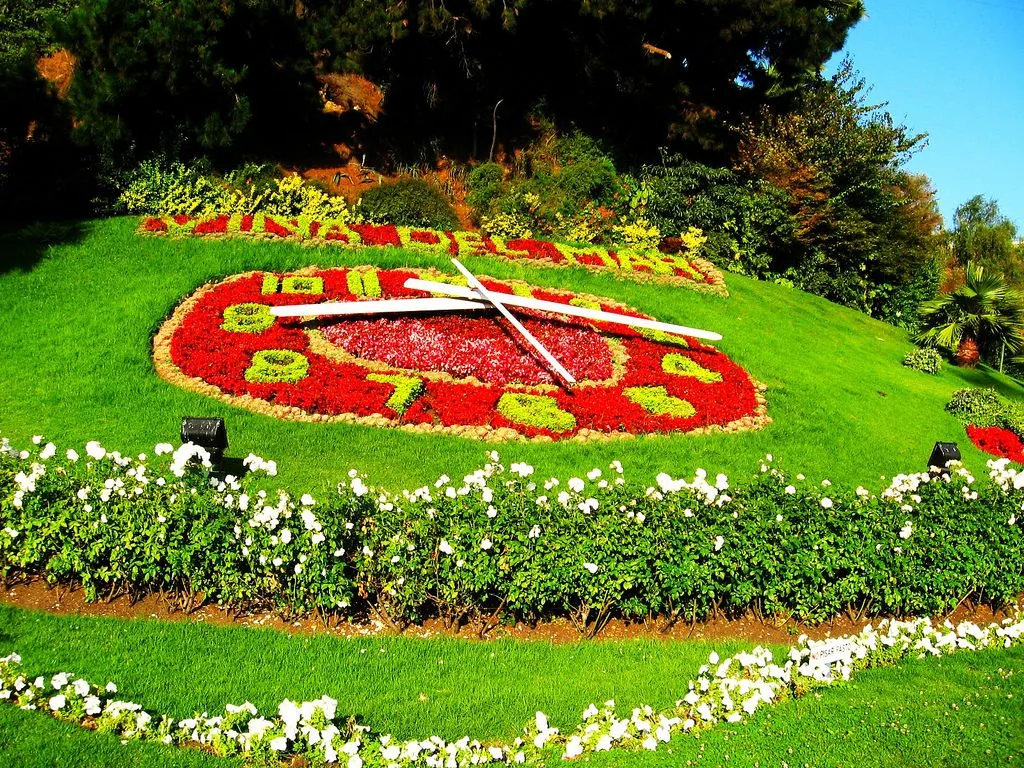
The Reloj de Flores in Viña del Mar is a working clock set into a hillside above the city's central waterfront, its face planted with seasonal flowers that are replanted six times per year to maintain the pattern through the changing colours of each season. The clock has been operating since 1962, and in that time it has become the most photographed object in Chile, not because it is extraordinary in itself, but because it is the emblem of a city that defines itself through its gardens and its climate, the Pacific resort that Santiaguinos have been escaping to since the railway connected the two cities in 1855. Viña del Mar sits immediately north of Valparaíso on the same bay, but the two cities could not be more different in character. Where Valparaíso is chaotic, hillside, and historically melancholy, Viña del Mar is flat, ordered, and prosperous, a city of wide avenues, casino hotels, and the most consistently maintained public gardens in Chile.
Viña del Mar sits immediately north of Valparaíso on the same bay, but the two cities could not be more different in character.
Flores was installed, 1962
The Reloj de Flores was installed in 1962 on the embankment above Avenida Marina as part of a civic beautification programme that the city of Viña del Mar had been running since the early twentieth century. The design follows a tradition of floral clocks that originated in European spa towns, Edinburgh had one in 1903, Geneva shortly after, and the adoption of the form in Viña del Mar was a deliberate reference to the European resort tradition that the city had been modelling itself on since its foundation as a planned resort suburb in the 1870s. The clock mechanism is conventional; the distinctive feature is the horticultural maintenance. A team of city gardeners manages the replanting schedule across the six seasonal rotations, choosing flower varieties for colour, durability, and the specific growing conditions of the embankment. The varieties change but the pattern, clock hands in a contrasting colour against a planted face, remains constant.
Visiting Flower Clock
The clock is set into the hillside at an angle designed for photography from the pavement below, and the viewing arrangement is entirely honest about this purpose. The embankment drops steeply from street level to the clock face, and the perspective from the pavement gives the clearest overall view of the planted pattern and the working hands above it. The surrounding area, Avenida Marina, the adjacent Quinta Vergara gardens, the beachfront promenade to the north, constitutes the core of Viña del Mar's resort identity and is worth exploring as a context for the clock. The casino hotel to the north, operating since 1930 and one of the oldest in South America, sits above the beach in a Belle Époque building that frames the northern end of the same waterfront.
Viña del Mar is 8 kilometres
Viña del Mar is 8 kilometres north of Valparaíso by road or the Metro Regional, a commuter rail that runs between the two cities every few minutes. From Santiago, the train to Valparaíso and then the Metro Regional covers the journey in under two hours. The Reloj de Flores is on Avenida Marina, walkable from the Viña del Mar metro station in ten minutes.
Viña del Mar is 8 kilometres north of Valparaíso by road or the Metro Regional, a commuter rail that runs between the two cities every few minutes.
The Experience
The clock is best visited in the early morning when the light is flat and the crowds have not yet formed on the embankment pavement. The seasonal planting changes the colour palette but not the composition, and arriving between rotations, when some flowers are past peak and the new planting has not yet filled in, reveals the horticultural mechanics behind the image. The wider embankment area along Avenida Marina repays a slow walk north toward the beach. The casino building, the palms along the promenade, the view of the bay with the hills of Valparaíso visible to the south, the scale of Viña del Mar's resort infrastructure, maintained with consistent civic investment since the 1870s, becomes clear in a thirty-minute walk.
Why It Matters
The Reloj de Flores is significant primarily as an emblem, the condensed image that represents Chilean coastal tourism in the national imagination. Its horticultural maintenance over sixty years is a minor but genuine achievement in civic gardening, requiring continuous expert attention to keep a working timepiece planted with living material across all seasons.
Why Visit
The clock is worth seeing once as the object it is, a well-maintained horticultural curiosity in a well-maintained resort city. The visit is more rewarding if extended to the surrounding waterfront and the Quinta Vergara gardens, which together give a fuller picture of what Viña del Mar is and has been since its founding.
✦ Insider Tips
- 1
The best photography angle is from the pavement directly in front of the clock face, the embankment angle is designed for this view.
- 2
The replanting schedule is posted on the city's tourism website; visiting shortly after a new planting gives the sharpest colour definition in the face.
- 3
The Quinta Vergara botanical gardens, five minutes' walk inland, are free to enter and include a substantial palm collection and the Palacio Vergara events venue.
- 4
The Metro Regional between Valparaíso and Viña del Mar runs every few minutes and costs almost nothing, it is faster and cheaper than a taxi between the two cities.
- 5
The casino Hotel del Mar on the beachfront north of the clock is open to non-guests for the restaurant and bar; the building's 1930s architecture is worth the entrance.