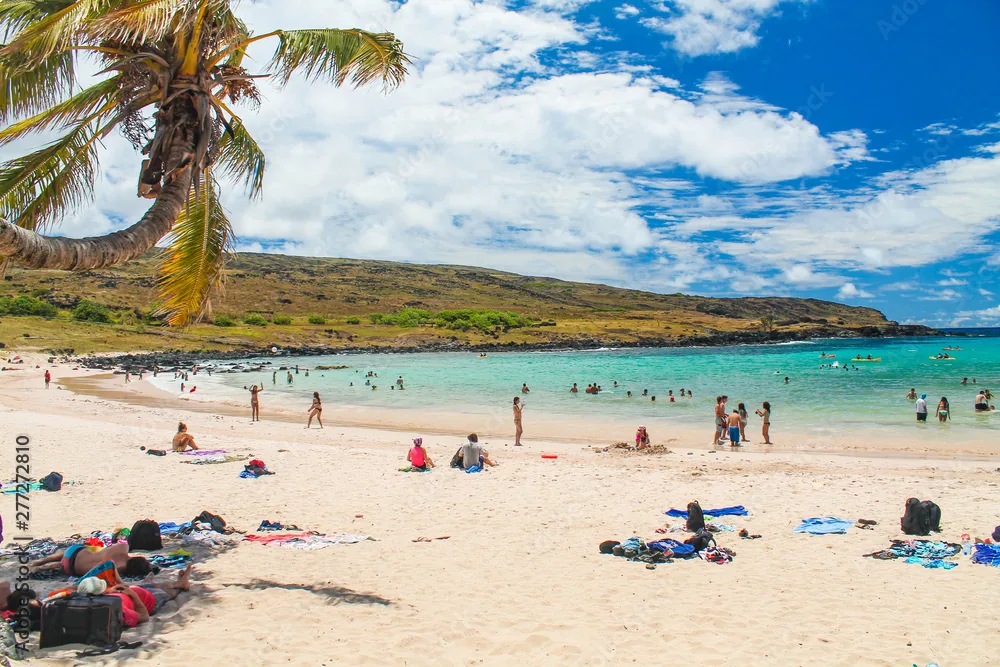
Rapa Nui legend says their founding chief landed his canoe on this exact beach, the only white sand on an island of black volcanic rock.
About Anakena Beach
The founding narrative of the Rapa Nui places Hotu Matu'a, the first ariki mau or paramount chief, arriving at Anakena from a distant homeland in the central Pacific. Archaeological evidence supports an initial settlement on the island around 1200 CE, and the site of Anakena, the island's only protected sandy bay with a reliable freshwater spring, is the logical landing point for a Polynesian navigation expedition. The ahu at Anakena were built and maintained by the Miru clan, whose territory covered the northern coast. Ahu Nau Nau's moai carry the most detailed surface carving on the island, ear extensions, fingernails, loincloth details, preserved by the sand burial that followed their toppling in the inter-clan wars. Thor Heyerdahl's 1978 excavation revealed the buried figures and led to the first major modern restoration work on the island. The coconut palms on the beach were planted by Chilean authorities in the 1960s and 1970s, part of an ill-considered beautification programme. They are not native to Easter Island and require supplemental irrigation, but they have become part of the beach's identity.
Anakena Beach
Anakena is the only white sand beach on Easter Island, and its combination of pink-white coral sand, coconut palms, warm water, and two ceremonial moai platforms makes it the island's most concentrated overlap of natural and archaeological beauty. The beach sits in a protected bay on the island's north coast, sheltered from the prevailing Pacific swells that make the rest of the coastline unswimmable, and the water temperature there, warmed by the bay's shallowness and the subtropical latitude, is genuinely inviting rather than merely symbolic. The two ahu on the beach's inland edge, Ahu Nau Nau, with seven moai, and Ahu Ature, with a single figure, position the stone ancestors watching over the swimming beach, which is either a coincidence the Rapa Nui found entirely natural or a deliberate decision to site the most sacred platform at the most welcoming approach from the sea.
Anakena's beach exists because the bay's
Anakena's beach exists because the bay's geology favoured coral sand accumulation, a condition that exists nowhere else on Easter Island's predominantly volcanic coast. The Rapa Nui founding legend places the landing of the first chief, Hotu Matu'a, at Anakena, the white sand bay was the obvious choice for a seafaring people choosing a sheltered landing point on an island whose coasts are mostly basalt cliffs and rough lava rock. Ahu Nau Nau's seven moai are among the best preserved on the island; the sand that buried them after toppling protected their surfaces from the weathering that eroded the features of moai left exposed on the surface. Their topknots, five of the seven still carry the red scoria cylinders, are the most complete examples of the form on the island. The restoration of the ahu was completed in 1978 under Norwegian archaeologist Thor Heyerdahl.
Anakena is a beach that works on both
Anakena is a beach that works on both its functions simultaneously. The swimming is genuine, the bay is protected and the water is warmer than the open coast, and the moai are directly visible from the water, watching from the platform at the beach's inland boundary. The coconut palms (not native to Easter Island; planted in the twentieth century) give the beach a tropical character that the rest of the island's windswept grassland does not prepare you for. The afternoon is the best time, the sun comes around to the northwest by 3pm and illuminates the moai faces directly, the beach crowd thins as the day-trippers return to Hanga Roa, and the light on the water in the bay turns the surface a deep, specific blue that the midday overhead light flattens out.
Anakena is 21 kilometres north
Anakena is 21 kilometres north of Hanga Roa on a paved road. Rental cars, scooters, and organised tours all reach it easily. Several food trucks and small kiosks operate on the beach; the national park entry fee applies.
The Experience
The beach is the one place on Easter Island where the weight of the island's history lightens. People swim in the bay while the moai watch from the platform twenty metres away, and the combination, living people in blue water, stone ancestors above the sand, is not incongruous but complementary, which probably reflects something accurate about how the Rapa Nui understood the relationship between the living and the dead. The Ahu Nau Nau moai are visibly better preserved than most on the island. The carved details of the ears and fingers, protected by sand for two centuries, are still sharp. Standing close to the platform and looking at the quality of the carving, the precision of the ear form, the delicacy of the loincloth relief, gives a different understanding of the craft than the more weathered examples elsewhere.
Why It Matters
Anakena is the point of origin of the Rapa Nui civilisation, the landing site of the founding migration and the location of the island's best-preserved ceremonial platform. The preservation quality of Ahu Nau Nau's moai, protected by accidental sand burial, makes it the primary site for understanding what the Rapa Nui intended the moai to look like before weathering and toppling erased the surface detail from most examples.
Why Visit
Easter Island's other sites are archaeological or geological. Anakena is both of those and also a functional beach with warm swimming water and a relatively intimate scale. The combination of the founding mythology, the best-preserved moai on the island, and the possibility of swimming in the Pacific with stone ancestors visible from the water makes it the island's most complete single experience.
✦ Photo Gallery
Best Season
🌤 November through March for swimming, the water is warmest and the bay is most sheltered from the trade winds. The beach is less crowded in the mornings; afternoons bring the daily tour visits from Hanga Roa.
Quick Facts
Best time to visit
November through March for swimming, the water is warmest and the bay is most sheltered from the trade winds. The beach is less crowded in the mornings; afternoons bring the daily tour visits from Hanga Roa.
Getting there
In Easter Island, Chile; reach Easter Island first, then continue to the site.
Location
Easter Island, Chile
Type
attraction
Insider Tips
- 1
Bring snorkelling equipment, the bay has coral reef sections with reasonable fish density visible from the water near the rocky northern headland.
- 2
The food kiosks on the beach serve grilled fish and local dishes at reasonable prices; they operate daily when the beach is open.
- 3
The spring behind the ahu is the island's historical freshwater source, the surrounding area is archaeologically sensitive and should not be approached beyond the marked visitor zone.
- 4
The afternoon light from the northwest illuminates the Nau Nau moai faces most directly; mid-morning light comes from behind the figures and leaves them in shadow.
- 5
Rent a car rather than relying on tours to allow time to swim, explore the ahu at your own pace, and stay for the afternoon light, tour visits typically allow 45 minutes.