“During the Pinochet dictatorship, this neighbourhood's bookshops functioned as the closest thing Santiago had to a free intellectual public space.”
About Barrio Lastarria
Lastarria developed as a residential district for Santiago's professional class in the 1870s and 1880s, when the city was expanding eastward and the area below Cerro Santa Lucía offered both elevation and proximity to the government centre. The street was named for José Victorino Lastarria, the liberal politician and writer who had shaped Chilean secular thought in the mid-nineteenth century, a choice that signalled the neighbourhood's intended identity. The district's cultural function intensified under adversity. After the 1973 coup, public intellectual life in Santiago contracted sharply; universities were purged, publishing houses closed, public gatherings required permits. Lastarria's density of small bookshops, private galleries, and theatre spaces made it a place where cultural activity continued at the margins of official tolerance. The habits formed then, the bookshop browsing, the long coffee conversations, the preference for small venues over large ones, persist in the neighbourhood's current character. Gentrification pressure accelerated from the 2000s onward, raising rents and replacing some of the older bookshops with restaurants and boutique hotels. The core character has survived the transition more intact than in comparable districts elsewhere in Santiago.
What Barrio Lastarria in Chile is
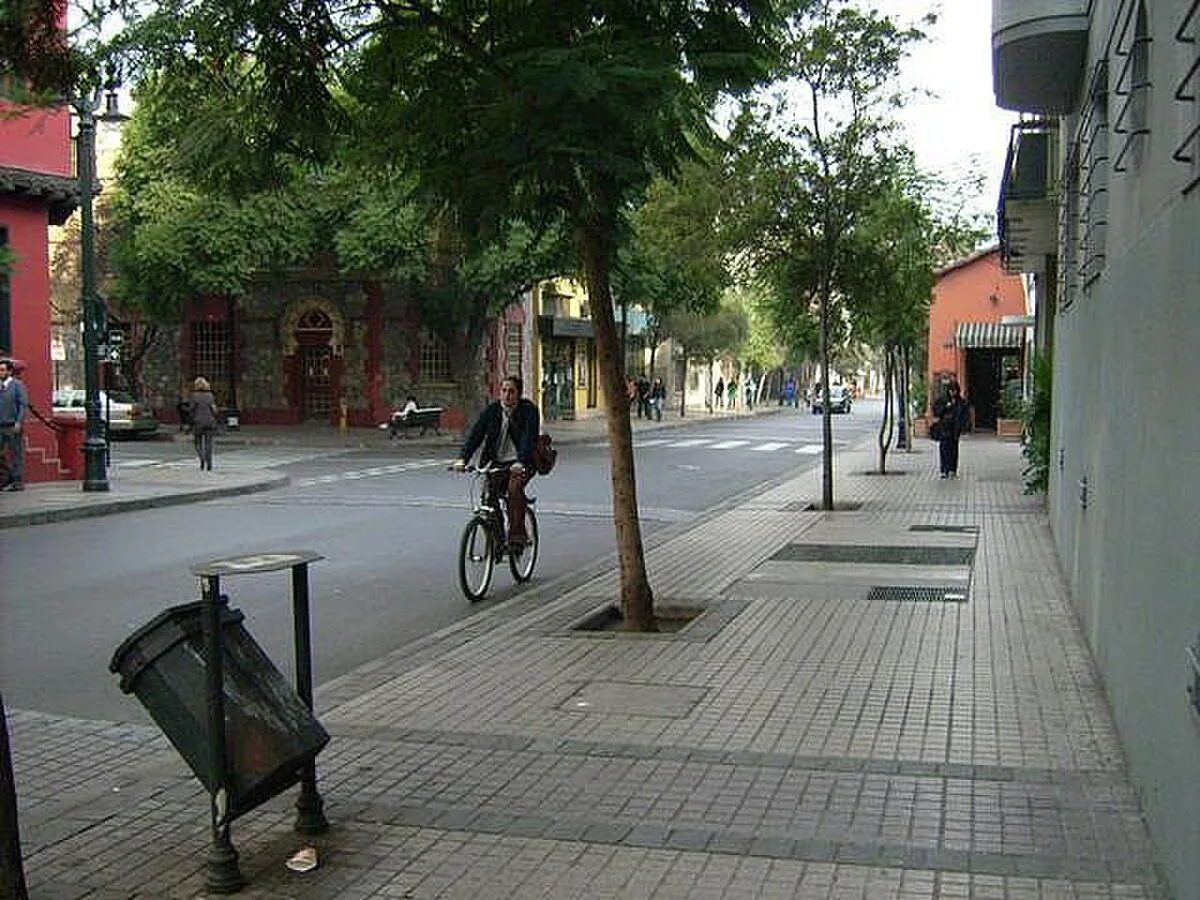
Barrio Lastarria occupies a few blocks of nineteenth-century townhouses on the eastern edge of Santiago's city centre, pressed against the base of Cerro Santa Lucía, and it operates as the city's most self-consciously cultured neighbourhood without being insufferable about it. The streets are narrow and tree-lined, the ground-floor facades given over to bookshops, wine bars, design studios, and cafés whose tables extend onto the pavement in warm weather. The Museo de Artes Visuales and the Museo Arqueológico de Santiago both have their entrances here, sharing a courtyard that functions as a public gathering space throughout the week. What distinguishes Lastarria from similar neighbourhoods in other Latin American capitals is the density of daily use, this is not a district that comes alive only on weekends or evenings, but a place that sustains its activity through the full working day, populated by a mix of residents, students from the adjacent universities, and the kind of regular visitor who returns for specific shops or restaurants rather than atmosphere.
The streets are narrow and tree-lined, the ground-floor facades given over to bookshops, wine bars, design studios, and cafés whose tables extend onto the pavement in warm weather.
The neighbourhood developed in the late
The neighbourhood developed in the late nineteenth century as Santiago's professional and intellectual class moved east from the colonial centre toward higher ground. The street itself is named for José Victorino Lastarria, a nineteenth-century Chilean writer and politician who championed secular education and liberal constitutional reform, a naming choice that accurately describes the neighbourhood's historical character. The Círculo Español, a Spanish immigrant social club whose ornate building still anchors one end of the street, was founded in 1895 and remains in operation. Lastarria's identity as a cultural district solidified during the Pinochet dictatorship (1973–1990), when it became one of the few Santiago neighbourhoods where a degree of intellectual and artistic life continued in semi-public form. Bookshops served as informal meeting points; theatre companies operated in basements. The neighbourhood's current density of cultural institutions is partly a legacy of that period.
The street market that sets up
The street market that sets up on the cobblestone plaza adjacent to the Círculo Español on weekday mornings sells antique books, vintage maps, old photographs, and used vinyl, the stock changes daily and rewards patient browsing. The Museo de Artes Visuales, entered through the shared courtyard, holds a strong collection of twentieth-century Chilean painting and contemporary work, with free admission on Tuesdays. The café tables on the main street come into their own in the late afternoon, when the angle of the sun drops below the building line and the street fills with a diffuse light that makes even routine sitting-and-watching feel particularly good. The restaurants along Lastarria and the parallel street Merced range from long-established Chilean classics to newer natural wine bars.
Barrio Lastarria is a ten-minute walk east
Barrio Lastarria is a ten-minute walk east of the Plaza de Armas or a five-minute walk from Baquedano metro station on line 1. The neighbourhood is entirely walkable. Cerro Santa Lucía, which borders it to the west, is a logical combined visit.
Barrio Lastarria is a ten-minute walk east of the Plaza de Armas or a five-minute walk from Baquedano metro station on line 1.
The Experience
The morning antique market on the cobblestone plaza is the neighbourhood at its most specific, dealers laying out their stock on folding tables, the categories blurring between genuine antiques and interesting junk, the prices negotiable without being theatrical about it. Old Chilean newspapers from the 1970s appear regularly, alongside technical manuals, school atlases, and the occasional genuinely valuable map. The museums in the shared courtyard, visual arts above, archaeology below, work well as a pair. The archaeology collection focuses on pre-Columbian cultures of central Chile and provides context for the broader pre-Columbian collection at the dedicated museum two blocks west.
Why It Matters
Barrio Lastarria is one of the few areas of Santiago where nineteenth-century urban fabric has survived without either demolition or excessive restoration, and it demonstrates what the city looked like before the concrete towers of the twentieth century redefined its scale. The neighbourhood's function as a cultural refuge during the dictatorship gave it a symbolic importance that the current restaurant-and-wine-bar density does not erase.
Why Visit
Santiago's central tourist circuit moves between La Moneda, the Plaza de Armas, and the Bellavista neighbourhood across the river. Lastarria sits between those points and rewards the detour with a neighbourhood that operates at a human pace, the right scale for walking, eating, and using the museums without the management infrastructure of larger attractions.
✦ Insider Tips
- 1
The antique book and map market on the plaza runs Tuesday through Sunday from roughly 9am; arrive before noon for the best stock.
- 2
Museo de Artes Visuales admission is free on Tuesdays and charges a small fee on other days, the collection justifies a visit regardless.
- 3
The Biógrafo cinema on José Victorino Lastarria street screens international and Chilean art cinema with original-language subtitles.
- 4
Merced street, parallel to and one block north of Lastarria, has the same neighbourhood character with fewer tourists and lower restaurant prices.
- 5
The Cerro Santa Lucía entrance is at the base of the hill at the western end of the neighbourhood, combining both in a single afternoon visit takes about three hours.