Three vertical granite shafts rising 2,500 metres from a glacial lake, the result of Miocene granite intrusion, glacial erosion, and one of the windiest climates on earth.
About Base Las Torres
The Torres del Paine formed through a geological process that took approximately 12 million years: the granite intrusion, the laying down of overlying sedimentary rock, the uplift of the Andes, and finally the glacial erosion that stripped the softer sedimentary cover and left the harder granite exposed. The shapes visible today are the direct result of the granite's jointing pattern, the rock breaks cleanly along horizontal and vertical planes, producing the characteristic rectangular tower forms. The first recorded ascent of the central tower was in 1963 by British climbers Chris Bonington and Don Whillans. The three towers were not climbed simultaneously until significantly later; the standard climbing routes established through the 1970s and 1980s made the peak accessible to serious alpinists. The current trekking infrastructure is entirely separate from the climbing routes and was developed for the non-climbing visitor market. The park's popularity grew dramatically through the late 1990s and 2000s, transforming Puerto Natales from a quiet regional town into a major trekking tourism hub. Annual visitor numbers now exceed 250,000, and the park administration manages access through quotas on the W Trek camping sites.
Base Las Torres
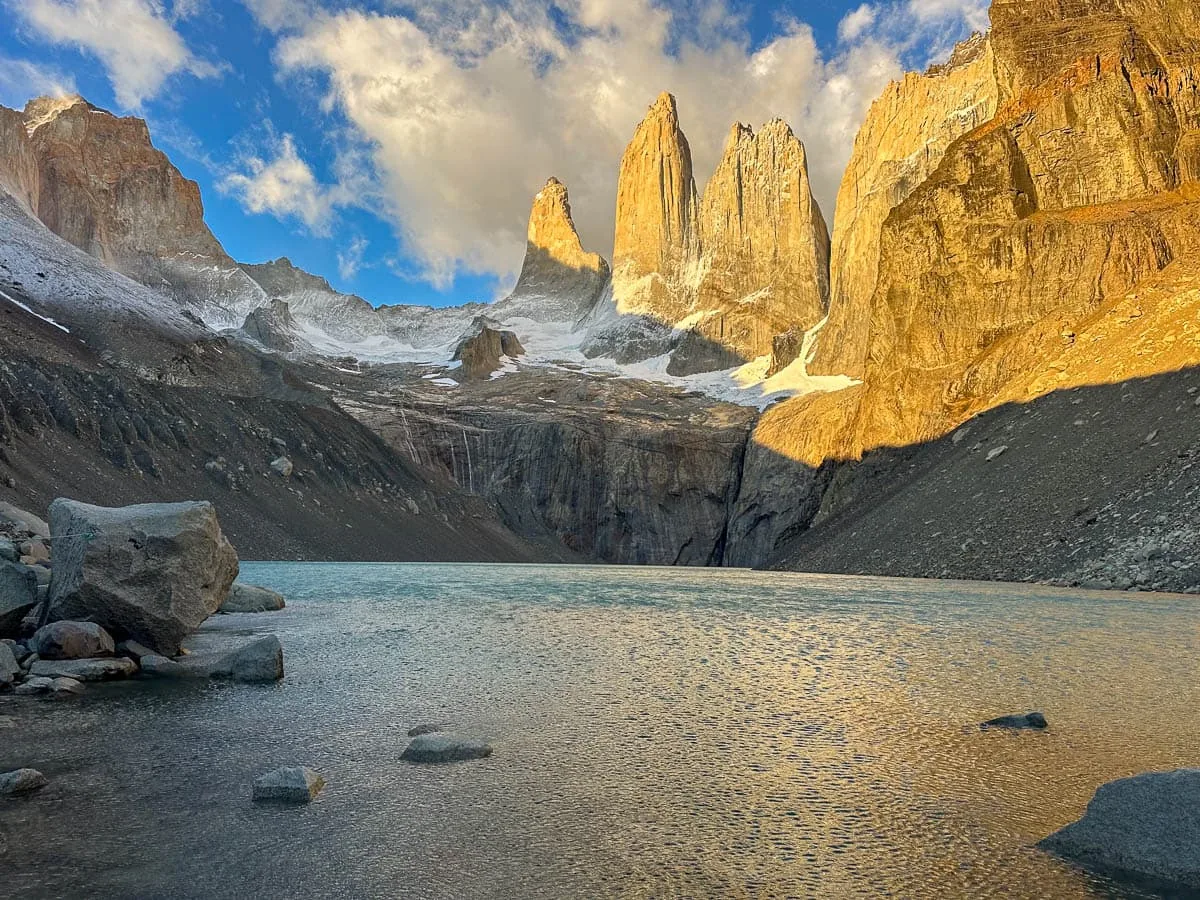
The mirador at the base of the Torres del Paine, the three granite towers that give the national park its name, sits at 900 metres above sea level above a glacial lake whose grey-green water reflects the towers when the wind dies. The trail from the Hostería Las Torres trailhead to the mirador takes three to five hours one way, gaining 700 metres through lenga beech forest and boulder fields before delivering you to the lake and the view that every image of the park compresses into a single frame: three granite shafts, vertical, impossibly sharp at their summits, rising 2,500 metres from the lake edge. The W Trek, Torres del Paine's primary multi-day route, begins and ends at this viewpoint. But the single-day round trip, returning from the lake to the trailhead in the same day, is the most common version and delivers the complete experience without the multi-day commitment.
“The W Trek, Torres del Paine's primary multi-day route, begins and ends at this viewpoint.”
Base Las Torres, Chile
The Torres del Paine massif
The Torres del Paine massif is a Miocene-era intrusion of granite into the older sedimentary rock of Patagonia, subsequently exposed by glacial erosion that removed the softer surrounding material and left the granite towers standing. The characteristic shape, vertical shafts with flat summits, results from the joint pattern in the granite, which breaks along horizontal and vertical planes rather than in curves. The glacier that carved the base of the towers retreated over the past 12,000 years to leave the lake that now fills the cirque. The national park was established in 1959 and expanded to its current 181,000 hectares in 1970. The Torres viewpoint became internationally known through climbing expeditions from the 1960s onward, but the current tourism infrastructure, the W Trek, the lodge accommodation, the circuit trails, developed primarily through the 1990s and 2000s.
The final section of the trail before
The final section of the trail before the lake is on large boulders that require hands-and-feet scrambling over the moraine. The transition from the forest trail to the boulder field is abrupt, and the towers become visible incrementally as you gain height, first the upper third above the ridge, then the full shafts as you crest the moraine lip and the lake and its reflection open in front of you. The wind at the lake varies from none to violent within minutes, Torres del Paine is one of the windiest places on earth, and the cirque concentrates and amplifies the prevailing westerlies. On calm mornings before 8am, the reflection is perfect; by midday the wind typically breaks the surface. The colour of the lake is glacial grey-green, specific to the mineral content of meltwater from the cirque glaciers.
National Park
Torres del Paine National Park is three hours north of Puerto Natales on a partially paved road. The Hostería Las Torres is the primary trailhead for the Base Torres hike, bookable for accommodation or as a day visitor. Park entry fees are paid at the park entrance. The hike requires physical fitness; the boulder section demands care.
“Torres del Paine National Park is three hours north of Puerto Natales on a partially paved road.”
The Experience
The towers at dawn, when the first direct light hits the summit rocks and the rest of the cirque is still in shadow, is the experience that rewards the pre-dawn wake-up that reaching the lake before sunrise requires. The granite turns from grey to orange to gold in approximately fifteen minutes; the reflected image in the lake tracks the same colour sequence below. By mid-morning the light is overhead and flat. The boulder field on the final ascent is where the physical character of the trail changes. The lenga beech forest below is shaded and sheltered; the moraine above it is exposed to whatever the Patagonian weather is doing. The transition is sudden and the last 45 minutes of climbing are the most demanding section of an otherwise moderate trail.
Why It Matters
The Torres del Paine are the primary symbol of Chilean Patagonia and one of the most recognisable natural landmarks in South America. The national park's protection of the massif and the surrounding ecosystem, guanacos, condors, pumas, the recovering lenga forest, makes it the largest intact temperate steppe and forest ecosystem in Chile. The park's management challenges, particularly managing the impact of over 250,000 annual visitors, are a case study in national park sustainability.
Why Visit
The Torres from the mirador lake are the specific experience, no photograph, however good, captures the scale of the towers relative to the people standing below them, or the quality of silence between wind gusts in the cirque, or the temperature change when the wind stops. The seven-hour round trip is the minimum investment for this experience.
Insider Tips
- 1
Depart the trailhead before 7am to reach the lake before the midday wind breaks the reflection surface.
- 2
The boulder section requires hands and feet; do not attempt in wet conditions with smooth-soled footwear.
- 3
W Trek camping reservations through CONAF open approximately 60 days in advance and fill rapidly, set a calendar reminder.
- 4
The Hostería Las Torres serves a hot lunch at the trailhead that returning hikers use as the recovery meal; no reservation required but expect a wait at peak times.
- 5
A waterproof layer and wind shell are essential regardless of the morning forecast, Torres del Paine weather changes within minutes.