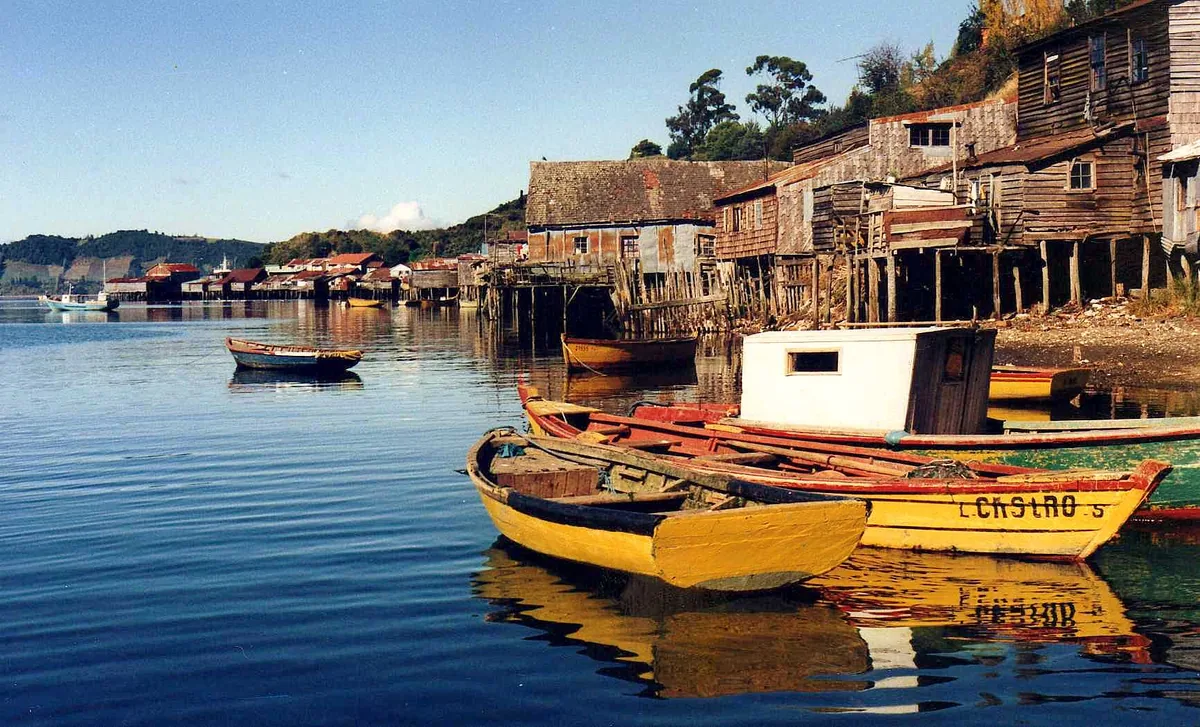
“Fishing families live in coloured wooden houses built over tidal water on stilts, the same house functions as a residence, fishing platform, and boat storage depending on the tide.”
About Castro Palafitos
Chiloé's isolation from mainland Chile, the archipelago sits 1,200 kilometres south of Santiago and was effectively separated from colonial administration by poor road access until the twentieth century, produced a distinctive culture that mixed indigenous Huilliche, Spanish colonial, and Jesuit missionary influences in proportions found nowhere else in Chile. The palafito tradition was one expression of this hybrid culture, adapting indigenous stilt-building to the specific tidal conditions of Castro's sheltered inlets. The palafitos survived the twentieth century's development pressures partly through poverty, the fishing communities that inhabited them lacked the capital to rebuild in more conventional forms, and partly through the heritage designation that followed the region's UNESCO listing of its wooden churches in 2000. The palafito districts were included in the protected zone by association. The 1960 Valdivia earthquake and the tsunami it triggered damaged parts of the Castro waterfront but left the palafito structures largely intact, the stilt construction, designed to move with tidal forces, proved more resilient than fixed-foundation waterfront buildings.
Castro Palafitos in Chile
The palafitos of Castro are wooden houses built on stilts directly over the tidal inlets of Chiloé's capital city, their coloured facades, yellow, red, green, purple, orange, reflected in the water at high tide and standing above exposed mud at low tide with their structural legs visible. The form is ancient, stilt houses over tidal water have been built by coastal peoples across the Pacific for millennia, but the Castro palafitos are specific to this place: the colours, the decay-and-maintenance cycle, the fishing boats moored beneath the living rooms, the cold fog that sits over the Chiloé Archipelago for most of the year. Castro is the capital of Chiloé and the largest city in the archipelago, and the palafitos on the tidal inlets of the Gamboa and Pedro Montt neighbourhoods are the city's visual signature, photographed from every angle, preserved as a cultural heritage zone, and still inhabited by working fishing families.
The palafito tradition in Chiloé developed over several
The palafito tradition in Chiloé developed over several centuries as the indigenous Chono and Huilliche peoples adapted building practices to an archipelago where tidal movement made fixed waterfront land economically valuable and physically impractical. The stilt construction allows the same structure to function as a house, a fishing platform, and a boat storage facility simultaneously, a solution to the multiple demands of tidal shoreline habitation. Castro's palafitos were declared a national monument in 1990 and subsequently listed as part of Chile's cultural heritage. The declaration did not prevent deterioration, many of the original structures have been rebuilt in the same form but with newer materials, but it established the palafito districts as preserved zones exempt from the waterfront commercial development that has modified comparable shorelines across southern Chile.
The standard view
The standard view is from the pedestrian bridge over the Gamboa inlet, which gives the full facade line of the Gamboa palafitos at water level. The high tide version, facades reflected in still water, the colours doubled, is the image on every tourism poster. The low tide version, structural legs exposed, fishing gear hanging from the platforms, the mud of the inlet visible below the houses, is more honest about what palafitos actually are. Walking through the palafito district at ground level, on the narrow lanes between the houses and the water, puts you inside the architecture rather than in front of it. The sounds change, the water moving beneath the floorboards is audible inside the houses, and the fishermen working their boats below the living spaces are close enough to speak to.
Castro is served by ferry from Puerto Montt
Castro is served by ferry from Puerto Montt and by regular buses from mainland Chile via the Chacao ferry crossing. Domestic flights connect Castro to Santiago via Puerto Montt. The Gamboa palafitos are a 10-minute walk from the central Plaza de Armas.
Castro is served by ferry from Puerto Montt and by regular buses from mainland Chile via the Chacao ferry crossing.
The Experience
The Gamboa inlet at high tide in the early morning, before the fog lifts, is the image of the palafitos at their most saturated, the colours of the facades reflected in still water, the mist reducing visibility to a few hundred metres, the sounds of the tide movement below the nearest house. The scene has a quality of suspended time that the midday visit, with the mud exposed and the tourist boats circling, does not reproduce. The restaurant district that has grown up in some of the more accessible palafitos serves Chiloé cuisine, curanto (clams, potatoes, and meat steamed over hot stones), milcao (potato cake), and the specific seafood of the cold Chiloé channels, in settings where the water is literally below the floor of the dining room.
Why It Matters
The Castro palafitos are the most visible architectural expression of Chiloé's specific coastal culture, and they have become a symbol of the archipelago's identity in Chilean national consciousness. Their preservation as inhabited structures, not museum exhibits but working fishing-community housing, makes them unusual in the context of Latin American heritage conservation, which more often removes communities from heritage zones than maintains them.
Why Visit
Chiloé is the most culturally distinctive part of Chile, and the palafitos are Chiloé's most immediately comprehensible architecture. The combination of colour, water, and the practical ingenuity of the form produces something you understand immediately and remember specifically, the kind of architecture that describes the culture that made it more precisely than any written account.
✦ Insider Tips
- 1
High tide at the Gamboa inlet is predictable and worth timing your visit around, the tide tables for Castro are posted at the ferry terminal and online.
- 2
The best palafito photography is from the pedestrian bridge over the Gamboa inlet; the view from the bridge gives the full facade line at water level.
- 3
The palafito restaurants on the Pedro Montt inlet serve curanto and other Chiloé traditional dishes, a better culinary choice than the tourist-oriented restaurants on the Plaza de Armas.
- 4
The Castro Saturday market, held on the plaza and surrounding streets, is the best place to buy the wool and wooden craft objects that Chiloé produces locally.
- 5
Combine the palafito visit with the Castro wooden church, an UNESCO-listed structure two blocks from the plaza, and the ferry to the smaller Chiloé islands for a full Chiloé itinerary.