Jesuits built over 150 wooden churches across the Chiloé islands between 1608 and 1767 using indigenous carpentry techniques, sixteen survive and are UNESCO listed; this is the largest.
About Church of San Francisco
The Chiloé church-building tradition began as a practical solution to the Jesuit mission circuit's requirement for worship spaces across an archipelago of 40 inhabited islands with no roads and minimal building resources. The missionaries worked with Huilliche carpenters who contributed structural techniques, the use of wooden pegs rather than nails, the mortise-and-tenon joinery, the curved rib construction for the nave ceiling, that made the buildings durable without metal hardware that would be unavailable in isolated locations. The Castro church on the Plaza de Armas has been rebuilt several times following fires; the current structure maintains the traditional form in materials and technique that were updated in the early twentieth century. The twin-tower facade design was introduced by Franciscan architects after the Jesuit expulsion and became the standard for the larger Chiloé churches. The UNESCO designation in 2000 triggered significant restoration funding for the sixteen listed churches. The San Francisco restoration, completed in stages since 2001, stabilised the structure, replaced deteriorated cladding using matching wood species, and repainted the exterior in colours documented from the pre-restoration photographs.
The Church of San Francisco on Castro's Plaza
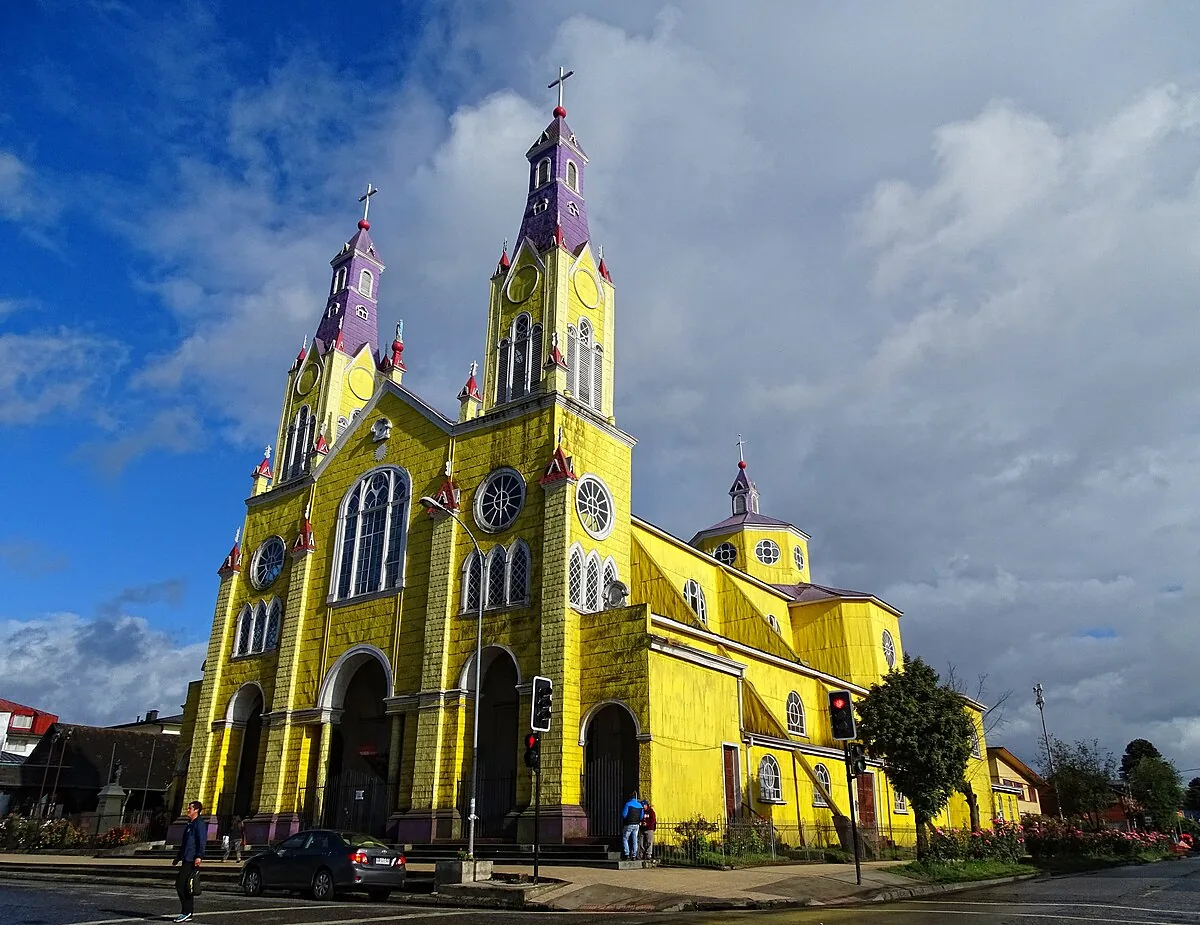
The Church of San Francisco on Castro's Plaza de Armas is the most recognisable of the UNESCO-listed Chiloé wooden churches and the one whose scale, twin towers, broad nave, facade painted in yellow and violet, most closely approaches the cathedral ambition that the Jesuit missionaries who built the first version intended. The current structure, the third or fourth on this site after the previous versions burned down, dates primarily from the early twentieth century and is painted in the distinctive Chiloé manner: vivid colour applied to wooden cladding with the confidence of a culture that understands weather as constant and paint as maintenance rather than decoration. The UNESCO listing of sixteen Chiloé wooden churches in 2000 recognised them as an outstanding example of a fusion of indigenous construction techniques and Jesuit European architectural forms, a specific religious and craft tradition found nowhere else in the world.
arrived in Chiloé, 1608
The Jesuits arrived in Chiloé in 1608 and developed the misiones circulares, a system of travelling missions that visited the archipelago's scattered islands on an annual circuit. Each mission stop required a church, and the church had to be buildable by indigenous labour using local materials without the specialist craftspeople available in mainland colonial cities. The solution was wood: the Chiloé forests provided excellent structural timber, and the Mapuche-Huilliche carpenters had sophisticated woodworking traditions that the Jesuits adapted to church construction. The resulting church type, wooden frame, clapboard exterior, arched nave, bell tower, was replicated across the Chiloé islands in over 150 examples by the late eighteenth century. The Jesuit expulsion from Spanish colonies in 1767 interrupted but did not end the tradition; the Franciscans who replaced them maintained the form. Fire, earthquake, and rot destroyed many of the original buildings; the sixteen surviving UNESCO-listed examples represent the tradition's best-preserved remainder.
Visiting Church of San Francisco
The San Francisco interior is the detail most tourists underestimate. The nave's structural system, wooden arched ribs forming the ceiling, the carpentry joints visible without ornament, the entire load-bearing system expressed rather than concealed, is the church's primary achievement. The colour inside is gentler than the exterior: pale blue and white with the wood tones of the structural elements providing warmth. The plaza surrounding the church is Castro's civic centre and the most legible introduction to the city, the coloured commercial facades around the square, the fog rolling in from the channel below, the twin yellow-and-violet towers of San Francisco as the visual anchor. From the plaza, the drop to the palafito inlets below is audible before it is visible.
The Church of San Francisco
The Church of San Francisco is on Castro's Plaza de Armas, the central square of the city, a ten-minute walk from the bus terminal and the ferry dock.
The Experience
The wooden ceiling of the nave, arched ribs of alerce timber forming a barrel vault, is the structural detail that most visitors look at once and then return to. The joinery is exposed at the rib bases, each curved member landing on a carved corbel, the geometry of the load transfer visible and elegant. The building makes no attempt to conceal how it is held up. The fog that sits over Castro for much of the year gives the church's facade a particular visual quality, the yellow and violet intensified against grey sky rather than bleached by direct sun. In the morning mist, the twin towers emerge from the fog over the plaza with a presence that the purely clear-weather photographs of the church do not capture.
Why It Matters
The Chiloé wooden churches represent a unique built tradition, the product of a specific encounter between Jesuit missionary strategy, indigenous carpentry skills, and the material resources of a Pacific archipelago. The San Francisco church is the tradition's most ambitious surviving example, and its UNESCO listing acknowledges a form of architectural heritage that has no close equivalent anywhere else in the world.
Why Visit
The wooden church tradition is the reason Chiloé is on the UNESCO list and the reason it should be on any serious traveller's itinerary of South America. San Francisco in Castro is the best single example of the tradition, the scale is right, the interior carpentry is accessible, and the plaza setting gives the building its proper civic context.
✦ Photo Gallery
Best Season
🌤 Year-round, the church is an interior experience that the weather does not significantly affect. The exterior is best in overcast conditions that reveal the facade colours without bleaching them.
Quick Facts
Best time to visit
Year-round, the church is an interior experience that the weather does not significantly affect. The exterior is best in overcast conditions that reveal the facade colours without bleaching them.
Getting there
In Chiloé, Chile; reach Chiloé first, then continue to the site.
What's nearby
Pumalín Park is also close by.
Location
Chiloé, Chile
Type
attraction
Coordinates
-42.4814°, -73.7639°
Insider Tips
- 1
The nave interior is open during daylight hours; the best light for the ceiling carpentry falls through the side windows in the mid-morning.
- 2
The church is an active parish, Sunday morning mass at 11am is open to visitors and provides the most complete experience of the building in liturgical use.
- 3
The Castro wooden church is the largest; the churches at Achao and Quinchao on the smaller Chiloé islands are better preserved in their original unrestored form.
- 4
The ferry to the Quinchao and Lemuy islands runs from Castro's dock and provides access to several of the smaller UNESCO-listed churches in a day trip.
- 5
A guide from the Castro tourism office can provide access to the bell tower, which is normally closed to visitors, with advance arrangement.