The highest geyser field on earth erupts most dramatically at sunrise, when minus 10-degree air meets water that has been heated to boiling point underground.
About El Tatio Geysers
El Tatio's geothermal system is part of the Andean volcanic arc, the chain of volcanoes that runs along Chile's eastern border with Bolivia and Argentina. The subsurface magma chambers heat groundwater to temperatures exceeding 100 degrees Celsius; where the water finds a path to the surface through rock fractures, it erupts as steam and boiling water. The field was industrially drilled in the 1960s and 1970s when global energy interest in geothermal power was high and Chilean state energy companies assessed El Tatio as a potential resource. The drilling caused measurable damage to the geyser activity, eruption frequencies changed, some vents sealed permanently, and the programme was abandoned without producing commercial energy. The damage was not fully reversible. CONAF's administration of the field since the 1990s has focused on visitor management rather than restoration, establishing boardwalks around the most active vents and limiting vehicle access to protect the ground surface from compaction that further affects the hydrothermal plumbing.
What El Tatio Geysers actually is
El Tatio sits at 4,320 metres on the Chilean altiplano, making it the highest geyser field in the world and the third largest by area. The geysers are most active at dawn, when the cold night air creates maximum contrast with the steam columns erupting from the vents, and every tour from San Pedro de Atacama reaches the field before sunrise, a two-hour drive in darkness on an unpaved road, arriving to find a flat plain of hissing vents, boiling pools, and columns of white steam lit by the first horizontal light of the day. The field covers roughly 30 square kilometres and contains over 80 active geysers along with hundreds of fumaroles and hot springs. At this altitude and in this cold, the steam columns can reach 6 metres before dispersing, and the sound of the field, a continuous, low hissing punctuated by the percussion of erupting vents, carries across the plain in the still morning air.
“El Tatio sits at 4,320 metres on the Chilean altiplano, making it the highest geyser field in the world and the third largest by area.”
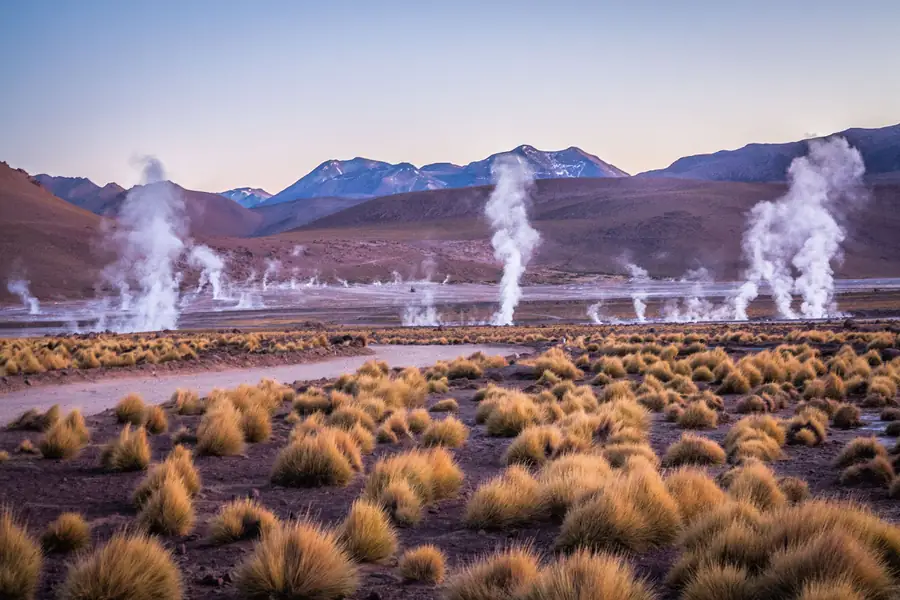
El Tatio Geysers, Chile
El Tatio's geothermal activity is driven
El Tatio's geothermal activity is driven by the volcanic system underlying the Atacama's altiplano, where a chain of active and dormant volcanoes creates subsurface heat that brings groundwater to eruption temperatures. The Atacameño people have known the field for millennia and used its hot spring margins for cooking and bathing. The colonial Spanish named it El Tatio, a word meaning crying grandfather in Quechua, a reference to the steam columns. In the 1960s and 1970s, Chilean and international energy companies drilled the field to assess its geothermal energy potential. The drilling disrupted the hydrothermal balance significantly, some geysers were permanently deactivated and the eruption patterns of others changed. The field was closed to industrial development subsequently, and CONAF established it as a protected area within Los Flamencos National Reserve.
The cold at 4,320 metres before sunrise
The cold at 4,320 metres before sunrise is genuine, temperatures of minus 10 degrees Celsius are not unusual in the winter months, and even in summer the pre-dawn altiplano requires serious layering. The reward for the discomfort is the field at its maximum activity: steam columns catching the first light, the ground warm underfoot at the geyser margins, the smell of sulphur cutting through the cold air. The hot spring pool at the field's edge, fed by the same geothermal system as the geysers, is warm enough to swim in and cold enough outside it that the contrast is extreme. Most tour groups build in time for the swim; the pool is chest-deep and the view from it, the geyser field steaming in every direction, the Andes volcanoes above the horizon, is not the kind of thing you forget. El Tatio is 95 kilometres north of San Pedro de Atacama on an unpaved road. The standard visit is by organised tour departing San Pedro at 4am to arrive at sunrise. Self-drive is possible in a 4WD vehicle but the road requires experience with high-altitude unpaved driving and the darkness on the approach makes navigation difficult. Entry fees are payable at the field.
The Experience
The field at dawn operates on its own schedule entirely independent of the visitors moving through it. Geysers erupt without warning, a vent that has been producing a thin steam column for ten minutes can suddenly throw a column of water and steam several metres into the air, then subside. The eruptions are not timed or predictable, which makes patience more useful than positioning. The sulphur smell is constant and specific, not unpleasant in small doses but pervasive enough that clothing retains it for the drive back to San Pedro. The ground around the active vents is warm underfoot, noticeably different from the frozen surface of the surrounding altiplano, and the thermophilic bacteria that live in the outflow channels colour the mineral deposits in yellows and oranges.
Why It Matters
El Tatio is the largest geyser field in the southern hemisphere and the third largest globally, and it sits within the Atacama's broader geothermal landscape, a region where volcanic, seismic, and climatic extremes converge in a way that makes it one of the most geologically active environments accessible to visitors anywhere on earth.
Why Visit
The experience of standing in a field of erupting geysers at 4,300 metres before sunrise, in serious cold, with the Andes illuminated behind you, is not replicable at lower altitudes or in warmer climates. Yellowstone is larger; Iceland's fields are more theatrical in individual eruptions. El Tatio's combination of altitude, cold, and the vastness of the altiplano setting is unique.
Insider Tips
- 1
Layer for minus 10 degrees even in summer, the altiplano pre-dawn cold is genuine and the tour vehicles are not heated for the 4am departure.
- 2
The hot spring pool at the field edge is included in most tour programmes; bring a swimsuit and a towel you do not mind getting mineral-stained.
- 3
Altitude sickness is possible at 4,320 metres, spend at least one night in San Pedro (at 2,400 metres) before attempting El Tatio to allow partial acclimatisation.
- 4
The boardwalks around the active vents exist for safety, the ground surface between the marked paths is thin crust over boiling water in many places.
- 5
Breakfast is served by the tour operators at the field using eggs cooked in the geyser outflow water, the novelty is genuine and the eggs are edible.