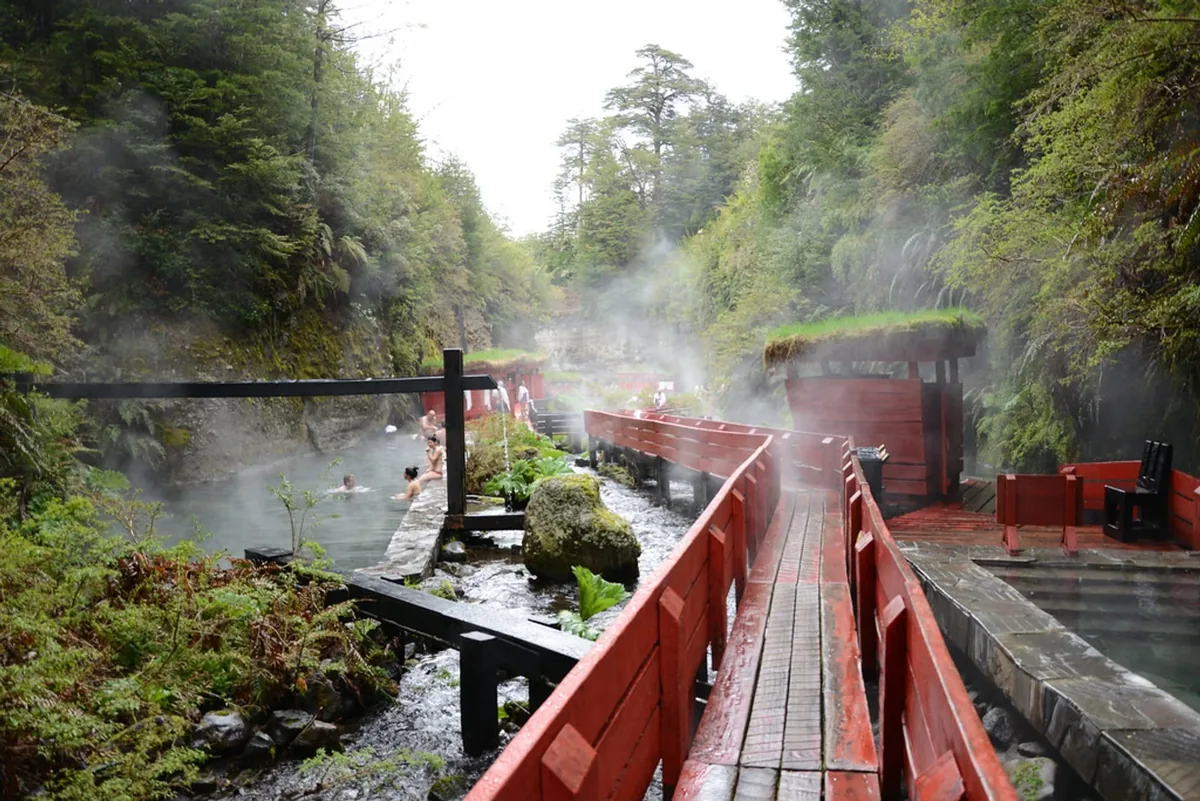
Seventeen thermal pools in a volcanic ravine, connected by red boardwalks through temperate rainforest, the design won international architecture awards and the water is 42 degrees.
About Geometricas Hot Springs
The Lake District's thermal activity is a direct result of the Andean volcanic arc that runs along Chile's eastern border. The Mocho-Choshuenco volcanic complex, whose caldera sits above the Termas Geométricas ravine, last erupted in 1864 and maintains the geothermal heat that drives the thermal springs. The springs themselves have been accessible at the surface for centuries; the permanent infrastructure is recent. Germán del Sol's design was developed after a site visit in the early 2000s convinced him that the ravine's character, the specific combination of volcanic water, cold stream, and dense temperate Valdivian rainforest, was the experience, and that the designer's job was restraint. The red boardwalk decision was made to create a clear visual logic that guided visitors through the canyon without requiring signage. The site opened in 2009 and received the Chilean Architecture Biennial Prize shortly after. Its reputation spread through design media before travel media, which produced an unusual initial audience of architecture-interested visitors that shaped the site's identity as a place where the design is as much the subject as the thermal water.
Termas Geométricas sits
Termas Geométricas sits in a volcanic ravine 60 kilometres east of Villarrica in the Chilean Lake District, seventeen thermal pools arranged along a narrow canyon floor connected by red painted boardwalks that wind 500 metres through dense temperate rainforest. The design, by Chilean architect Germán del Sol, treats the ravine as the architecture and the infrastructure as minimal intervention: the pools follow the canyon's natural pools and channels, the boardwalks match the geometry of the rock faces, and the changing rooms are small wooden huts set back into the forest above the stream. The thermal water, emerging at 60–72 degrees Celsius from the volcanic system beneath the Mocho-Choshuenco massif, is cooled by mixing with the cold stream water to produce pool temperatures between 36 and 45 degrees. You catch of water, the stream below, the thermal channels above, the rain that falls here frequently, is constant throughout the ravine.
“You catch of water, the stream below, the thermal channels above, the rain that falls here frequently, is constant throughout the ravine.”
Geometricas Hot Springs, Chile
The volcanic system underlying the Villarrica-Lanín
The volcanic system underlying the Villarrica-Lanín corridor has been producing thermal water at the surface for as long as the overlying river canyons have existed. Indigenous communities in the Lake District used thermal springs as both medicinal and ceremonial resources; the specific ravine of Termas Geométricas was known locally but remained without infrastructure until the early 2000s. Germán del Sol, already known for his Remota Hotel in Patagonia, designed the Termas Geométricas installation between 2007 and 2009 with a specific philosophy: the natural setting was the primary experience and the human infrastructure should do as little as possible to interrupt it. The red painted wood, a single strong colour chosen to be visible against the forest's green and grey without competing with it, is the most visible design decision and the one that has defined the site's identity in architectural photography.
Visiting Geometricas Hot Springs
The ravine is narrow enough that you move through it in single file on the boardwalk, the pools below you at step level, the forest pressing in from both sides. The mist from the thermal pools mixes with the forest humidity to produce a micro-environment where your glasses fog immediately and your skin feels the difference before you have entered any water. The pools at the ravine's deepest and most sheltered section, the middle third of the 500-metre walk, are the hottest and the most enclosed. Sitting in 42-degree water with the canyon walls a metre away on both sides, the tree canopy above, and rain falling through it, is the experience the design was built around. The contrast between the hot water and the cold rain on your face is extreme and specific. Termas Geométricas is 60 kilometres east of Villarrica on the road toward the Argentine border at Paso Mamuil Malal. A private vehicle or a taxi from Pucón is required; no public transport serves the location. Entry is by timed ticket available on the Termas Geométricas website. The site opens daily with limited capacity per time slot.
The Experience
The Valdivian rainforest that surrounds the ravine is the wettest temperate forest in the Americas, annual rainfall exceeds 3,000 millimetres, and the vegetation density reflects that. The moss on the rock walls of the canyon, the ferns growing from every crack, the tree ferns above the upper pools produce a jungle quality that the Chilean Lake District's more open landscapes do not prepare you for. The pools are graduated by temperature from the entrance, with the hottest at the ravine's deepest section. The standard approach is to ascend to the top, enter the hottest pool, and work back down through cooler temperatures, finishing at the entrance pool where the cold stream is most proximate. The full sequence takes two to three hours.
Why It Matters
Termas Geométricas is internationally recognised as one of the most successful examples of minimal architectural intervention in a natural setting, a site where the design makes the natural experience more accessible without mediating or diminishing it. The project has influenced how Chilean and international architects approach sensitive natural site development.
Why Visit
The Lake District has many thermal springs, several near Pucón alone. Termas Geométricas earns the additional distance because the design quality is genuinely exceptional and transforms what would otherwise be a pleasant natural pool experience into something that engages both the senses and the architectural intelligence simultaneously.
Insider Tips
- 1
Book timed entry online in advance, the limited capacity means popular slots fill days ahead, especially on weekends and Chilean holidays.
- 2
Arrive in rain gear you can leave at the changing rooms, the boardwalk is exposed to the forest canopy and rain is frequent year-round.
- 3
The hottest pools are at the top of the ravine; ascend first and work your way back down through cooler temperatures rather than the reverse.
- 4
The site provides no food or drinks, bring water, snacks, and any medication you require.
- 5
The 60-kilometre road from Pucón is paved and passable in a standard vehicle; the final approach has one river ford that is avoidable by the main route.