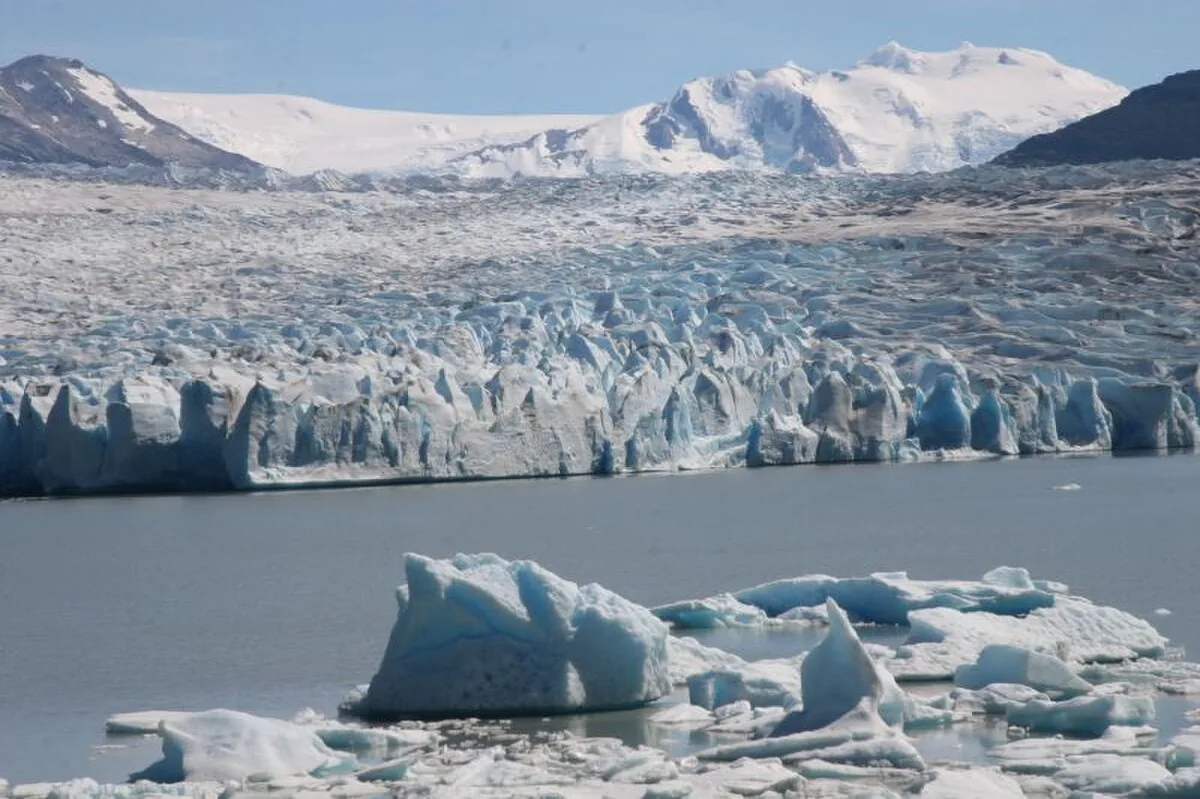
The blue of freshly calved glacial ice is not a trick of the light, ice compressed for centuries absorbs red wavelengths and reflects blue, the colour of deep time made visible.
About Grey Glacier
Glaciar Grey has been retreating since measurements began in the 1970s, with the retreat accelerating from the 1990s onward as regional temperature increases affected the ice field's mass balance. The glacier has lost approximately 4 kilometres of length since 1975, a retreat that exposes previously glaciated bedrock and creates new lake surface where ice once stood. The Southern Patagonian Ice Field was surveyed comprehensively for the first time in the 1940s and 1950s. The surveys established baseline measurements that subsequent satellite monitoring has used to quantify the rate of ice loss. Glaciar Grey's retreat is consistent with the overall pattern across the ice field's outlet glaciers, all of which have retreated significantly in the past fifty years. The Torres del Paine park administration has documented the glacier's changes through a long-term photographic record taken from fixed points, comparison images showing the same viewpoint across decades are among the clearest visual evidence of Patagonian glacial retreat available to the public.
What Grey Glacier is
Glaciar Grey is the largest glacier in Torres del Paine National Park, a six-kilometre-wide ice front calving directly into the grey waters of Lago Grey on the park's western side. The glacier descends from the Southern Patagonian Ice Field, the world's third largest freshwater ice reserve, in a face of blue and white ice whose crevasse patterns and calving activity change daily. The icebergs that break from the face drift across the lake toward the shore, where they ground in the shallows and melt over days or weeks into specific, irreplicable shapes of blue-white ice. The glacier is accessible from the Grey refugio and camping area at the lake's southern end, three days' walk from the Hostería Las Torres trailhead on the W Trek's western leg.
History
The Southern Patagonian Ice Field was formed during the Pleistocene glaciations and has been retreating since the last ice age's end approximately 12,000 years ago. The retreat accelerated significantly in the twentieth century, satellite imagery shows the Grey Glacier front retreating several kilometres from its 1970 position, a pace that increased further after 2000. The current calving face is measurably smaller than any generation of observers before the current one has seen. The icebergs calved from the Grey front carry compressed air from snowfalls that occurred centuries ago and glacial minerals from the bedrock beneath the ice field. The blue colour visible in freshly calved ice comes from the density of the ice, dense glacial ice absorbs red wavelengths and reflects blue, a physical phenomenon rather than a dye or light effect.
The standard approach is a two-day walk
The standard approach is a two-day walk from Paine Grande refugio to the Grey refugio, with the glacier visible for much of the second day's approach across an open moraine landscape. The ice front is closest from the hanging bridge above the grey lake shore near the refugio, where the calving face is approximately 4 kilometres across the water, close enough to see the crevasse patterns and, on active days, to hear the crack and percussion of calving events before the ice falls. Boat excursions from Paine Grande refugio approach the calving face more closely, including stops at grounded icebergs where passengers can handle ice that was last exposed to air approximately 500 years ago during its time in the glacier. Grey Glacier is accessible by the W Trek on foot (3 days from the main park entrance) or by boat from Paine Grande refugio on Lago Pehoé. Lago Pehoé is connected to the park entrance by a further boat crossing. W Trek camping reservations are required through CONAF.
The Experience
The icebergs grounded in the shallows near the Grey refugio are the most accessible encounter with the glacier. The largest ones are the size of houses, their above-water surfaces weathered and white, the waterline revealing the deep blue of the compressed interior ice. Down the shore among them, the scale shifts constantly, what appeared from a distance to be a small ice fragment reveals itself up close as a mass several metres in each dimension. The calving events, ice breaking from the glacier face with a crack audible across the lake, are unpredictable in timing but frequent during warm summer days. The noise travels across the water before the visual effect is visible: a deep crack, then a second lower sound as the ice enters the water, then the ripple pattern spreading across the lake surface.
Why It Matters
Glaciar Grey is the most accessible section of the Southern Patagonian Ice Field and the primary site in Chile where the general public can directly observe a large, actively retreating glacier. Its retreat documentation provides some of the most visually compelling evidence of climate-driven glacial change in the southern hemisphere.
Why Visit
The W Trek's western leg, which delivers you to the Grey Glacier shore, is the quietest section of the most famous trekking route in South America. The glacier adds a geological dimension to the Torres del Paine experience that the eastern towers section does not provide, the Ice Field is visible in the background, the icebergs are in the foreground, and the scale of both exceeds expectation.
✦ Photo Gallery
Best Season
🌤 December through February for the most active calving season, when warmer temperatures accelerate ice break. November and March have fewer visitors and similar conditions. The winter months see the trail close due to snow; the boat from Paine Grande operates year-round.
Quick Facts
Best time to visit
December through February for the most active calving season, when warmer temperatures accelerate ice break. November and March have fewer visitors and similar conditions. The winter months see the trail close due to snow; the boat from Paine Grande operates year-round.
Getting there
In Torres del Paine, Chile; reach Torres del Paine first, then continue to the site.
Location
Torres del Paine, Chile
Type
attraction
Insider Tips
- 1
The boat excursion from Paine Grande approaches the calving face and grounded icebergs, book it at the refugio on arrival as capacity is limited.
- 2
The hanging bridge viewpoint above the lake shore near the Grey refugio gives the best fixed-point view of the calving face, arrive early morning for the calmest light on the ice.
- 3
W Trek western leg camping at Grey refugio requires advance CONAF reservation; the campsite fills completely in January.
- 4
The comparison photographs of the glacier's retreat, displayed at the Grey refugio information panels, are worth reading before the viewpoint visit, the historical context changes how you read the current ice front.