“The Panama Canal opening in 1914 destroyed Valparaíso's economy so completely that it accidentally preserved the city's nineteenth-century architecture intact.”
About Historic Quarter
Valparaíso's position on the Pacific route around Cape Horn made it South America's most important port for the ships of the California Gold Rush era and the subsequent commodity export boom. British, German, and Italian merchant houses established their operations in the port district from the 1840s onward, building in the hybrid styles they imported from their home countries and adapting them to the corrugated iron construction that the local humidity demanded. The boom created a city of exceptional architectural variety in a remarkably short time. The funicular ascensores, of which twenty-three were eventually built, solved the problem of moving people and goods between the flat port and the residential hills with an engineering pragmatism that became the city's defining feature. At its peak, Valparaíso was the wealthiest city on the Pacific coast of South America. The Canal's opening in 1914 redirected shipping traffic with brutal speed. The merchant communities departed, the warehouse districts emptied, and the city's decline began. The UNESCO listing in 2003 recognised the Historic Quarter as an outstanding example of late nineteenth-century urban development in Latin America, preserved, ironically, by the economic catastrophe that ended it.
In brief
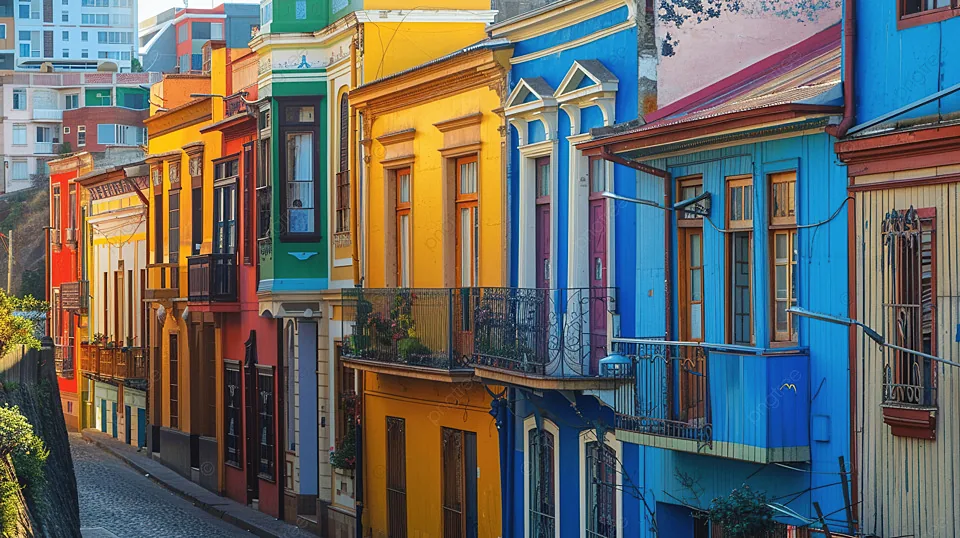
Valparaíso was built on the wrong terrain by people who had no choice. The city's port occupied the narrow strip of flat land at the bay's edge, and everything else, the houses, the churches, the funicular railways, the painted staircases, climbed forty-two hills that rise directly from the waterfront in gradients that defeat sensible urban planning. The Historic Quarter, the section of the port and the lower hillsides listed by UNESCO in 2003, preserves the physical record of a city that grew rapidly in the nineteenth century as the principal Pacific port of South America, then declined with equal speed when the Panama Canal opened in 1914 and the traffic moved elsewhere. What the decline preserved was the architecture. The buildings that would have been replaced by development money sat instead in a kind of interrupted time, their corrugated iron facades and wooden balconies maintained just enough to inhabit but never modernised. The result is a city that looks without parallel in South America.
Valparaíso was built on the wrong terrain by people who had no choice.
Valparaíso's boom years ran from roughly 1840 to 1914
Valparaíso's boom years ran from roughly 1840 to 1914. The California Gold Rush of 1849 made the port the primary re-supply point for ships rounding Cape Horn; the subsequent development of Chilean copper and nitrate exports sustained the growth through the late nineteenth century. European merchant communities, British, German, French, Italian, established themselves in the port district and on the hills above, building their homes and offices in the hybrid architectural styles that give the city its character: Italianate facades, Victorian ironwork, German half-timbering, all executed in the local tradition of corrugated zinc sheeting over timber frames. The Canal opened in August 1914. Within a decade, Valparaíso had lost most of its transit traffic to Panama. The merchant communities shrank, the warehouses emptied, and the city entered a long contraction that lasted into the late twentieth century.
The historic quarter
The historic quarter is the flat port district, the Barrio Puerto, and the two hills immediately above it, Cerro Concepción and Cerro Alegre, where the European merchant houses have been converted to cafés, boutique hotels, and galleries. The ascensores, the funicular lifts that connect the flat port to the hills, are the most specific experience: small wooden cars hauled up steep tracks by cables, operating since the 1880s, the city's original vertical transport infrastructure still in use. Cerro Concepción and Cerro Alegre are walkable in an hour or two, the streets too steep and narrow for cars in most places, the walls and staircases covered in murals commissioned and painted over decades. The view from the hilltops across the bay, the water grey-green or blue depending on the sky, the container cranes of the working port visible to the west, connects the heritage district to the ongoing industrial reality below.
Valparaíso is 120 kilometres west of Santiago
Valparaíso is 120 kilometres west of Santiago by road or rail. The train from Santiago's Alameda station to Valparaíso takes about an hour and forty minutes and deposits passengers in the port district adjacent to the historic quarter. The ascensores are within walking distance of the terminal.
Valparaíso is 120 kilometres west of Santiago by road or rail.
The Experience
The ascensores are the correct way to arrive on the hills, the view from inside the wooden car as it crests the hilltop and the bay opens below is the introduction the city deserves. Most are operated by a single attendant and cost a few hundred pesos for the ride. The streets of Cerro Concepción and Cerro Alegre change atmosphere completely from the port district below. The murals are everywhere, not grafitti in the usual sense but commissioned works that treat the stairwells and retaining walls as permanent gallery space. The best are found by walking without a map on the smaller lanes off the main tourist circuit.
Why It Matters
Valparaíso's Historic Quarter is the most intact surviving example of nineteenth-century Pacific port architecture in South America. The city's economic decline, which would in most cities have been followed by demolition and redevelopment, instead produced one of the continent's most legible records of the commercial and residential architecture of the commodity export era.
Why Visit
Valparaíso does not resemble anywhere else. The corrugated iron facades, the funiculars, the muraled staircases, the view of an active container port from Victorian-era hillside terraces, the combination is specific to this city and not reproducible. Santiago is two hours away; the day trip pays dividends.
✦ Insider Tips
- 1
Ascensor Concepción, the oldest still-operating funicular in the city (1883), is the one to ride first, the view from the top over the bay is the clearest available from the historic quarter.
- 2
The port market, Mercado Puerto, at the foot of the hills is a working fish and produce market that opens at dawn and closes by early afternoon, arrive before 9am.
- 3
Many of the ascensores are closed for maintenance on a rotating basis; check which are operating before planning a specific route.
- 4
The Pablo Neruda house La Sebastiana, on Cerro Florida above the historic district, requires a separate entry ticket and is worth the additional climb.
- 5
Stay overnight in the historic quarter rather than commuting from Santiago, the city's atmosphere changes completely after the day-trippers leave.