“Neruda watched Valparaíso's New Year's fireworks from this top-floor window every year he lived here, the view of the bay it frames is the reason he bought the unfinished house.”
About La Sebastiana
Neruda's relationship with houses was an extension of his relationship with objects, both were collections, both expressed his refusal to separate the domestic from the intellectual. La Sebastiana was the third house he acquired, following La Chascona in Santiago and Isla Negra on the coast, and it reflected his particular affection for Valparaíso's chaotic hillside geography. The purchase in 1959 was opportunistic: the unfinished structure on Cerro Florida offered vertical rooms with bay views at a price that Neruda, then at the peak of his celebrity and income, could manage easily. The two-year renovation involved local craftsmen, imported tiles, and the systematic filling of the spaces with the objects Neruda had been accumulating for decades, ships in bottles, figureheads, maps, telescopes, coloured glass. The junta's 1973 ransacking of the house was both political and personal, Neruda had been Allende's ambassador to France and was an unambiguous symbol of the left. The damage was significant but not total. The Fundación Neruda, established after the return to democracy, restored all three houses using documentation from photographs and the memories of people who had known them in use.
What La Sebastiana actually is
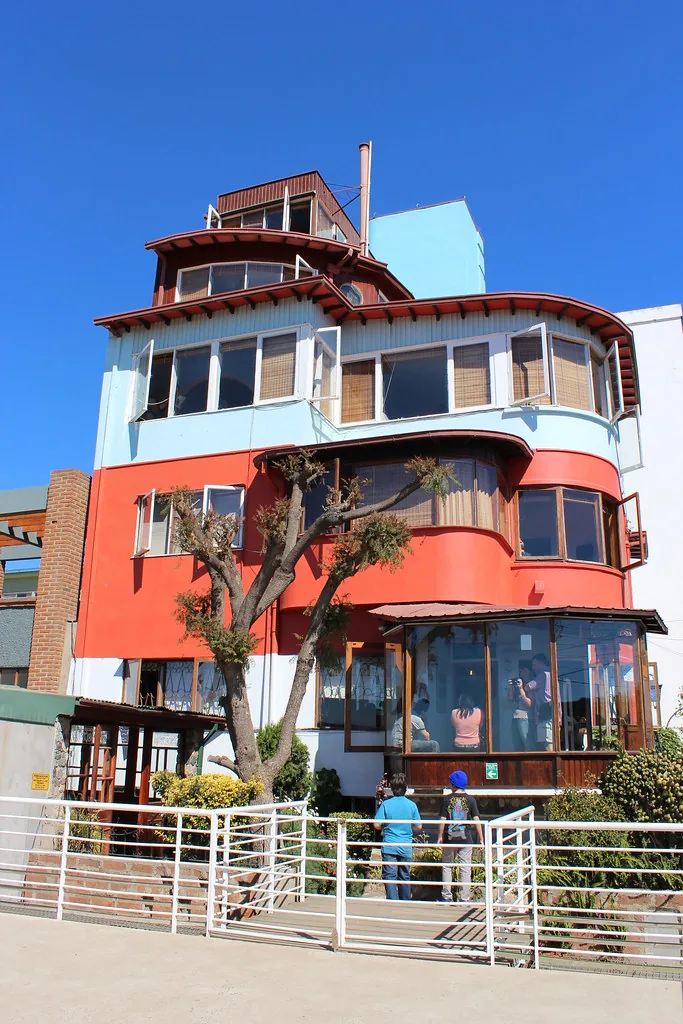
Pablo Neruda built three houses in Chile and lived in all three simultaneously, moving between them according to his mood and the season. La Sebastiana, on Cerro Florida above Valparaíso, was the last of the three and the one that most directly reflected his relationship with the sea. The house climbs five floors up a steep hillside, its rooms stacked vertically like the decks of a ship, each level connected by narrow stairs and each window framing a different slice of the bay below. Neruda described the view from the top floor as the best in Valparaíso, and the description holds. The house is now a museum administered by the Fundación Neruda, open to visitors who move through its rooms largely as they were when the poet and his wife Matilde Urrutia used them, the bar with its coloured glass bottles, the study with its overlapping surfaces of books and objects, the dining room with its view over the rooftops toward the Pacific.
Pablo Neruda built three houses in Chile and lived in all three simultaneously, moving between them according to his mood and the season.
the unfinished house, 1959
Neruda bought the unfinished house in 1959 from a Spanish refugee named Sebastián Collado, who had started construction and then abandoned it mid-build. The name La Sebastiana honours both Collado and the city's hillside nomenclature. Neruda and his collaborators spent two years completing and decorating the interior, following the same design philosophy as his other houses, an accumulation of found objects, nautical equipment, outsider art, folk ceramics, and personal collections arranged to create an environment that expressed its owner's obsessions rather than any coherent decorative scheme. Neruda received the Nobel Prize in Literature in 1971 and died twelve days after the military coup of September 11, 1973. His houses were subsequently ransacked by the junta. La Sebastiana was looted and partially damaged before it was secured. Restoration and conversion to a museum took place through the 1990s after the return to democracy.
The house is small enough that the museum
The house is small enough that the museum limits visitor numbers and moves people through in timed groups. The effect of the rooms is cumulative rather than immediately overwhelming, each floor adds another layer of the collecting logic, and by the time you reach the top-floor bar and studio the house makes complete sense as a portrait of its owner. The coloured glass bottles on the bar windowsill filter the afternoon light into primary colours on the wooden floor; the large rocking horse that dominates one room was a permanent fixture that Neruda reportedly rode when thinking. The view from the top floor across Valparaíso's rooftop geometry to the bay is the house's best argument. Neruda watched the New Year's Eve fireworks over the bay from this window for the years he lived here, a detail that the museum notes with quiet precision.
La Sebastiana is on Calle Ferrari
La Sebastiana is on Calle Ferrari in the Cerro Florida district of Valparaíso, about a 30-minute walk from the port or reachable by taxi or rideshare. The museum opens Tuesday through Sunday. Timed entry tickets can be purchased online and are strongly recommended in summer.
La Sebastiana is on Calle Ferrari in the Cerro Florida district of Valparaíso, about a 30-minute walk from the port or reachable by taxi or rideshare.
The Experience
The house works as an immersive environment rather than a conventional museum. The objects are not behind glass, they are on shelves, on tables, on the walls, in the positions they occupied when Neruda was alive, and the effect is of a room recently vacated rather than one preserved under institutional glass. The bar on the upper floor is the room most visitors spend longest in. Neruda designed it himself, positioning the coloured bottles on the window ledge to filter the incoming light, and the bar top was stocked for serious entertaining, he was a generous and exacting host. The view from the bar window down the hillside and across the bay is the house at its most persuasive.
Why It Matters
La Sebastiana is one of three Neruda houses that together constitute a unique form of self-portrait by one of the twentieth century's major writers. The houses are not biographical museums in the conventional sense, they are three-dimensional expressions of a sensibility, preserved at the moment of their owner's death with a completeness that most literary heritage sites cannot match.
Why Visit
Literary tourism rarely justifies itself independently of the writing. Neruda's houses are the exception, the collecting logic and the spatial arrangements are interesting on their own terms, separate from any knowledge of the poems. La Sebastiana in particular earns its visit for the top-floor view and the bar alone.
✦ Insider Tips
- 1
Book timed entry tickets online at fundacionneruda.org before traveling, summer weekends sell out days in advance.
- 2
Audio guides are included with admission and are genuinely useful for understanding the objects' provenance and Neruda's collecting logic.
- 3
The top-floor bar and the view from it are the house's highest point and worth the full climb, budget 90 minutes for a visit that reaches the top floor without rushing.
- 4
Combine with the Historic Quarter and Cerro Concepción on the same day; La Sebastiana is on a different hill and requires a separate 30-minute walk or taxi.
- 5
The museum shop sells Neruda's poetry in good Chilean editions at lower prices than Santiago bookshops.