The second largest lake in South America has two active volcanoes reflected in it on calm mornings, and the towns on its southern shore look like they were built in Bavaria.
About Lake Llanquihue
The Chilean government's 1845 immigration law opened southern Chile to European settlers, and the first German colonists arrived at Lake Llanquihue in 1852 under the administration of Bernardo Philippi, a German naturalist serving as Chilean immigration agent. The settlers received land grants on the lake's uninhabited southern shore and built their farms, churches, and schools on a territory that had previously been Huilliche Mapuche land, the same process of colonial dispossession that characterised settlement programmes across the Americas. The German character of Frutillar and Puerto Varas has been commercially cultivated since the late twentieth century as a tourism asset, with annual festivals, German-language cultural events, and the preservation of the colonial-era architecture. The relationship between this nostalgic heritage tourism and the Mapuche history that preceded it is not prominently addressed in the region's tourism narrative. Calbuco volcano, visible from the lake's southern shore, erupted explosively in April 2015 for the first time since 1972, sending ash columns 15 kilometres into the atmosphere and depositing ash across the lake region. The eruption was unannounced, Calbuco gave less than an hour's warning before the first major explosive phase, and produced the most dramatic volcanic images from Chile in decades.
Lake Llanquihue is the second largest lake
Lake Llanquihue is the second largest lake in South America, 860 square kilometres of glacial water in the Chilean Lake District, and its scale is most apparent when you are standing on its southern shore at Frutillar or Puerto Varas and looking north: the water disappears into the distance with the horizon quality of an inland sea, the Osorno and Calbuco volcanoes rising from the far shore in perfect symmetry, their snow caps reflected in the lake surface on calm mornings. The volcanoes are not a backdrop, they are the lake's defining features, impossible to separate from the water in any photograph or any memory of the place. The lake's southern shore was colonised primarily by German immigrants in the mid-nineteenth century, and the architecture of Frutillar and Puerto Varas, half-timbered houses, Lutheran churches, a civic orderliness, preserves that heritage in a form that feels organic rather than preserved.
“The volcanoes are not a backdrop, they are the lake's defining features, impossible to separate from the water in any photograph or any memory of the place.”
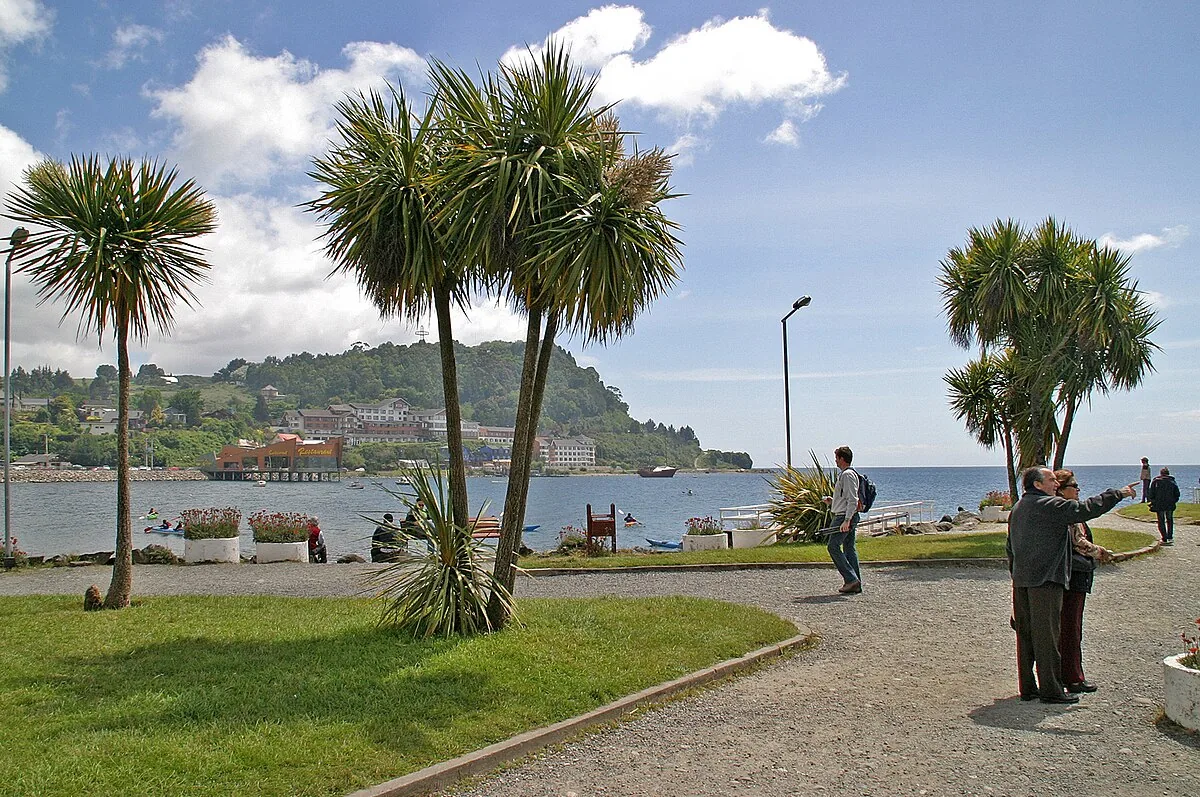
Lake Llanquihue, Chile
History
Lake Llanquihue was formed by glacial activity during the last ice age; the lake basin is a glacial scour depression filled by meltwater as the ice retreated. The surrounding landscape, the forested hillsides, the moraines, the river deltas entering from the east, is the direct product of the same glacial period. The volcanoes that dominate the lake's northeastern shore, Osorno and Calbuco, are post-glacial features, having built their current forms over the past 40,000 years through repeated eruptions. The German colonisation of the lake's southern shore began in 1852, when the Chilean government under President Manuel Montt invited German settlers to colonise the unpopulated lake region as part of a broad southern Chile immigration programme. The settlers arrived in a wilderness, the Mapuche territory around the lake had not been permanently settled by Europeans, and built a farming community that maintained its cultural character across generations. The descendants of those original settlers still live in the towns around the southern shore.
Frutillar's Teatro del Lago and the lakeside promenade
Frutillar's Teatro del Lago and the lakeside promenade give the most controlled introduction, the architecture of the German colonial houses along the waterfront, the lake opening behind them, the volcanoes in the distance. Puerto Varas, the larger and more commercial town, has the closer view of Osorno's cone and more accommodation and restaurant options. The lake is swimmable in summer from the beaches at Playa Hermosa and Ensenada, though the water is cold, the glacial origin keeps even summer surface temperatures around 18 degrees. Kayaking on the lake in flat conditions, with the volcanoes at full height visible from water level, is the clearest way to understand the lake's scale. Puerto Montt, the Lake District's main city, is 20 kilometres south of Puerto Varas and served by frequent flights from Santiago. The bus from Santiago to Puerto Montt takes 12 hours; the bus from Puerto Montt to Puerto Varas runs every 30 minutes. Frutillar is 35 kilometres north of Puerto Varas on a lakeside road.
The Experience
The lake at dawn on a calm day delivers the reflection that makes it photogenic. Osorno's perfect cone doubles in the water, the surface between the real mountain and its image a single undifferentiated plane of grey-blue. By midday the wind typically breaks the surface and the reflection disappears; the window of stillness lasts one to two hours after first light. The drive around the lake's southern shore, from Frutillar east to Ensenada and then north toward the Vicente Pérez Rosales National Park, passes through the landscape that the German settlers farmed: dairy farms with red-roofed barns, lakeside fields, the occasional surviving colonial house set back from the road in a garden that still follows a European layout.
Why It Matters
Lake Llanquihue is the primary natural feature of the Chilean Lake District and the clearest example in the region of how volcanic activity, glacial history, and human settlement have interacted to produce a landscape of unusual layered beauty. The German colonial heritage adds a cultural dimension that distinguishes the lake's southern shore from comparable glacial lake landscapes elsewhere in Patagonia.
Why Visit
The combination of the lake's scale, the volcano symmetry, and the German colonial architecture on the southern shore is unique in South America. Puerto Varas has developed good infrastructure without losing its character. The day-trip options, Petrohué waterfalls, Osorno volcano, Vicente Pérez Rosales park, make the lake a base for the best of the northern Lake District.
Insider Tips
- 1
The dawn reflection requires setting a 6am alarm, the wind typically rises within two hours of sunrise and breaks the surface.
- 2
Puerto Varas has better restaurant options than Frutillar; base yourself there and day-trip to Frutillar for the architecture and the Teatro del Lago.
- 3
The road from Puerto Varas to Ensenada on the eastern shore passes several viewpoints specifically positioned for the Osorno cone and lake combination.
- 4
Rent a kayak from Ensenada rather than Puerto Varas for the best open-water access with the volcanoes in the northern sightline.
- 5
Avoid driving the lake circuit on weekends in January and February when the single-lane sections between Frutillar and Ensenada become congested.