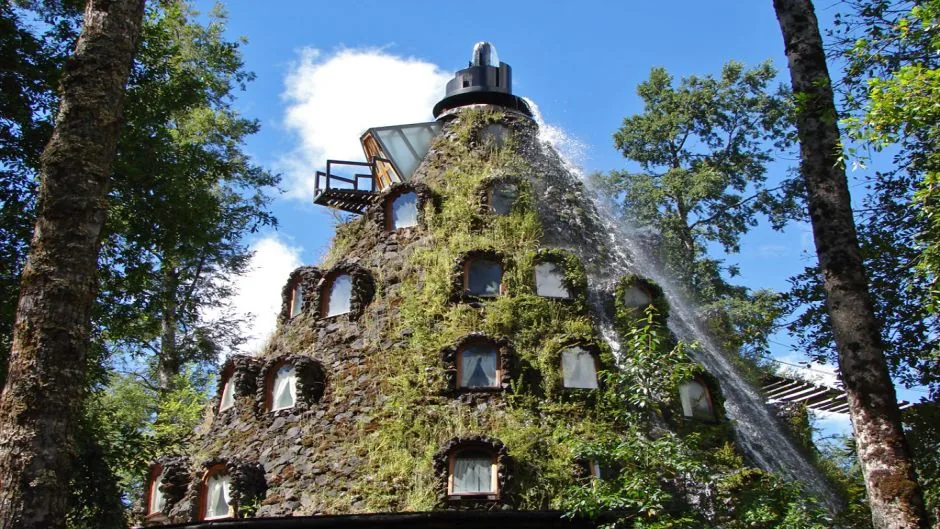
A four-storey conical tower with water cascading down its exterior walls, standing in old-growth Valdivian rainforest, it looks like a fairy tale and charges like one too.
About Montana Magica Lodge
The Huilo Huilo land was clearcut for timber from the mid-twentieth century onward, part of the broader logging industry that reduced Chile's Valdivian temperate rainforest, one of the rarest forest types on earth, covering less than 3% of its original range, to fragments by the 1990s. The Morales family's purchase and conversion to a biological reserve was part of a broader trend of private conservation in Chilean Patagonia that included Doug Tompkins's Pumalín Park project further south. The forest recovery at Huilo Huilo is ongoing, the oldest logged areas have had 20-25 years of undisturbed growth since the reserve's establishment, producing a secondary forest that is recovering toward old-growth character in the fastest-recovering sections. The reserve's wildlife monitoring documents the slow return of species that had retreated from the logged areas. Montaña Mágica opened for guests in 2007 and became the reserve's primary marketing image almost immediately, appearing in design and travel publications that gave Huilo Huilo an international profile disproportionate to its location.
About Montana Mágica Lodge
Montaña Mágica Lodge is a four-storey conical tower of dark wood rising from the rainforest floor of the Huilo Huilo Biological Reserve, its peak trailing water from a natural spring that cascades down the moss-covered exterior walls and disappears into the tree canopy below. The structure is built without straight lines, each floor is a slightly different diameter, the whole form tapering from a wide base to a narrow apex, and the surrounding Valdivian rainforest has grown up around it to the point where the lodge and the forest are in active conversation rather than the forest and a building sharing space. Huilo Huilo, a private biological reserve in the Andes foothills 100 kilometres east of Villarrica, was established in 2000 and encompasses 100,000 hectares of temperate rainforest, volcanic lakes, and river canyons. The Montana Mágica is its most recognisable structure and the most-photographed building in the Chilean Lake District.
Huilo Huilo was assembled from timber
Huilo Huilo was assembled from timber company land by the Morales family in the early 2000s and converted from active forestry to conservation and sustainable tourism, a transition that involved halting logging operations that had been running for decades and beginning the long process of forest recovery. The decision was commercial as well as conservationist: the reserve's founders calculated that intact old-growth rainforest had higher long-term value as an ecotourism asset than the diminishing timber yields the land was producing. The Montana Mágica lodge concept grew from the reserve's design philosophy, all built structures should emerge from the natural context rather than impose on it. The architect's brief specified no right angles, materials that weathered to blend with the surrounding forest, and a relationship with water drawn from the reserve's abundant rainfall and river network.
Visiting Montana Mágica Lodge
The interior of Montana Mágica is arranged vertically around a central staircase, with guest rooms on each floor at different heights within the forest canopy. The lower floors are below the treetops; the upper floors emerge above them. The hum of the water cascading down the exterior walls is audible throughout the building and changes character with rainfall intensity. The reserve itself, accessible by a network of trails from the lodge, is home to puma, pudú (the world's smallest deer), Kodkod wild cat, and the huemul, a large Andean deer listed as endangered. The river canyons within the reserve include the Huilo Huilo waterfall, which falls 37 metres into a basalt canyon accessible on foot from the lodge in about 90 minutes.
Huilo Huilo is 100 kilometres
Huilo Huilo is 100 kilometres east of Villarrica on the road to the Argentine border at Paso Hua Hum. Direct bus services from Villarrica and Pucón serve the reserve's main entrance at Neltume village, from which the Montana Mágica is a short transfer. The reserve maintains its own transport for guests between arrival point and the various lodges.
The Experience
Staying at Montana Mágica requires accepting the building's idiosyncrasies, the round rooms, the curved walls, the constant sound of falling water. These are features rather than defects. The upper-floor rooms emerge above the tree canopy in the late afternoon, giving a view of the surrounding forest from above at the hour when the bird activity peaks in the canopy. The trail to the Huilo Huilo waterfall is the most accessible of the reserve's paths and provides the best introduction to the Valdivian forest character, the coigüe and ulmo trees, the bamboo understory, the density of ferns and epiphytes that the annual rainfall supports. The waterfall itself drops into a basalt canyon that the river has been carving for thousands of years.
Why It Matters
Huilo Huilo represents one of the most successful examples of private conservation in Chile, transforming active logging land into a biologically recovering reserve within two decades. The reserve's charismatic architecture, not only Montana Mágica but several other lodges and structures designed with the same forest-emergence philosophy, has demonstrated that sustainable ecotourism can generate revenue competitive with extractive industry from the same land.
Why Visit
Montana Mágica is worth the visit if you engage with it as what it actually is: a design object embedded in one of the rarest forest types on earth, in a reserve that is actively recovering from industrial logging. The combination of the architecture, the forest, the wildlife, and the waterfall makes Huilo Huilo one of the most complete ecotourism destinations in Chile.
✦ Photo Gallery
Best Season
🌤 December through March for the driest conditions and the best trail access. The reserve is beautiful in rain, the forest and waterfall are best in high-water conditions, but some trails become difficult in July and August. Booking Montana Mágica requires advance reservation, sometimes months ahead for peak season.
Quick Facts
Best time to visit
December through March for the driest conditions and the best trail access. The reserve is beautiful in rain, the forest and waterfall are best in high-water conditions, but some trails become difficult in July and August. Booking Montana Mágica requires advance reservation, sometimes months ahead for peak season.
Getting there
In Huilo Huilo, Chile; reach Huilo Huilo first, then continue to the site.
Location
Huilo Huilo, Chile
Type
attraction
Insider Tips
- 1
The Huilo Huilo waterfall trail is 90 minutes each way from the lodge, start before 10am to avoid the tour groups that arrive from Pucón mid-morning.
- 2
Ask the lodge about current puma tracking data, the reserve's puma population is monitored and sighting areas change seasonally.
- 3
The reserve's horseback riding programme reaches areas of the forest not covered by the main trail network and is worth booking at the lodge.
- 4
The restaurant at Montana Mágica uses produce from the reserve's organic garden and local farms, the menu changes daily based on what is available and is consistently better than resort food typically is.