According to Chiloé mythology, the souls of the dead depart from this exact coastline on a ghost ship, the wooden dock was built to mark the departure point.
About Muelle de las Almas
Chiloé's mythological tradition developed over centuries of relative isolation in an archipelago where the sea was simultaneously the primary food source, the main transport route, and the most dangerous environment. The resulting mythology is maritime in character, spirits that live in the water, boats crewed by the dead, sorcerers who can call the weather, and the Caleuche ghost ship is the tradition's central figure. The Muelle de las Almas was installed in 2006 as a site-specific art installation responding to this mythology. Cristián Aros designed the structure to function as both a contemporary sculpture and a marker of the mythological site, a physical acknowledgment of the Chiloé belief tradition in a form that is accessible to visitors without reducing the mythology to tourism signage. The installation has weathered consistently since 2006, the Pacific wind and salt air accelerating the ageing of the untreated wood, and the grey, textured quality of the current structure is part of its presence at the site.
What Muelle de las Almas actually is
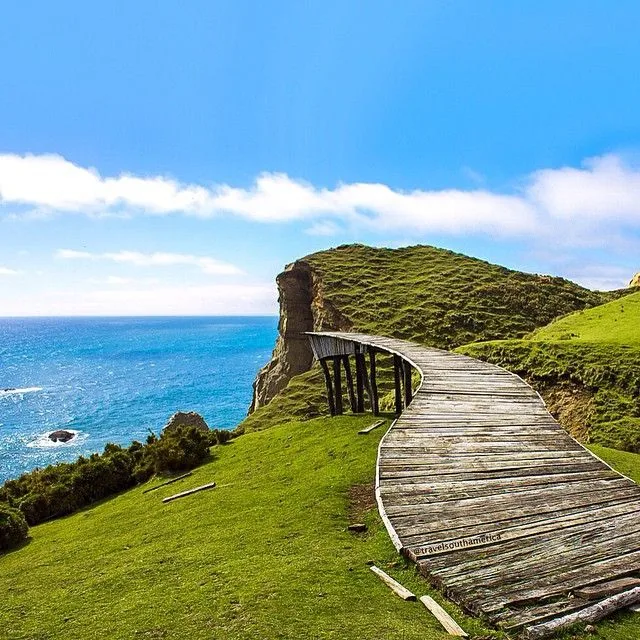
The Muelle de las Almas, Dock of Souls, is a wooden jetty structure built on a clifftop above the Pacific on Chiloé's western coast, near the village of Cucao. The installation, designed by Chilean sculptor Cristián Aros, extends from the cliff edge over the ocean in a form that suggests a dock for a boat that never arrives, the planking ends at a railing above open water, the Pacific crashing against the cliffs 30 metres below, the horizon an uninterrupted line of grey-blue ocean without land between this point and Antarctica. The Muelle was installed in 2006 and references Chiloé mythology directly: according to Huilliche belief, the souls of the dead journey from this coastline on a boat called the Caleuche to the underworld beneath the sea. The structure marks the departure point.
“The Muelle de las Almas, Dock of Souls, is a wooden jetty structure built on a clifftop above the Pacific on Chiloé's western coast, near the village of Cucao.”
Muelle de las Almas, Chile
Cucao is on the western coast of Isla
Cucao is on the western coast of Isla Grande de Chiloé, facing the open Pacific and the prevailing swells that have shaped the coast's dramatic cliff and beach landscape. The Chiloé National Park, which protects the western coastal strip including the beach at Cucao and the forest inland, surrounds the Muelle site. The installation was commissioned by local cultural organisations seeking to create a contemporary art response to the Chiloé mythological tradition. The Caleuche mythology, the ghost ship that ferries the dead to the underworld, crewed by sorcerers and the souls of drowned sailors, is one of the most developed in the Chiloé mythological canon, which includes a rich pantheon of spirits, witches, and supernatural entities specific to the archipelago's maritime culture. The Muelle de las Almas literalises the departure point of that mythology.
The walk from the Cucao park entrance
The walk from the Cucao park entrance to the Muelle takes about 45 minutes through coastal temperate forest and along clifftop paths above the Pacific. The approach is gradual, the ocean is audible before it is visible, the sound of Pacific swells against the Chiloé cliffs a continuous low percussion. The Muelle appears at the cliff edge without warning. The structure itself is simple, rough-hewn wooden planking, a railing at the ocean end, the entire form weathering in the Pacific wind toward a grey that blends with the sky on overcast days. Near the railing, the ocean below and the open horizon ahead, the wind coming directly from the southwest, the Chiloé forest behind you, the effect is of genuine suspension between the land and what lies beyond it.
Cucao is 35 kilometres west
Cucao is 35 kilometres west of Castro on a paved road. Regular buses connect Castro to Cucao in about an hour. The Chiloé National Park entrance is at Cucao village and charges a small CONAF fee. The walk to the Muelle follows a marked trail from the park entrance.
“The Chiloé National Park entrance is at Cucao village and charges a small CONAF fee.”
The Experience
The wind at the Muelle is not incidental, it is part of the experience. The Pacific swells that generated while traveling from the Southern Ocean arrive at the Chiloé cliffs as substantial surf, and the sound at the cliff edge is the full expression of what open ocean sounds like when it meets rock. The wind carries salt and the smell of kelp from the beds below. The Chiloé National Park forest that you walk through to reach the Muelle is Valdivian temperate rainforest at its most intact, the western coast's distance from settlement has preserved old-growth character. The trail passes through tree fern groves and over streams that drain the forest directly to the cliff edge.
Why It Matters
The Muelle de las Almas is significant as both a contemporary art installation and a living reference to the Chiloé mythological tradition, one of the most developed indigenous mythological canons in South America. The site's relationship to the open Pacific and the installation's weathering presence combine to produce one of the most affecting landscape art experiences in Chile.
Why Visit
The Pacific western coast of Chiloé is the part of the island that most tourism misses. Cucao and the national park are a 35-kilometre drive from Castro, and the Muelle is the specific destination that makes the trip worthwhile. The installation, the cliffs, the Pacific view, and the national park forest together constitute a half-day experience that the eastern coast's palafitos and wooden churches do not duplicate.
Insider Tips
- 1
The walk from the Cucao park entrance takes 45 minutes each way on a marked trail; wear waterproof footwear as the trail crosses several small streams.
- 2
The Cucao beach, just south of the park entrance, is a Pacific surf beach with cold water and strong rip currents, swimming is inadvisable but the beach walk is worth including.
- 3
The park trail to the Muelle continues north beyond the installation to further clifftop sections and a second beach, allow additional time if you want to extend beyond the Muelle.
- 4
Return buses from Cucao to Castro run on a limited schedule in the afternoon, check the departure times before leaving Castro to avoid a long wait at the village.