“A single Chilean architect spent thirty years quietly buying the finest pre-Columbian objects he could find, then gave them all to the state on condition they be displayed together.”
About Museum of Pre-Columbian Art
Sergio Larraín García-Moreno began collecting pre-Columbian art in the 1950s when the field was largely ignored by Chilean institutions and the objects were dispersed through private hands across the continent. His acquisitions were systematic and scholarly, he sought quality and geographic range rather than any single cultural tradition. By the late 1970s he held one of the finest private pre-Columbian collections in South America. The donation to the Chilean state in 1981 came with specific conditions: a dedicated building, professional curation, and public access without restriction. The colonial customs house at Bandera 361 was assigned, restored under Larraín's architectural supervision, and opened the same year. The museum has expanded its collection since through loans, purchases, and long-term deposits from Chilean universities and research institutions. The collection now spans cultures from the Alaskan Yupik to Patagonian Tehuelche, with particular depth in Andean civilisations, Tiwanaku, Wari, Moche, Chinchorro, and Inca, whose proximity to Chilean territory gave Larraín natural collecting advantages.
Overview
Santiago's Museum of Pre-Columbian Art occupies a colonial customs house two blocks from La Moneda, and the gap between its modest exterior and the depth of what it holds is one of the more pleasurable surprises in South American museology. The Museo Chileno de Arte Precolombino, to give it its full name, houses one of the finest collections of indigenous American objects on the continent, 5,000 pieces drawn from cultures across the Americas, from the Arctic to Patagonia, spanning 10,000 years of human creative production before European contact. The building itself, the Real Casa de Aduana, was constructed in 1807 and has the high-ceilinged, courtyard-centred layout of serious colonial architecture. The collection inside it belongs to a different civilisational order entirely: textiles from the Andes, ceramics from Mesoamerica, goldwork from Colombia, carved stone from Mesoamerica's forest cities, all displayed with the seriousness that objects of this age and quality demand.
The building itself, the Real Casa de Aduana, was constructed in 1807 and has the high-ceilinged, courtyard-centred layout of serious colonial architecture.
the Chilean state, 1981
The museum was created largely through the personal effort of Sergio Larraín García-Moreno, a Chilean architect who spent decades acquiring pre-Columbian objects from private collections and archaeological contexts, then donated the entire collection to the Chilean state in 1981. The donation was conditional on a dedicated museum space, the colonial customs house was assigned, restored, and opened to the public in 1981. The collection's geographic scope is unusual: most pre-Columbian museums focus on a single region or culture. This one spans the full range of American indigenous production, allowing visitors to trace both the diversity of technique and the surprising connections between cultures separated by thousands of kilometres, the recurring geometric patterns in Andean and Mesoamerican textile work, for instance, or the consistent attention to transformation and cosmology in ceremonial objects from entirely unconnected civilisations.
The textile galleries hold the museum's most
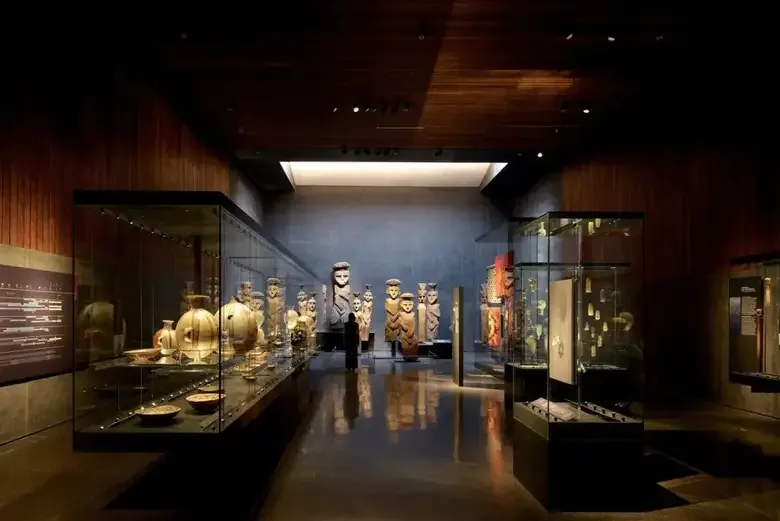
The textile galleries hold the museum's most technically extraordinary objects. Andean weavers working before the wheel or the loom as Europeans understood it produced cloth of such structural complexity that contemporary textile engineers still cannot fully reverse-engineer the techniques. The pieces here are fragile and old and handled with the care of objects whose replication is currently beyond our ability. The ceramics from the Andean and Mesoamerican sections reward slow movement. The figurative vessels, portrait ceramics from the Moche culture of coastal Peru, stirrup-spout bottles whose surfaces carry narrative scenes of daily and ritual life, are as specific in their observations of human expression as anything in European portraiture, made a thousand years before those traditions developed.
The museum is at Bandera 361
The museum is at Bandera 361, two blocks north of La Moneda in central Santiago. Metro line 1 at Plaza de Armas or Baquedano stations provides the closest access. The museum opens Tuesday through Sunday. Tuesday admission is free for Chilean residents; a small charge applies to other visitors.
The museum is at Bandera 361, two blocks north of La Moneda in central Santiago.
The Experience
The museum moves chronologically and geographically through the building's rooms, and the best approach is to follow neither structure too strictly. The objects reward attention given on their own terms rather than in sequence. You find yourself stopping at a Moche portrait vessel, a ceramic face so specific it could be identified in a crowd, and losing track of the curatorial logic entirely. The textile room requires the longest time. The Andean weavings, some over a thousand years old, are displayed flat under glass in low light, and the structural complexity visible on close examination, interlocking colour sequences that function as a binary code, is genuinely difficult to process as something made by hand.
Why It Matters
The Museum of Pre-Columbian Art is the primary institution in Chile for understanding the indigenous cultures that inhabited the Americas before European contact. Its geographic scope, covering the full range of American civilisations rather than focusing on Chilean territory alone, makes it an argument for the interconnectedness of pre-Columbian cultures across a continent that European maps divided into separate national narratives.
Why Visit
Most museums of this type in Latin America are either too large to navigate or too narrowly focused to give context. This one is calibrated: a single colonial building, a focused collection, curatorial decisions that consistently prioritise quality over quantity. Two hours here produces a richer understanding of American indigenous cultures than a full day in larger but less focused institutions.
✦ Insider Tips
- 1
The textile gallery requires the most time, allow at least 45 minutes for that room alone if the techniques interest you.
- 2
The museum shop carries serious academic publications on pre-Columbian cultures not available in general bookshops, at reasonable prices.
- 3
Audio guides are available in Spanish and English and add significant depth to the ceramic galleries where label information is deliberately minimal.
- 4
Photography without flash is permitted throughout; the textile cases require patience with low-light conditions.
- 5
Combine with La Moneda's Cultural Centre below the plaza, ten minutes' walk south, for a full day of Chilean cultural institutions without transport.