“A piece of fresh-looking reddish animal skin found in this cave in 1895 triggered international expeditions to search for a living giant ground sloth, the skin was 10,000 years old.”
About Mylodon Cave
Hermann Eberhard's 1895 discovery of the preserved mylodon skin in the cave he had been using as a storage facility triggered one of the more unusual episodes in late Victorian natural history. The skin's fresh appearance, the hair intact, the hide pliable, led respected naturalists to argue that mylodon might survive in the unmapped interior of Patagonia. Expeditions funded by the London Zoological Society and independent collectors searched the region through the early 1900s without result. The cave's subsequent systematic excavation, conducted by Erland Nordenskiöld in 1900 and Swedish expedition members in subsequent years, produced the most detailed Pleistocene megafauna record from South American Patagonia. Mylodon bones, dung, and skin were dated; evidence of concurrent human occupation was documented; the site's role as a Pleistocene refuge was established. The cave is thought to have been inhabited intermittently by indigenous peoples for several thousand years after the mylodon disappeared, with the earliest human presence dated to approximately 11,000 years ago, among the oldest evidence of human occupation in southern South America.
What Mylodon Cave actually is
The Cueva del Milodón, 24 kilometres north of Puerto Natales in Chilean Patagonia, is a complex of three caves eroded from a massive granite cliff by glacial meltwater at the end of the last ice age. The main cave, 200 metres long, 80 metres wide, and 30 metres high, is large enough to swallow a building and did, for several thousand years, shelter the mylodon: a giant ground sloth the size of a rhinoceros that lived in Patagonia until approximately 10,000 years ago. In 1895, German explorer Hermann Eberhard found a piece of fresh-looking animal skin in the cave, hide with short, reddish hair still attached, and the discovery launched a wave of speculation that the mylodon might still be alive somewhere in Patagonian Patagonia. The skin was subsequently dated to approximately 10,000 years old; the cave's cold, dry conditions had preserved it.
The Cueva del Milodón, 24 kilometres north of Puerto Natales in Chilean Patagonia, is a complex of three caves eroded from a massive granite cliff by glacial meltwater at the end of the last ice age.
The mylodon, Mylodon darwinii, named for Darwin
The mylodon, Mylodon darwinii, named for Darwin who found mylodon bones in Argentina in 1833, was one of the megafauna that inhabited Patagonia in the late Pleistocene alongside the short-faced bear, the horse, and the giant armadillo. The cave at Milodón provided an ideal hibernation and habitation shelter: south-facing, sheltered from the prevailing westerly winds, with a freshwater spring at the entrance and grazing land visible from the mouth. The discovery of Eberhard's skin piece prompted expeditions from Europe and North America to search for a living mylodon in the Patagonian wilderness. The searches failed, but the cave's contents, bone fragments, dung, skin, and tool marks indicating human occupation, provided one of the most detailed records of Patagonian megafauna and early human presence anywhere in South America. The site is a national monument.
The scale of the cave interior registers immediately.
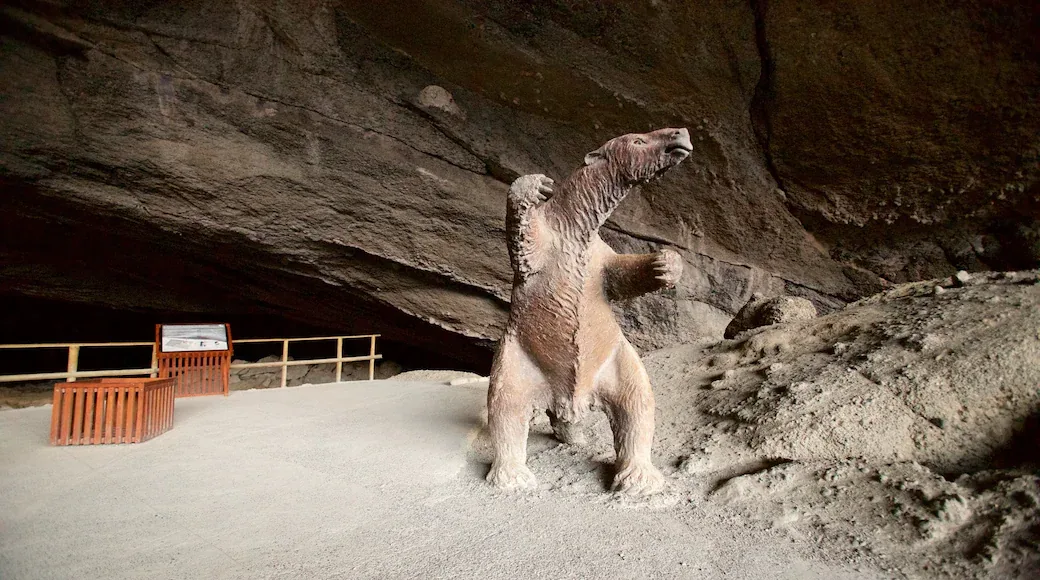
The scale of the cave interior registers immediately. The entrance is wide and high enough to admit a large building, and from inside, looking back toward the opening, the Patagonian landscape, the pampa, the Torres del Paine massif in the distance on clear days, frames itself within the cave mouth like a painting. A life-size fibreglass mylodon replica stands inside the cave at the approximate location where the original remains were found. The replica communicates the animal's scale more effectively than any exhibit case, the creature was genuinely rhinoceros-sized, and standing beside the reproduction in the cave where the actual animal sheltered produces a different quality of temporal disorientation than museum specimens.
The cave is 24 kilometres north
The cave is 24 kilometres north of Puerto Natales on a paved road, reachable by taxi or organised day trip from the town. Puerto Natales is The way into Torres del Paine and served by buses from Punta Arenas and by Navimag ferry from Puerto Montt. The cave is open daily and charges a small entry fee.
The cave is 24 kilometres north of Puerto Natales on a paved road, reachable by taxi or organised day trip from the town.
The Experience
The main cave is freely walkable, its floor smooth and dry, the walls rising to the ceiling in a dome whose size you keep recalibrating. The light from the entrance reaches deep into the cave but does not illuminate the back sections, which remain in a brown dimness. The fibreglass mylodon at the midpoint is well-placed, you encounter it at the scale the original animal occupied the space, and the effect is disorienting in the way that correctly scaled animal replicas in natural settings always are. The smaller adjacent caves, the Cueva Chica and the Seno Última Esperanza cave, are accessible on trails from the main cave and give a different perspective on the cliff geology and the meltwater channels that created the complex.
Why It Matters
The Cueva del Milodón is the most significant Pleistocene megafauna site in Patagonia and the source of the best-preserved mylodon material known anywhere in the world. The cave's preservation conditions, cold, dry, consistently shaded, maintained organic material for 10,000 years in a state that revolutionised the study of Patagonian prehistory and contributed directly to the understanding of megafauna extinction timing in South America.
Why Visit
Most travellers to the Puerto Natales area focus exclusively on Torres del Paine. The cave is 24 kilometres from the town and takes two hours, the giant fibreglass mylodon alone justifies the detour, but the cave's actual scale and the Patagonian landscape visible through its entrance make it one of the more memorable individual sites in Chilean Patagonia.
✦ Insider Tips
- 1
Combine the cave visit with Puerto Natales as a base day trip, the timing works naturally alongside the Torres del Paine planning and park logistics.
- 2
The life-size mylodon replica is in the main cave's midpoint; allow time to walk the full cave length past it to the back wall for the best scale comprehension.
- 3
The walking trail between the three cave sections involves some uneven terrain; closed shoes with grip are recommended over sandals.
- 4
The Torres del Paine massif is visible from the cave entrance on clear days, the cave's sightline is the most underrated view of the towers available without entering the park.