“About 400 moai were left exactly where they stood when the carving stopped, abandoned mid-production in the quarry where almost every moai on the island was made.”
About Rano Raraku
The Rapa Nui carved moai as representations of ancestral lineage chiefs, positioning completed statues on ceremonial platforms called ahu with their backs to the ocean and their faces watching over the living community inland. The carving and transport operation required a level of social organisation and resource management that sustained itself for several centuries before the system collapsed. The collapse is documented archaeologically as a series of overlapping crises, deforestation from canoe and transport log consumption, soil erosion from cleared agricultural land, decline in the bird populations that had supplemented the diet, and eventually inter-tribal conflict. The toppling of the standing moai on their platforms was not random but systematic, each toppling was an act of war against the lineage the statue represented. European contact began with Dutch explorer Jacob Roggeveen in 1722, who arrived to find an island already significantly reduced from its peak population. The subsequent century brought Peruvian slave raids, introduced disease, and the effective destruction of the oral tradition that had preserved Rapa Nui history. What survives is archaeological record, the moai themselves, and the partial recovery of a community whose population had dropped to 111 people by 1877.
About Rano Raraku
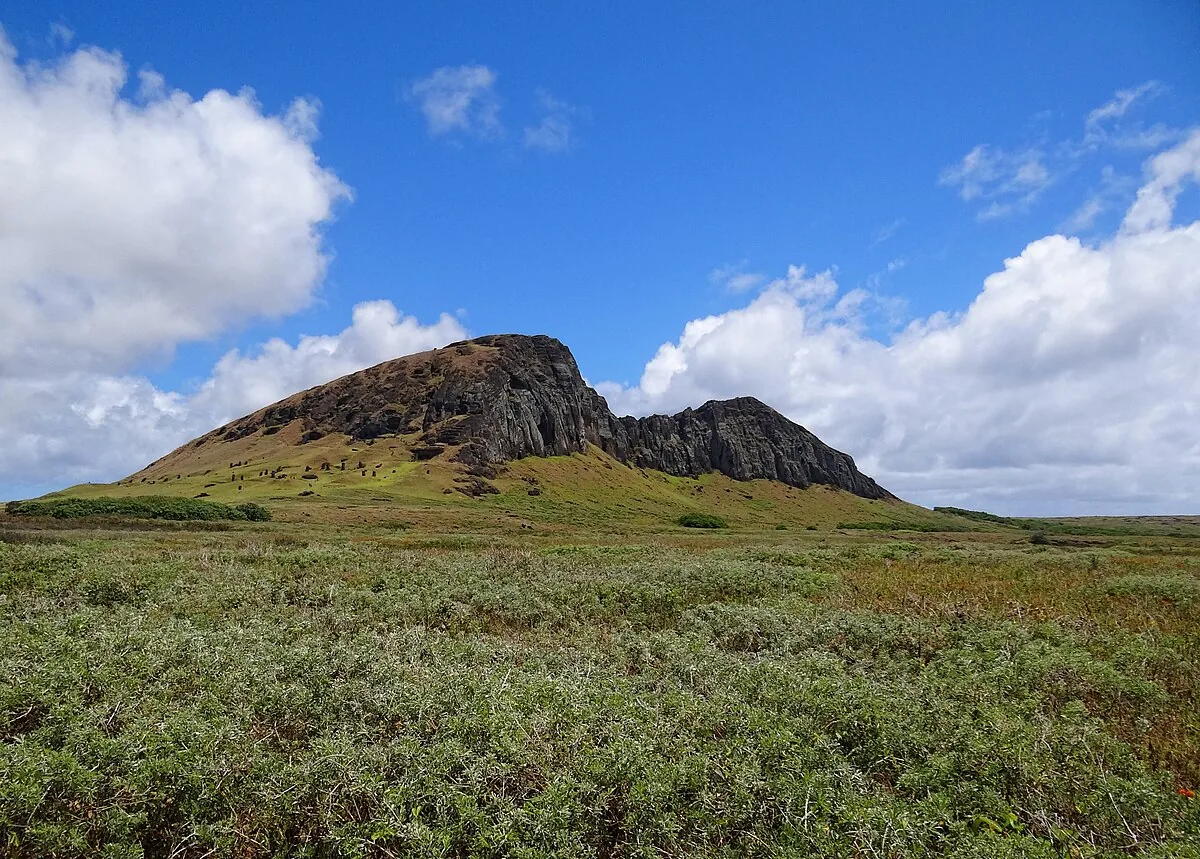
Rano Raraku is a volcanic crater on Easter Island's southeastern coast where the island's indigenous Rapa Nui people quarried the volcanic tuff from which they carved the moai statues. The quarry produced approximately 900 of the island's 1,000 known moai, and some 400 of them remain here in various stages of completion, embedded in the crater's inner and outer slopes, partially carved from the living rock, standing upright where they were left when the carving stopped. Walking the quarry path, surrounded by massive stone heads emerging from the hillside at every angle, is one of the more viscerally unusual experiences available to a traveller anywhere in the Pacific. The crater itself contains a shallow freshwater lake, the only permanent freshwater source on the island, fringed with totora reeds. Inside and outside the crater walls, moai stand and lean and protrude from the earth in a density that no photograph adequately communicates.
Rano Raraku is a volcanic crater on Easter Island's southeastern coast where the island's indigenous Rapa Nui people quarried the volcanic tuff from which they carved the moai statues.
The Rapa Nui began carving moai
The Rapa Nui began carving moai sometime around the thirteenth century, using the soft volcanic tuff of Rano Raraku because it could be worked with basalt hand tools. The carving technique began with the face and torso; once the front was complete, the figure was undercut from the rock and walked, using ropes and a rocking motion, according to oral tradition, to its platform site across the island. The quarry was abandoned sometime in the seventeenth or eighteenth century, when the transport system broke down amid the social collapse that followed environmental degradation and inter-tribal conflict. The partially finished moai were left exactly as they stood. Those in transit to their destinations were left on the roads across the island; those on their platforms were toppled during the subsequent wars. Only the moai at Rano Raraku remained largely undisturbed, too numerous and too embedded in the rock to be easily moved.
The outer slope of the crater
The outer slope of the crater is the first and most concentrated section. Moai heads protrude from the hillside at close intervals, some buried to the chin, some to the shoulders, some standing nearly full-height with their torsos visible above the grass. The faces vary individually: different nose widths, different brow angles, different lip lines. The carvers were not working from a single template. The inner crater path descends to the lake, ringed with reeds and with several moai standing on the inner slope facing the water. The light on the inner crater in the late afternoon is softer than the exposed outer slope, and the reeds and water give the space a stillness that the outer hillside's more populated character does not offer.
Easter Island is served by daily flights
Easter Island is served by daily flights from Santiago (approximately five hours) and weekly flights from Tahiti. Rano Raraku is 18 kilometres east of Hanga Roa, the island's only town, accessible by rental car, bicycle, or organised tour. Entry to the Rapa Nui National Park, which covers most of the island including Rano Raraku, requires a single park ticket available at the Hanga Roa airport on arrival.
Easter Island is served by daily flights from Santiago (approximately five hours) and weekly flights from Tahiti.
The Experience
The moai in the quarry are different from the moai on the platforms around the island. On the platforms they are restored, upright, presented. At Rano Raraku they are in the state they were left, some still attached to the bedrock, their backs unfinished, their plinths uncut. The incompleteness is the thing. You are seeing the production facility rather than the finished product, which means you understand the process rather than simply experiencing the monument. The faces emerging from the hillside at various angles and burial depths produce a quality of attention that the restored platform moai do not. The individuality of the carvers' choices, this brow slightly heavier, this nose wider, is visible when you move slowly along the outer slope.
Why It Matters
Rano Raraku is the primary site for understanding how the moai were made, and that understanding has direct implications for how the Rapa Nui civilisation as a whole is interpreted. The quarry evidence shows a highly organised production system operating at considerable scale; the abandoned figures show how abruptly that system stopped. Together, the evidence shapes the debate about whether the collapse was environmental, social, or both.
Why Visit
The platform moai around Easter Island are the better-known monuments; Rano Raraku is the more intellectually satisfying site. Understanding that the statues were made here, in this hillside, with these specific tools, by people who then moved them across the island using techniques that were lost when the society collapsed, that sequence of facts makes the platform statues meaningful in a way they are not without this context.
✦ Insider Tips
- 1
The inner crater path to the lake requires descending steep steps, wear closed shoes with grip rather than sandals.
- 2
Move slowly along the outer slope with binoculars for the individual facial variations between moai, the differences are subtle but real and invisible at normal walking pace.
- 3
The park ticket purchased on arrival at Hanga Roa airport covers all sites including Rano Raraku; it is valid for five days and can only be purchased once.
- 4
Early morning visits before 9am are significantly less crowded than midday, and the low eastern light illuminates the outer slope faces most directly.
- 5
The moai are sacred to the Rapa Nui community, touching the statues is prohibited and the prohibition is enforced. Stay on the marked paths.