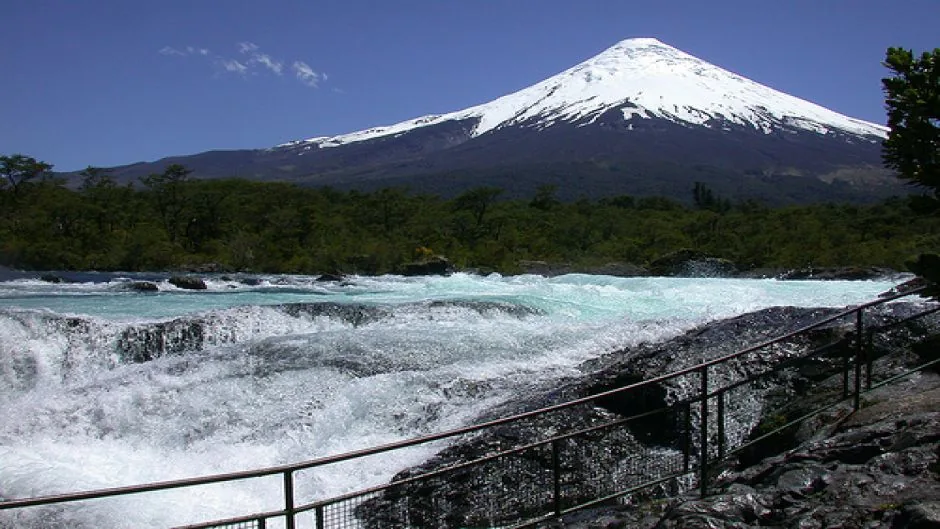
Glacial meltwater the colour of turquoise forces through channels in a Osorno lava flow while the volcano's snow cap hangs directly above, the geology is still unresolved.
About Saltos del Petrohué
Vicente Pérez Rosales was a Chilean writer, adventurer, and immigration agent who explored the Lake District in the 1850s and described its landscapes in terms that introduced them to the Chilean national imagination. The national park named for him, established in 1926 as Chile's first, preserves the landscape he documented in a territory that had been lightly settled by Huilliche Mapuche and was then largely uninhabited when Pérez Rosales walked it. The Petrohué corridor was an important route for early European settlers moving from the Pacific coast through the Lake District to the Argentine pampas, the ferry across Lake Todos los Santos to Peulla and then overland to Bariloche on the Argentine side was one of the principal east-west passages in the southern Andes before roads were built. The Saltos were a known obstacle on this route, requiring portage around the constricted channel. Current tourism infrastructure at the Saltos dates from CONAF's development of the boardwalk in the 1990s, which opened the cascade section to visitors without requiring off-trail movement through the lava field.
About Saltos del Petrohué
The Saltos del Petrohué are a series of rapids and cascades where the Petrohué River, draining Lake Todos los Santos eastward, encounters a lava flow from Osorno volcano that has partially dammed the river channel and forced the water through a narrow basalt gorge. The result is not a single dramatic waterfall but a sustained sequence of turquoise water forcing through black lava rock in a series of channels, jets, and pools over several hundred metres, the colour of the water, a specific deep turquoise produced by glacial mineral content, the most immediately striking detail against the black of the surrounding basalt. The backdrop completes the composition: Osorno's snow-capped cone rises directly above the cascades to the northwest, present in every view from the falls. The combination of the geological immediacy, lava rock and glacial water actively shaping each other, and the volcano visible above makes the Saltos one of the most photographically satisfying landscapes in the Lake District.
The Petrohué River flows from Lake
The Petrohué River flows from Lake Todos los Santos, a glacially formed lake that receives meltwater from Osorno and Tronador volcanoes. The lava flow that created the cascade conditions at the Saltos came from one of Osorno's historical eruptions, the volcano's most recent significant activity was in 1869, though the specific lava field at Petrohué is older. The river has been cutting through the basalt since the lava flow cooled, producing the current channel geometry through ongoing hydraulic erosion. Vicente Pérez Rosales National Park, which contains the Saltos, was Chile's first national park, established in 1926. The park encompasses Lake Todos los Santos, the Petrohué river corridor, the lower slopes of Osorno, and extends east to the Argentine border, one of the most ecologically complete national park territories in temperate South America.
The boardwalk from the car park follows
The boardwalk from the car park follows the river's south bank for about 500 metres through the most active section of the rapids. The sound is substantial, the constricted channel concentrates the river's flow to produce a continuous roar, and the spray from the main channel reaches the boardwalk intermittently. The turquoise colour of the water is genuine and remains constant regardless of cloud cover or time of day. The most photographed view is the upstream perspective from the boardwalk's midpoint, with Osorno's cone centred above the main cascade channel. The morning light from the east illuminates the water surface most directly; the afternoon light backlights the spray.
National Park
The Saltos del Petrohué are 64 kilometres east of Puerto Varas in Vicente Pérez Rosales National Park, on a paved road that continues to the Petrohué ferry terminal for boats across Lake Todos los Santos. CONAF charges a park entry fee at the Petrohué checkpoint. Day trips from Puerto Varas are organised by multiple operators; the drive takes about an hour.
The Experience
The turquoise water in the basalt channels is the tactile detail, you want to reach into it, which the boardwalk prevents. The colour comes from glacial rock flour suspended in the water, fine particles ground from rock by glacial action that scatter light in the blue-green wavelengths. The effect is more intense in high-water conditions when the glacial input is greatest. The sound in the main channel constriction, where the full volume of the river passes through a gap barely five metres wide, is surprisingly loud for a river of this size. The compressed flow produces a resonance in the basalt walls that the open sections do not generate.
Why It Matters
The Saltos del Petrohué are one of the most visited sites in Chilean Patagonia and the most accessible demonstration of the active geological processes, lava flows, glacial rivers, ongoing erosion, that continue to shape the Lake District's landscape. Vicente Pérez Rosales National Park's protection of the full Petrohué-Todos los Santos corridor preserves one of the most ecologically intact river-lake systems in temperate South America.
Why Visit
The Saltos are a 90-minute drive from Puerto Varas and combine logically with the boat crossing of Lake Todos los Santos to Peulla, which adds the lake's full scale and Tronador volcano's ice-covered summit to the day's landscape range. The cascade itself takes about 45 minutes to walk properly; the full day trip to Peulla and back earns the journey.
✦ Photo Gallery
Best Season
🌤 October through April for the highest water levels, spring snowmelt from Osorno and Tronador maximises the turquoise colour intensity and the cascade volume. Summer visits (December–February) are the busiest; the morning hours before 10am are significantly quieter than midday.
Quick Facts
Best time to visit
October through April for the highest water levels, spring snowmelt from Osorno and Tronador maximises the turquoise colour intensity and the cascade volume. Summer visits (December–February) are the busiest; the morning hours before 10am are significantly quieter than midday.
Getting there
In Puerto Varas, Chile; reach Puerto Varas first, then continue to the site.
Location
Puerto Varas, Chile
Type
attraction
Insider Tips
- 1
The ferry across Lake Todos los Santos to Peulla departs from the Petrohué terminal 3 kilometres beyond the Saltos, combining the cascade visit with the lake crossing makes the trip significantly more complete.
- 2
The boardwalk's midpoint viewing platform for the Osorno cone composition works best in the morning before cloud builds over the summit.
- 3
A waterproof jacket is useful on the main cascade section, the spray from the narrowest channel reaches the boardwalk intermittently.
- 4
The CONAF entry fee covers the full park including the Saltos and the lake road, keep the receipt for the day.
- 5
Kayaking on the lower Petrohué river below the Saltos, organised from the Petrohué terminal area, gives a different perspective on the lava landscape from water level.