Some areas of the Valle de la Luna have never recorded measurable rainfall — the formations visible today are shaped entirely by wind on salt and stone.
About Valley of the Moon (Valle de la Luna)
The Atacama Desert's current hyperaridity developed gradually over millions of years as the Andes rose to block Atlantic moisture and the cold Humboldt Current cooled the Pacific coastal air below its dew point. The Río Vilama carved the Valle de la Luna before this drying was complete; the valley floor shows the river's work in its meandering profile and the smooth erosion surfaces on the lower rock formations. The Atacameño people, who have occupied the oasis at San Pedro for at least three thousand years, understood the valley as part of a landscape that required careful management of water and grazing resources. The desert's extremes were not obstacles but parameters within which a sophisticated culture developed agriculture, trade routes, and ceremonial life. The colonial Spanish encountered a population with detailed knowledge of the landscape's resources and hazards. The Valle de la Luna's modern identity as a tourist destination dates from the 1990s, when San Pedro began developing as a base for Atacama Desert exploration. CONAF established the Los Flamencos National Reserve, of which the valley is a part, in 1990.
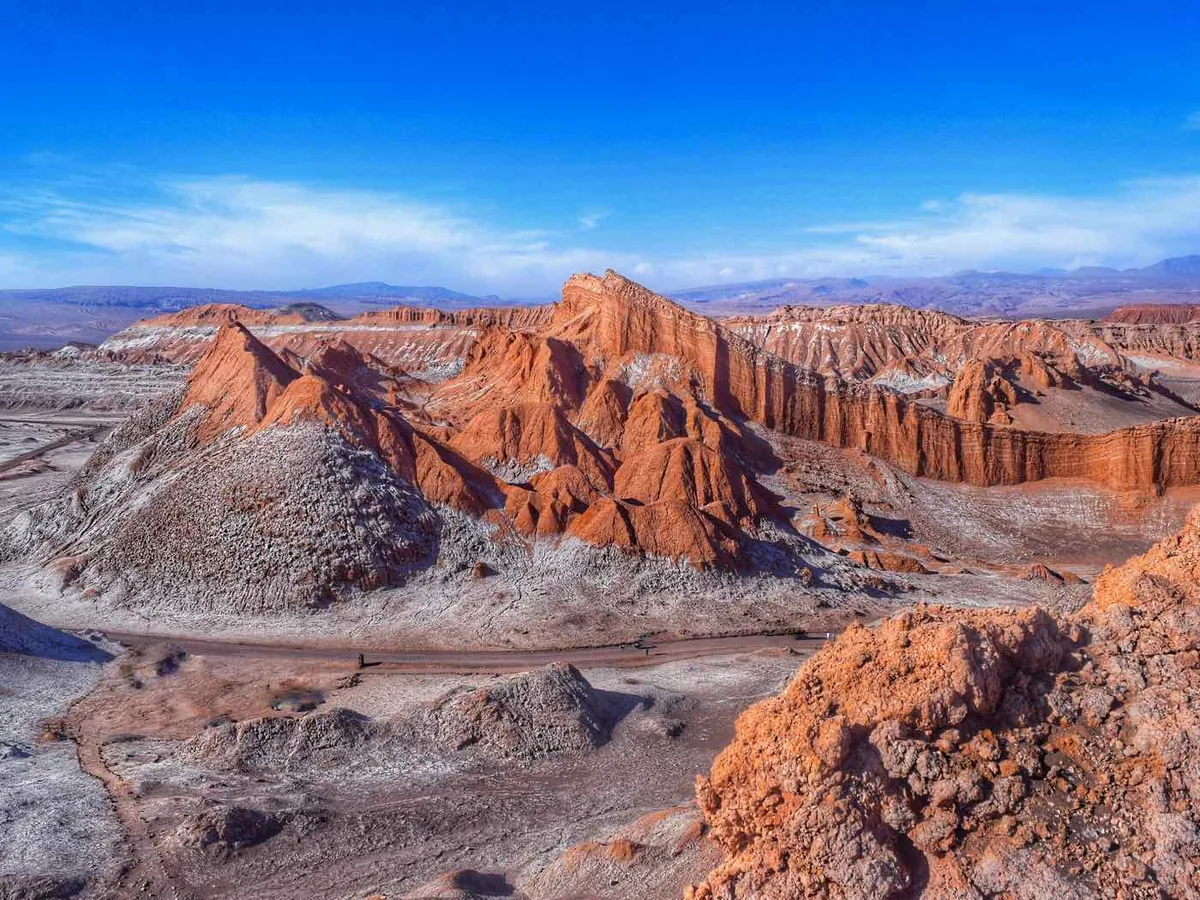
The Valle de la Luna, 15 kilometres west of San Pedro de Atacama, is a dry river valley carved through a salt mountain range whose erosion has produced a landscape of white salt formations, wind-sculpted rock, and rust-coloured ravines that bears almost no resemblance to anything in the rest of Chile. The name is not hyperbole — the valley's surface, bleached and pitted and devoid of any organic material, has the specific visual quality of a place where life has never found purchase. The afternoon light turns the salt formations amber, then orange, then a deep copper before the sun drops behind the Andes and the colours extinguish instantly.
The valley is part of the Los Flamencos National Reserve, administered by CONAF, and requires an entry fee. It sits within the Atacama Desert — the driest non-polar desert on earth — at an altitude of approximately 2,400 metres.
The valley was carved by the Río Vilama over millions of years before the climate shift that created the Atacama's current hyperaridity ended the river's flow. What remains is the carved bedrock, the salt lake deposits of ancient enclosed basins, and the ongoing wind erosion that continues to sculpt the formations daily. The Atacama's aridity — in some zones, no measurable precipitation has been recorded in recorded history — means that the erosion is entirely aeolian: the wind shapes everything.
San Pedro de Atacama, the nearest town, was an oasis settlement on the pre-Inca trade route between the altiplano and the Pacific coast, and the indigenous Atacameño people who have occupied the valley for millennia understood the landscape as sacred. The Valle de la Luna was a place outside ordinary human use — too dry, too salt-laden, too remote from the oasis to farm or graze.
The valley is best experienced in the three hours before sunset, when the angle of the light transforms surfaces that appear flat and white at noon into something textured and specific. The main circuit trail passes through the principal salt formations, along the crest of a sand dune with a view across the full valley floor, and through a narrow salt ravine whose walls are close enough to touch simultaneously.
The silence is total in the absence of wind, which in the Atacama is not a frequent condition — the valley funnels air from the west, and the sound of wind on salt crystal is constant and specific, a dry hiss rather than the organic sound of wind through vegetation. At the valley's highest point, with the Andes to the east and the salt plain below, the scale of the Atacama landscape becomes momentarily comprehensible.
San Pedro de Atacama is served by flights from Santiago to Calama airport, 100 kilometres to the north, with connecting bus or transfer to San Pedro. The Valle de la Luna is 15 kilometres west of San Pedro by paved road and is accessible by bicycle, rental car, or the tour vans that depart from San Pedro in the mid-afternoon for the sunset visit.
The Experience
The light change in the final hour before sunset is the primary reason tour operators time their departures from San Pedro for mid-afternoon. You feel the colour shift begin around 5pm — the white salt surfaces start picking up yellow tones, then deepen to amber — and by 6pm the valley looks like a different place than it did at noon. The sand dune at the valley's centre is climbable in about 20 minutes and gives the widest available view. On the dune crest, facing west, the sun tracks toward the horizon over a landscape where nothing moves and nothing grows, and the silence between the wind gusts has a depth that urban environments do not produce.
Why It Matters
The Valle de la Luna is a terrestrial analogue for geological processes visible elsewhere only on other planets — the combination of hyperaridity, salt tectonics, and wind erosion produces surface features that NASA has used for comparative studies of Mars and the Moon. The valley is a living laboratory for understanding how landscapes develop in the complete absence of water and biological activity.
Why Visit
The Atacama is the most extreme desert environment accessible to ordinary tourists anywhere on earth, and the Valle de la Luna is its most concentrated expression. The sunset visit is a cliché for a reason — the light change over the salt formations is genuine and difficult to convey in photographs. See it once at sunset and you understand why people come back.
✦ Photo Gallery
Best Season
🌤 Year-round, but avoid the Bolivian winter (January–February) when afternoon thunderstorms can close the valley suddenly. May through November offers the most reliable skies. The Atacama's star visibility makes any moonless night extraordinary at the valley.
Quick Facts
Location
Chile
Type
attraction
Insider Tips
- 1
Tour vans from San Pedro time the sunset visit precisely — the independent bicycle route allows more time in the valley but requires strong legs for the return uphill in fading light.
- 2
Bring a windproof layer regardless of the midday temperature — the valley funnels wind consistently and the temperature drops rapidly after sunset.
- 3
The narrow salt ravine near the main circuit's midpoint is the most tactile section of the route; the walls are salt crystal and you can hear the grains shifting underfoot.
- 4
Entry fees are payable at the CONAF booth at the valley entrance; carry cash as card payment is not always available.
- 5
The full moon rises over the Andes to the east while the sun sets to the west in a specific calendar window each month — the San Pedro tourism office posts dates when this alignment occurs.