Villarrica holds a persistent lava lake in its crater that glows red on clear nights, the summit is climbable by guided groups on calm days and the descent is by plastic sled.
About Villarrica Volcano
Villarrica's eruption history is one of the most documented in the southern Andes, with continuous monitoring since the 1960s and a record of major events stretching back to the first Spanish colonial observations in the sixteenth century. The 1971 eruption destroyed farming settlements on the volcano's lower flanks; the 1984 eruption produced lava flows that reached the Quillelhue River; the 2015 eruption sent an ash column 3 kilometres into the atmosphere and triggered evacuations across the Lake District. The Mapuche resistance to Spanish colonisation in the Lake District was among the most sustained in the Americas, maintaining effective independence until the late nineteenth century. The volcano's symbolic status as Rucapillán, the house of the spirits, was part of the broader Mapuche cosmology in which landscape features were understood as living, intentional presences. This understanding shaped the Mapuche's relationship to their territory in ways that continue to influence indigenous land rights arguments in Chile today. Pucón's transformation from a small timber and farming town to a major adventure tourism destination accelerated through the 1990s, driven by a combination of the volcano's commercial appeal, the Lake District's natural scenery, and infrastructure investment following Chile's return to democracy.
Villarrica Volcano
Villarrica is one of the most consistently active volcanoes on earth, its summit crater holding a persistent lava lake that glows red at night and occasionally throws incandescent material above the crater rim. At 2,847 metres, the snow-capped cone rises above the lake-filled valley of the Chilean Lake District with a symmetry that makes it the most visually definitive volcano in South America, the form that all other cones are compared against. The town of Pucón on the lake's eastern shore has built an entire economy around it, positioning itself as the adventure capital of southern Chile with Villarrica as the backdrop and, on summit days, the destination. The climb to the crater is commercially guided from Pucón and reaches the crater rim on clear-weather days via a glacier ascent. Looking into an active lava lake from 2,847 metres, with the Lake District spread below and the Andes visible in every direction, is an experience that justifies the early start and the physical effort.
“The climb to the crater is commercially guided from Pucón and reaches the crater rim on clear-weather days via a glacier ascent.”
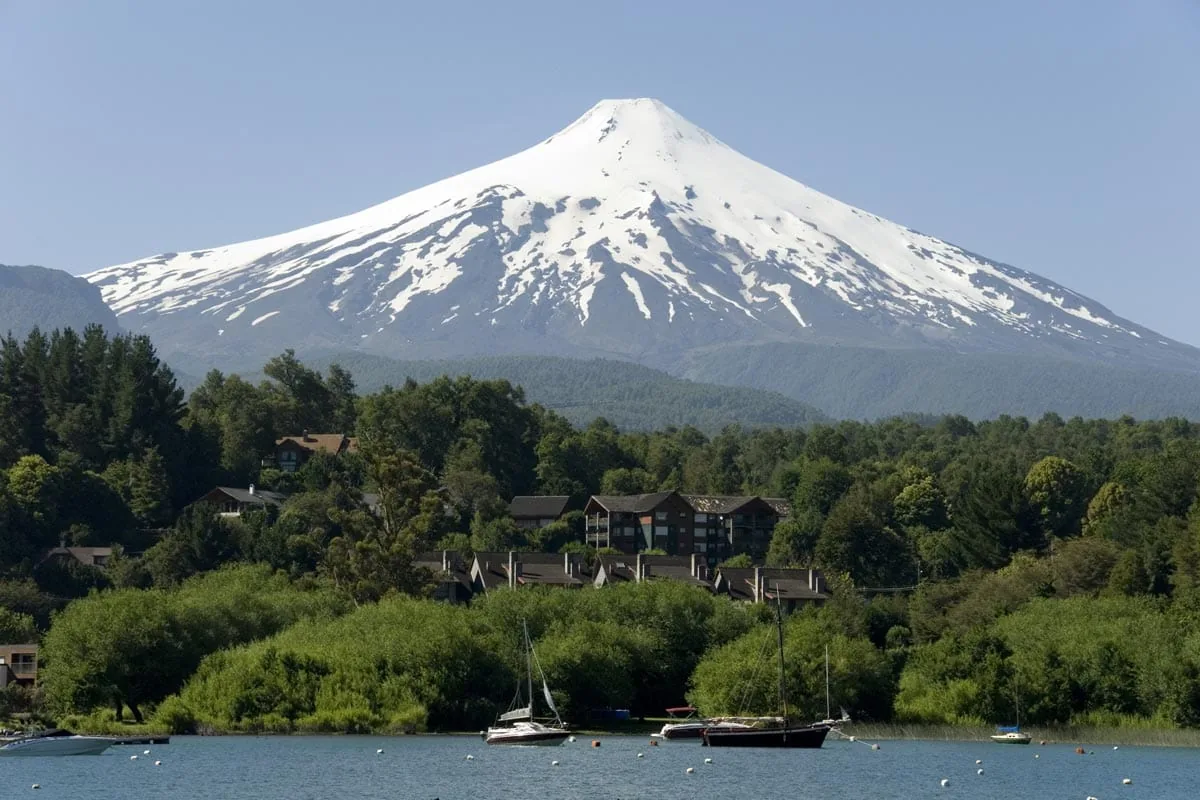
Villarrica Volcano, Chile
major eruptions recorded, 1640
Villarrica has been erupting continuously in a low-level sense for centuries, with major eruptions recorded in 1640, 1948, 1963, 1971, 1984, and 2015. The 2015 eruption was the most recent major event, producing lava flows and ash columns that required the evacuation of Pucón and surrounding communities. The volcano returned to its baseline persistent lava lake activity within weeks. The Mapuche people, who have inhabited the Lake District for over a thousand years, knew the volcano as Rucapillán, house of the spirits, and understood its activity as a direct expression of the supernatural. The Spanish colonial settlement of Villarrica town at the volcano's base in 1552 was repeatedly destroyed by Mapuche resistance and volcanic eruption before re-establishment in the nineteenth century.
The summit climb departs Pucón at approximately 7am
The summit climb departs Pucón at approximately 7am and takes three to five hours depending on snow conditions. The upper section of the climb is on hard ice, requiring crampons and ice axe use that the guiding companies teach at the base before departure. At the crater rim, the smell of sulphur is sharp and the sound of the lava lake, a deep, irregular bubbling, is audible over the wind. On clear days the view from the rim across the Lake District's chain of volcanic lakes and cones extends 200 kilometres in every direction. The descent is by plastic sled down the glacier, fast and undignified and the most memorable ten minutes of the day. The slope angle and the snow surface produce speeds that feel inconsistent with the mountain's otherwise serious character.
Pucón is seven hours south
Pucón is seven hours south of Santiago by bus or one hour by air to Temuco followed by a 90-minute bus connection. Summit climb operators are concentrated along Pucón's main street; the standard climb requires advance booking and is weather-dependent. The volcano authority closes the climb on red or yellow alert days, which occur frequently, check alert status before traveling specifically for the summit.
“Pucón is seven hours south of Santiago by bus or one hour by air to Temuco followed by a 90-minute bus connection.”
The Experience
The crater rim visit is brief by necessity, the sulphur concentration and the physical exposure at 2,847 metres mean that guides limit time at the top to 15–20 minutes. In that window, the lava lake below the rim edge is visible during active periods, a circular orange surface 50 metres below the walkable edge of the crater, occasionally throwing spatter against the inner walls. The sled descent is the democratising moment, the same glacier that required four hours of careful crampon work descends in ten minutes of sliding. You arrive at the snow base wet, slightly stunned, and with a clear view back up the cone of what you just climbed.
Why It Matters
Villarrica is the most accessible active volcano in South America and the primary natural symbol of Chile's Lake District. Its persistent activity, the lava lake is a rare geological phenomenon, with fewer than ten on earth at any given time, makes it scientifically significant as well as visually compelling. The Mapuche cultural relationship to the volcano adds a human historical layer that the purely geological account cannot contain.
Why Visit
Most active volcanoes are observable only from a distance. Villarrica allows summit access on clear-weather days, putting you at the crater rim of a lava-lake volcano on foot. The Lake District landscape visible from the summit, the chain of volcanic lakes and snow cones extending south, is the best aerial view of Chilean Patagonia's transition zone available without a plane.
Insider Tips
- 1
The volcano authority (SERNAGEOMIN) posts daily alert levels online, check before booking travel specifically for the summit climb as yellow and red alert days close the route.
- 2
Book the climb with an operator who includes ice axe arrest instruction at the base, the technique is essential for safety on the upper ice section.
- 3
The sled descent requires waterproof trousers; the operators provide them but the fit is often poor, bring your own if you have them.
- 4
Arrive in Pucón with two nights of flexibility to allow for weather windows; the climb runs approximately 60% of days in summer and less in shoulder months.
- 5
The thermal hot springs at Termas Geométricas, 60 kilometres south, are the ideal recovery activity the day after the climb.