Refused land for a town hall, the townsfolk built one on a man-made island in the middle of the river instead.
About Altes Rathaus
According to local tradition, the citizens of Bamberg built their town hall on an artificial island in the Regnitz because the prince-bishop would not give them ground for it, neatly placing it between his territory and theirs. The building dates in its current form to the 15th to 18th centuries, with later Baroque and Rococo decoration and the famous frescoes. Bamberg's old town is a UNESCO World Heritage Site.
Altes Rathaus (Bamberg)
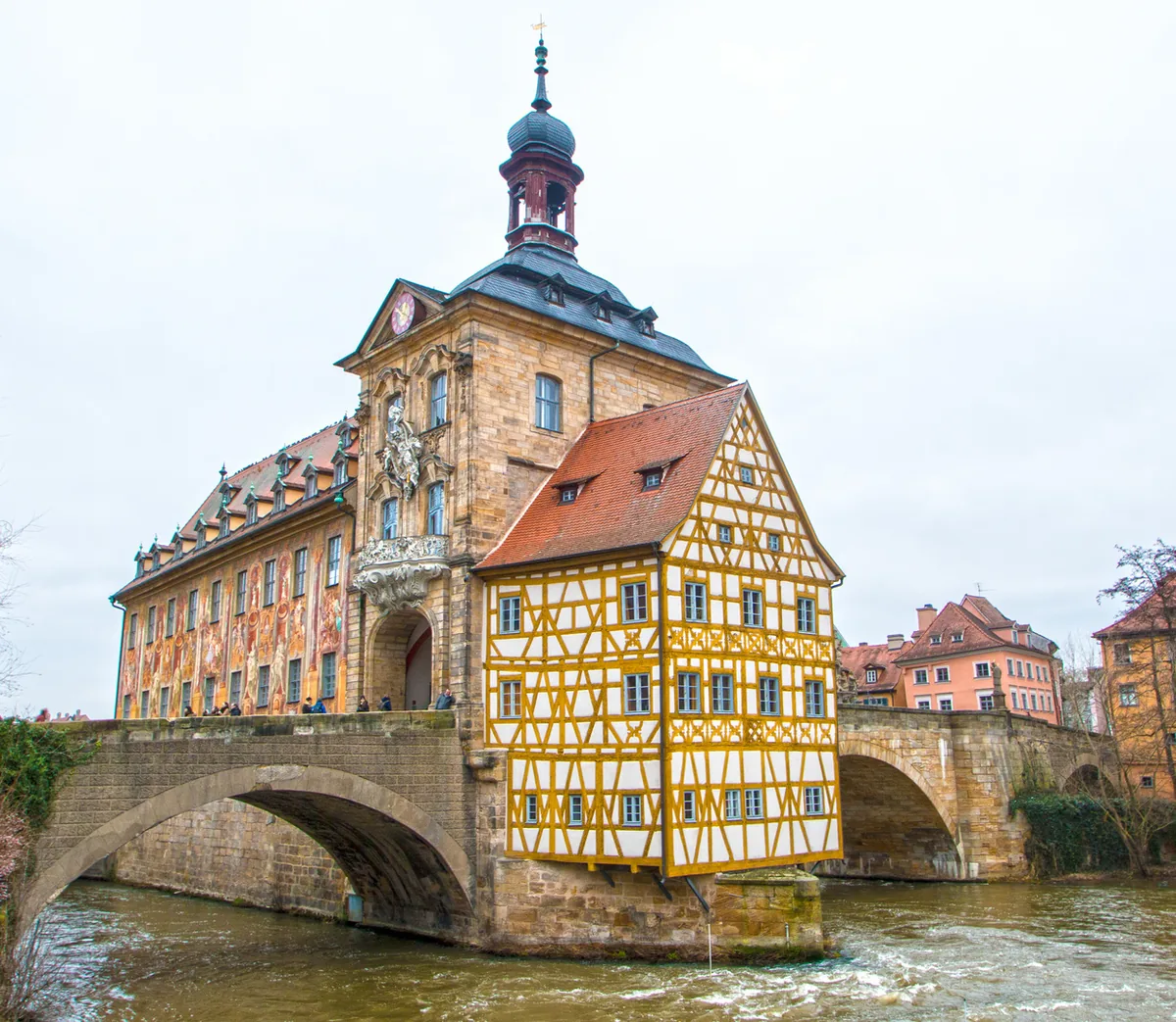
The Old Town Hall of Bamberg is one of the most photographed buildings in Germany, an extraordinary structure built on a tiny artificial island in the middle of the Regnitz River, connected to the banks by two bridges. Its half-timbered tower, painted facades and improbable mid-river position make it the icon of Bamberg, a UNESCO World Heritage town in Bavaria.
“Its half-timbered tower, painted facades and improbable mid-river position make it the icon of Bamberg, a UNESCO World Heritage town in Bavaria.”
Altes Rathaus, Germany
A Town Hall Built in the River
Legend says the bishop of Bamberg would not grant the townspeople land for a town hall, so they drove stakes into the river to create an artificial island and built it there, between the bishop's district and the burghers' town. The building straddles the water, reached by bridges, and is covered in vivid trompe-l'oeil frescoes that make its flat walls appear three-dimensional. A small half-timbered house even juts out over the rushing river.
The Experience
You photograph the town hall from the bridges as the river rushes around it, admiring the elaborate frescoes that trick the eye and the little timber-framed house hanging out over the water. The building now houses a collection of porcelain. The surrounding UNESCO town of Bamberg, with its cathedral, hillside churches and smoked-beer breweries, makes the island town hall the centrepiece of a delightful visit.
Why It Matters
The Old Town Hall is the emblem of Bamberg, a UNESCO World Heritage town, and one of the most charming and unusual civic buildings in Germany. Its improbable mid-river setting and rich decoration make it a beloved landmark and a symbol of the town's history.
Why Visit
Bamberg's iconic Old Town Hall, built on an artificial island in the river with vivid trompe-l'oeil frescoes, in a UNESCO World Heritage town.
Insider Tips
- 1
Photograph it from both river bridges.
- 2
Look for the frescoes and the timber house over the water.
- 3
Explore the wider UNESCO old town of Bamberg.
- 4
Try Bamberg's famous smoked beer nearby.