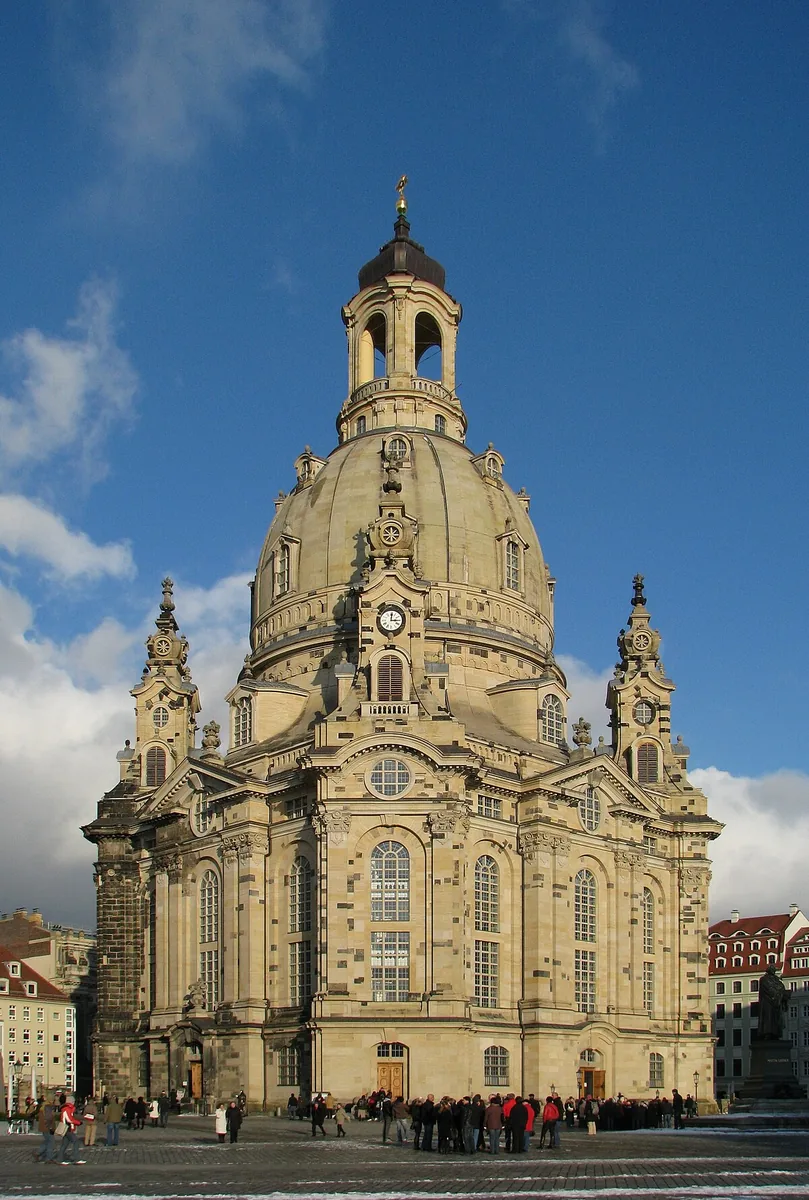
Rebuilt after the 1945 firestorm, this church's pale new walls are speckled with thousands of its original soot-blackened stones.
About Frauenkirche
The Frauenkirche was completed in 1743 as a masterpiece of Protestant Baroque architecture. The 1945 firebombing of Dresden destroyed it, and its ruins stood as a stark memorial for decades. Following German reunification, a major reconstruction used original plans and salvaged stones to rebuild the church faithfully, finishing in 2005, funded partly by international donations including from former wartime enemies.
Frauenkirche (Dresden)
The Frauenkirche in Dresden is a magnificent Baroque Protestant church crowned by a great stone dome, one of the most beloved landmarks in Germany. Destroyed in the firebombing of Dresden in 1945 and left as a ruin for decades, it was painstakingly rebuilt after German reunification, using thousands of original stones salvaged from the rubble, and now is a powerful symbol of reconciliation.
Rebuilt From Its Own Ashes
Completed in 1743, the Frauenkirche was famous for its bold sandstone dome, the 'Stone Bell'. In February 1945 the Allied bombing of Dresden set off a firestorm, and the gutted church collapsed two days later. Its blackened ruins were left untouched through the communist era as a war memorial. After reunification, an international effort rebuilt the church, completed in 2005, incorporating around 3,800 original soot-darkened stones, which speckle the new facade as visible scars of history.
The Experience
You take in the great domed church on the restored Neumarkt square, noticing the darker original stones scattered across the pale new sandstone, each a survivor of the firestorm. Inside, the bright, pastel-toned galleries and the restored organ recreate the Baroque splendour. Climbing to the dome rewards you with views over rebuilt Dresden. The story of destruction and renewal gives the beautiful church profound emotional weight.
Why It Matters
The Frauenkirche is one of Germany's most significant monuments of war, memory and reconciliation, as well as a masterpiece of Baroque architecture. Its reconstruction from ruins, blending old and new stone, makes it a powerful symbol of healing and the rebirth of Dresden.
Why Visit
Dresden's iconic Baroque domed church, rebuilt from the 1945 firestorm using thousands of its original stones, a moving symbol of reconciliation.
✦ Photo Gallery
Best Season
🌤 Dresden is pleasant in late spring through early autumn. The church is indoor and open year-round; climbing the dome is best on a clear day for the views.
Quick Facts
Best time to visit
Dresden is pleasant in late spring through early autumn. The church is indoor and open year-round; climbing the dome is best on a clear day for the views.
Getting there
In Dresden, Germany; reach Dresden first, then continue to the site.
Location
Dresden, Germany
Type
attraction
Coordinates
51.0519°, 13.7417°
Insider Tips
- 1
Spot the darker original stones in the pale rebuilt facade.
- 2
Climb the dome for views over restored Dresden.
- 3
It was rebuilt from ruins after the 1945 firestorm.
- 4
Combine it with the restored Neumarkt and old town.