Only silent electric motors are permitted on these emerald waters, ensuring that a flugelhorn played mid-lake can echo off the mountain walls seven distinct times.
About Königssee
Formed by glaciers that retreated ten thousand years ago, this fjord-like lake was once the exclusive domain of the prince-prophets of Berchtesgaden. Its isolation was its protection, reachable only by treacherous mountain paths or the water itself. In 1909, the Bavarian state took the radical step of banning steam and petrol engines, a decision that predated modern environmentalism by decades. This move was prompted by the royal family's desire to keep the lake’s legendary char fish and mountain silence undisturbed, a legacy that now anchors the Berchtesgaden National Park.
What Königssee actually is
Glacial water so pure it is legally classified as drinking water fills this emerald fjord, wedged between the near-vertical limestone walls of the Berchtesgaden Alps. Königssee remains one of the few places in Europe where nature sounds exactly as it did centuries ago, largely because only silent, electric-powered boats have been allowed to traverse its length since 1909. The lake stretches like a dark green ribbon for eight kilometers, culminating in the remote Salet basin where the mountains hem you in completely. On the western shore, the onion domes of St. Bartholomä glow white and red against the grey rock, a lonely outpost of civilization in a landscape defined by rock and ice. This is not a place for high-speed thrills; it is a sanctuary designed for slow observation and the appreciation of deep, alpine silence.
“Glacial water so pure it is legally classified as drinking water fills this emerald fjord, wedged between the near-vertical limestone walls of the Berchtesgaden Alps.”
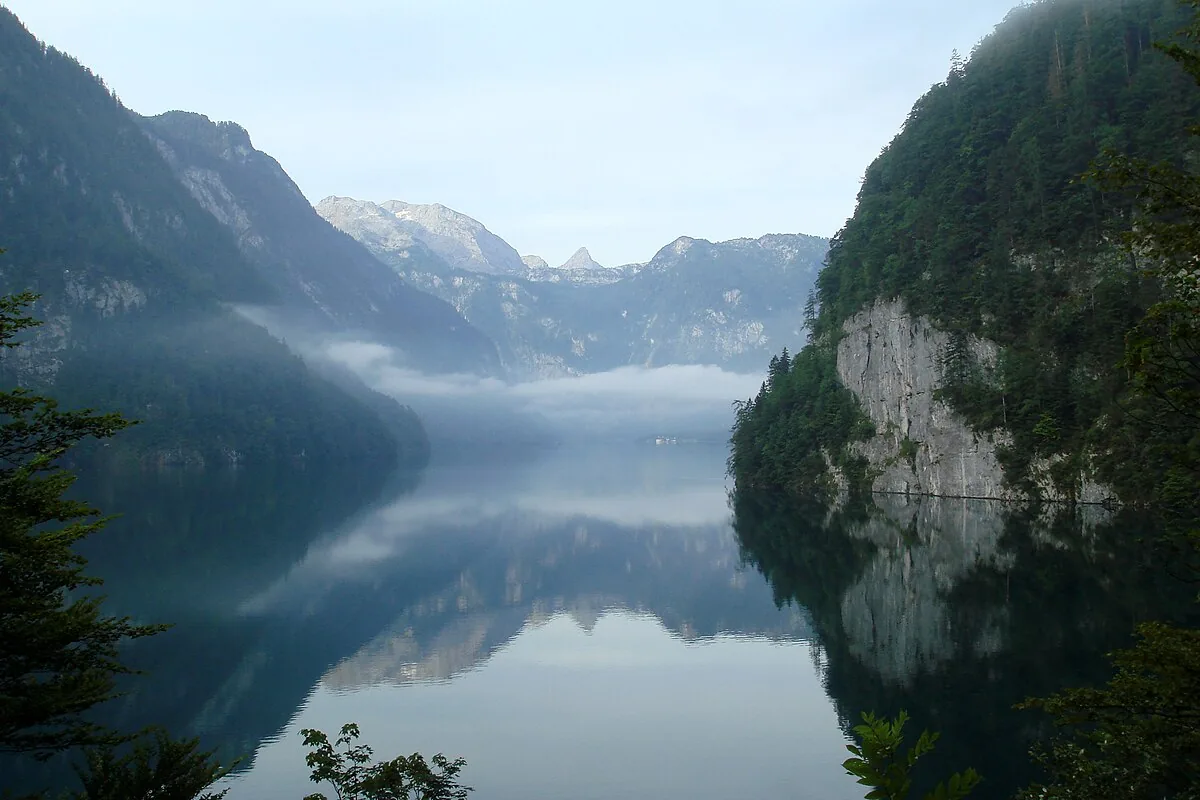
Königssee, Germany
Geological forces carved this deep basin
Geological forces carved this deep basin during the last ice age, leaving a body of water that reaches depths of nearly 200 meters. For centuries, the lake was a private hunting ground for the Provosts of Berchtesgaden and later the Bavarian royalty, who prized the isolated waters for their rare Arctic char. The pilgrimage church of St. Bartholomä dates back to the 12th century, though its current baroque flourishes were added much later to satisfy the tastes of the Wittelsbach kings. A pivotal moment in the lake’s modern history occurred at the turn of the 20th century when Prince Regent Luitpold of Bavaria insisted on electric propulsion to preserve the tranquility and purity of the environment. His foresight prevented the soot and noise of the industrial age from ever touching these waters, ensuring that the echo of the mountain walls remained unblemished.
Gliding across the surface on a quiet timber
Gliding across the surface on a quiet timber ferry, The water is so clear that the submerged rocks appear to be floating in mid-air. A sharp, invigorating chill even in mid-summer, smelling of wet stone and pine needles. a sudden hush fall over the passengers as the boatman stops mid-lake to play a flugelhorn, the melody bouncing off the 'Echo Wall' with startling clarity. There is a feeling of scale of the Watzmann mountain as its shadow stretches across the deck, making the boat feel like a mere splinter of wood. People often miss the small waterfall at Schrainbach, which tumbles into the lake with a thunderous roar hidden behind a screen of trees. What stays with you is disembarking at Salet and walking ten minutes to Obersee, where the reflection of the mountains in the still water is so perfect it becomes difficult to tell where the earth ends and the sky begins.
Access begins in the town
Access begins in the town of Berchtesgaden, which is well-connected by regional trains from Salzburg or Munich. From the station, a short bus ride or a thirty-minute walk along the Ache river leads to the Königssee parking area and the boat docks. The electric ferries run year-round, except when the lake freezes over entirely, a rare event that turns the surface into a natural skating rink. Arriving before the first boat at 8:00 AM is the only way to experience the docks before the day-trippers arrive from the surrounding Bavarian resorts.
“Access begins in the town of Berchtesgaden, which is well-connected by regional trains from Salzburg or Munich.”
The Experience
The temperature drop by several degrees as the boat moves into the shadows of the 2,000-meter cliffs. Audible: the electric motor is a barely audible hum, allowing you to hear the distant tinkling of cowbells from the high alpine pastures. The damp, cool mist on your skin as you approach the St. Bartholomä peninsula. Most visitors miss the hike up to the Eiskapelle, a permanent ice cave at the foot of the Watzmann East Face. The quality of light here is extraordinary, often creating a brilliant emerald glow that seems to emanate from the depths of the water itself.
Why It Matters
Königssee is the centerpiece of Germany’s only Alpine National Park and a model for sustainable tourism. It represents a rare successful balance between mass human interest and strict ecological preservation. Historically, it remains a site of deep cultural importance for Bavaria, blending religious pilgrimage with the rugged myths of the high mountains.
Why Visit
Visit Königssee because it is the closest you will get to the primal, untouched Alps. While other lakes are ringed by roads and hotels, this water remains walled in by stone. It offers a meditative stillness that is increasingly impossible to find in Central Europe, rewarding those who seek silence over spectacle.
Insider Tips
- 1
Sit on the right side of the boat when heading out from the docks for the best view of the Echo Wall performance.
- 2
Take the very first boat of the morning to reach the Obersee before the midday sun creates a hazy glare on the water.
- 3
The smoked trout at the fisherman’s hut on the St. Bartholomä peninsula is caught directly from the lake and prepared using traditional methods.
- 4
Bring cash, as the remote mountain huts and some boat services in the national park often cannot process credit cards.
- 5
If you plan to hike to the Röthbachfall, the highest waterfall in Germany, wear sturdy boots as the path beyond the lake is frequently muddy and slick.