There are no names on these 2,711 concrete pillars, only a grid of grey silence that seems to swallow the city whole as you walk deeper into its center.
About Memorial to the Murdered Jews of Europe
After the fall of the Berlin Wall, the city struggled with how to utilize the vacant land near the Tiergarten. Journalist Lea Rosh and historian Eberhard Jäckel campaigned for a central memorial to the Jewish victims of the Holocaust, leading to a design competition that saw hundreds of entries. Peter Eisenman's winning concept was controversial for its abstraction and its sheer scale. Since its completion in 2005, the memorial has become a permanent part of Berlin’s topography, forcing the nation to confront the physical presence of its history in the middle of its most modern, commercial district.
What this is
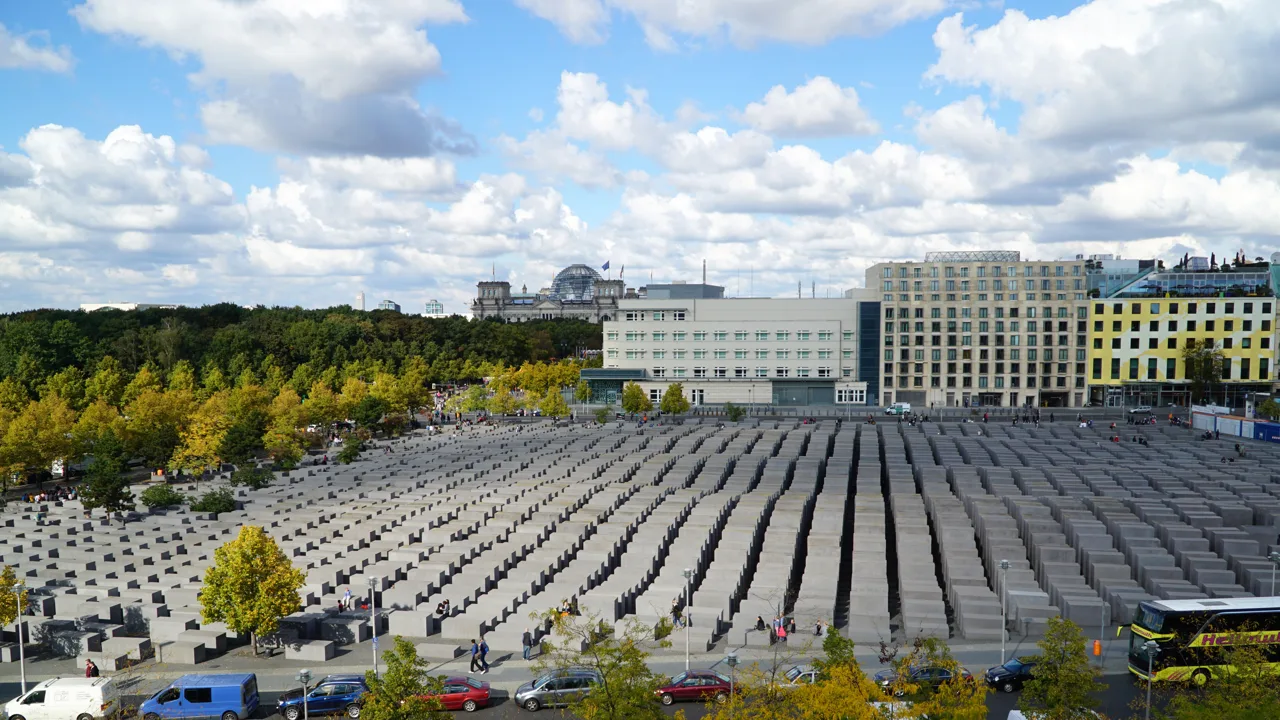
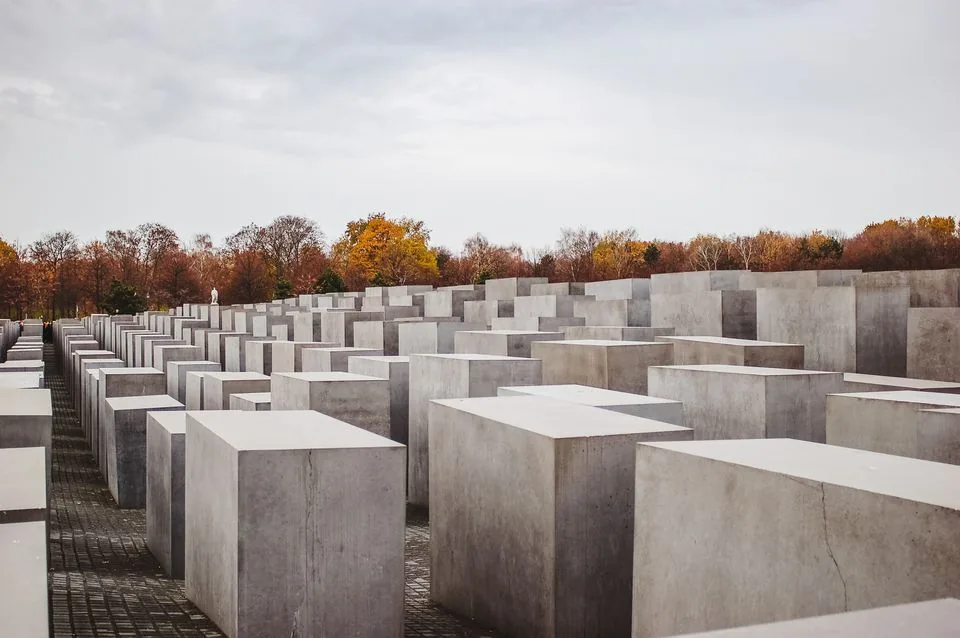
At the core of Berlin, between the Brandenburg Gate and the site of Hitler’s former bunker, 2,711 grey concrete slabs rise in a rhythmic, undulating wave. The Memorial to the Murdered Jews of Europe, designed by Peter Eisenman, refuses to offer the easy comfort of a traditional monument. There are no names inscribed on the stones, no statues of mourning, and no clear instructions on how to feel. Instead, the memorial creates a physical environment that grows increasingly oppressive as you descend into its center. The ground slopes unevenly beneath your feet, and the pillars, some barely ankle-high, others towering over four meters, block out the sound and sight of the city, leaving you in a grid of cold, grey silence.
“At the core of Berlin, between the Brandenburg Gate and the site of Hitler’s former bunker, 2,711 grey concrete slabs rise in a rhythmic, undulating wave.”
Memorial to the Murdered Jews of Europe, Germany
What it represents
The path to creating this memorial was fraught with fifteen years of intense national debate about how Germany should remember its greatest crimes. It was eventually inaugurated in 2005, sixty years after the end of World War II, on land that once stood in the 'death strip' of the Berlin Wall. Eisenman’s design was intended to represent a supposedly ordered system that has lost touch with human reason. The slabs, known as stelae, are arranged in a precise grid, yet the shifting heights and the dipping ground create a sense of disorientation and instability. Below the field of stones lies the Information Center, which provides the human names and stories that the abstract monument above intentionally omits, creating a powerful tension between the scale of the genocide and the individual lives lost.
Entering the grid from the sunlit sidewalk
Entering the grid from the sunlit sidewalk of Ebertstraße, The sounds of Berlin’s traffic begin to fade with every step you take toward the center. The air between the slabs is noticeably cooler and carries the scent of damp concrete and shadows. It becomes clear how the light is sliced into narrow, vertical strips that shift moving, creating a flickering effect that can feel deeply unsettling. The surface of the stelae, which are treated with a special anti-graffiti coating that makes the stone feel unnaturally smooth and industrial. Simple to walk past is the subtle way the slabs tilt at slight angles, never quite standing perfectly upright. What sticks with you is looking up from the deepest part of the memorial and seeing only the sky and the tops of the pillars, feeling momentarily lost in a labyrinth of stone.
The memorial is centrally located
The memorial is centrally located and impossible to miss if you are exploring Berlin’s Mitte district. It is a short walk from the Brandenburger Tor S-Bahn and U-Bahn station. Because the memorial has no gates or fences, it is accessible twenty-four hours a day, allowing for a visit in the quiet hours of the late night or early morning when the emotional impact is most acute. The Information Center, located at the southeast corner, has specific opening hours and often requires a wait in line due to security screenings, so it is best to visit the subterranean museum first before walking through the stelae.
“The memorial is centrally located and impossible to miss if you are exploring Berlin’s Mitte district.”
The Experience
The way the uneven cobblestones make you look down at your feet, forcing a posture of reflection. Nearby, children playing hide-and-seek often echoes through the rows, a jarring contrast to the site's purpose that highlights the memorial's role as a living part of the city. A sudden surge of isolation when you turn a corner and find yourself alone in a corridor of grey. Most visitors miss the small, individual rooms in the museum below that read out the names of every known Jewish victim. What lingers with you is the feeling of emerging back into the bright, noisy reality of Berlin after the grey weight of the grid.
Why It Matters
This memorial is a landmark in the history of memory. It represents Germany’s commitment to 'Vergangenheitsbewältigung', the process of coming to terms with the past. By placing such a massive, uncompromising space in its capital’s center, Germany acknowledges that the Holocaust is an inseparable part of its national identity that can never be hidden away.
Why Visit
Visit this memorial because it is one of the few places in the world where architecture is used to trigger a physical, emotional response to history. It is not a place to learn facts, that happens in the museum below, but a place to feel the disorientation and loss of the individual within a brutal system. It is a haunting, essential experience for anyone trying to understand modern Berlin.
Insider Tips
- 1
Visit at dusk when the long shadows stretch between the pillars, making the labyrinth feel even more immersive and mysterious.
- 2
The Information Center is closed on Mondays; plan your visit for mid-week to avoid the heaviest tourist weekend crowds.
- 3
Respect the site’s solemnity; avoid climbing on top of the slabs, as it is widely considered disrespectful to the memory of the victims.
- 4
The museum below is free of charge, but allow at least 90 minutes to properly absorb the deeply personal letters and diaries on display.
- 5
Bring a jacket even in summer; the deep corridors between the tall stelae retain the cold and can be surprisingly chilly.