“The first king of the Germans is buried on this castle hill, above a town with some 1,300 half-timbered houses.”
About Schlossberg
Quedlinburg rose to prominence under the Ottonian kings in the 10th century, when Henry the Fowler and his successors made it a centre of power; an influential abbey of noble women was founded here. The Romanesque church and treasury date from this era. The town survived the centuries with extraordinary completeness, and both town and castle hill are inscribed as a UNESCO World Heritage Site.
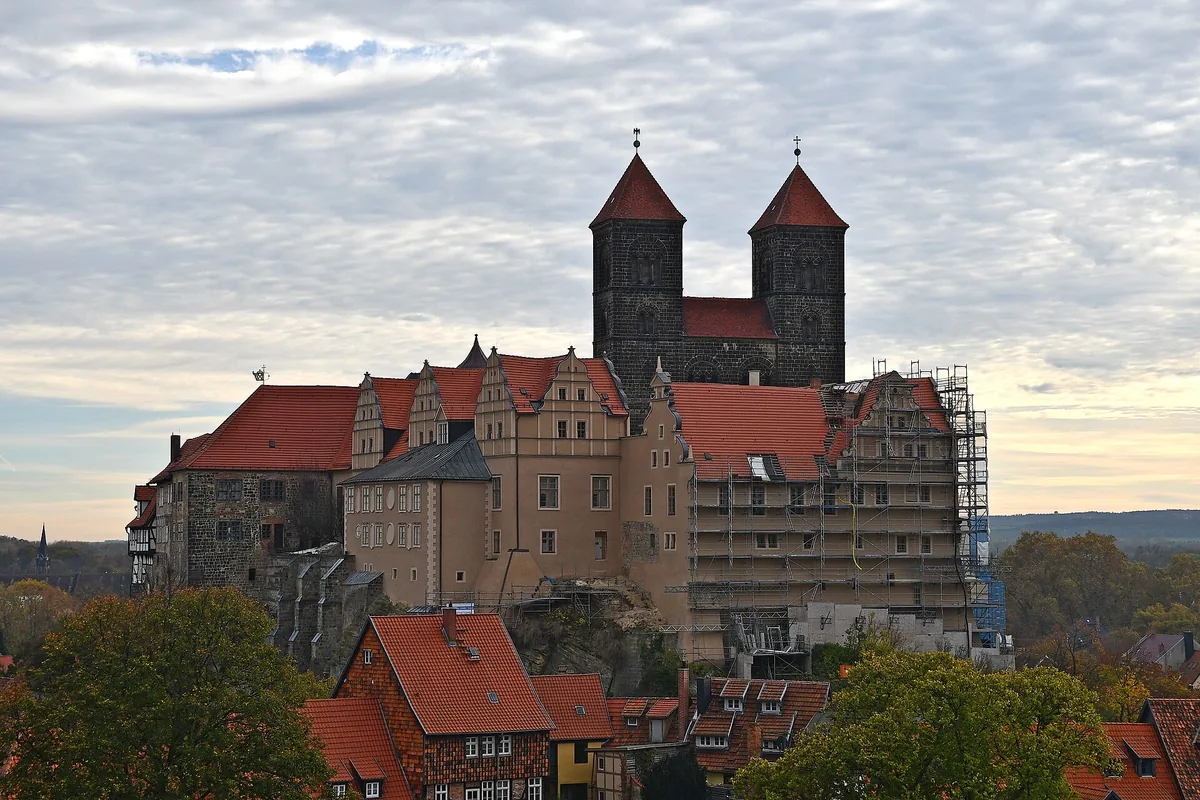
The Schlossberg in Quedlinburg crowns one of the most remarkable medieval towns in Germany, a UNESCO World Heritage Site with around 1,300 half-timbered houses spanning centuries. The castle hill holds a Romanesque collegiate church and the famous Quedlinburg Treasury, in a town that was once a seat of the very first German royal dynasty.
The Schlossberg in Quedlinburg crowns one of the most remarkable medieval towns in Germany, a UNESCO World Heritage Site with around 1,300 half-timbered houses spanning centuries.
Cradle of a German Kingdom
Quedlinburg was a favoured residence of the Ottonian dynasty, the rulers who forged the early medieval German kingdom in the 10th century, and Henry the Fowler, regarded as the first king of the Germans, is buried in the Romanesque church of St Servatius on the Schlossberg. The hilltop also guards the Quedlinburg Treasury, a hoard of medieval gold and jewelled reliquaries, while below spreads a town of 1,300 timber-framed houses from six centuries.
The Experience
Taking the Schlossberg to the Romanesque St Servatius church, with the royal tombs and the dazzling medieval treasury of gold reliquaries, then look out over the sea of timber-framed roofs below. Descending into the town, you wander winding lanes among 1,300 half-timbered houses from many periods. The combination of deep royal history and remarkably preserved architecture makes Quedlinburg captivating.
Why It Matters
The Schlossberg and town of Quedlinburg are a UNESCO World Heritage Site of exceptional importance, linked to the origins of the German kingdom and preserving one of the largest and finest collections of half-timbered architecture in Europe. It is a key site for understanding early medieval Germany.
It is a key site for understanding early medieval Germany.
Why Visit
A UNESCO-listed medieval town with 1,300 half-timbered houses and a castle hill holding royal tombs and a medieval treasury, in central Germany.
✦ Insider Tips
- 1
See the royal tombs and treasury in St Servatius church.
- 2
Wander the town's 1,300 half-timbered houses below.
- 3
The hilltop gives fine views over the old-town roofs.