“Martin Luther translated the New Testament here in ten months while hiding from the Holy Roman Emperor under a false name. The translation created modern literary German. The inkstain on the wall where he supposedly threw his inkwell at the devil is a tourist fake, he said so himself.”
About Wartburg Castle
Founded 1067; Romanesque Palas built around 1170, the oldest surviving castle hall in Germany. Saint Elisabeth resided here from 1211. Luther hid here 1521–22 under the pseudonym Junker Jörg after the Diet of Worms, translating the New Testament into standardized German. UNESCO World Heritage Site 1999.
Wartburg Castle
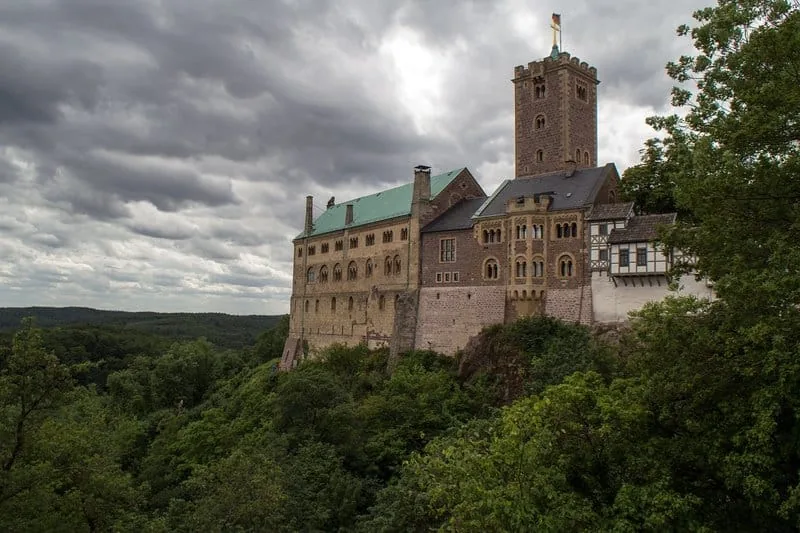
Wartburg Castle rises from a forested hill above Eisenach in Thuringia and is one of the best-preserved medieval castles in Germany. The UNESCO listing came it a World Heritage Site in 1999 for its historical significance: it was home to Saint Elisabeth of Hungary in the thirteenth century, and to Martin Luther in 1521–22, when he translated the New Testament into German while hiding from the Holy Roman Emperor after the Diet of Worms. Luther's translation effectively created modern literary German.
Wartburg Castle rises from a forested hill above Eisenach in Thuringia and is one of the best-preserved medieval castles in Germany.
Background
The castle was founded in 1067 by Ludwig the Springer, according to legend on a disputed hilltop, accompanied by the exclamation Wart Berg!, wait, mountain!, which became the name. The Romanesque Palas, built around 1170, is the oldest surviving castle hall in Germany. Saint Elisabeth lived at the Wartburg from 1211 and became the subject of the Minnesingers' court at the castle, commemorated in Wagner's opera Tannhäuser. Martin Luther arrived in 1521 after being placed under imperial ban at Worms; Elector Frederick the Wise had him kidnapped for his protection and hidden at the Wartburg under the pseudonym Junker Jörg. In ten months, working from Erasmus's Greek edition, Luther translated the New Testament into a German that was comprehensible across regional dialects, an act of linguistic standardization as significant as its theological content.
The castle tour includes the Luther Room, his actual working chamber, preserved with period furnishings, and the medieval Palas with its Romanesque hall. The Elisabeth Gallery documents her life and canonization in thirteenth-century mosaics added in the nineteenth century. The views from the castle terrace over the Thuringian Forest are the best in the region. An inkstain on the wall of the Luther Room, supposedly where Luther threw his inkwell at the devil, is a later tourist addition, as Luther himself acknowledged.
Eisenach is on the main Berlin–Frankfurt
ICE rail line (Berlin 2.5 hours, Frankfurt 1.5 hours). The castle is 2 kilometers above the town; a shuttle bus runs from Eisenach station.
The Experience
Luther's preserved working chamber, the Romanesque Palas hall, nineteenth-century Elisabeth mosaics, and terrace views over the Thuringian Forest, a layered castle visit whose medieval architecture and Reformation history are equally present.
Why It Matters
Wartburg is where modern literary German was created, Luther's translation was the first major text written in a German comprehensible across all dialect regions, and it established the linguistic standard that became the basis of German as a written national language.
Why Visit
The Luther Room is the actual physical space where one of the most consequential translation projects in the history of any language was completed in less than a year. The Romanesque Palas adds architectural quality that most Reformation sites lack.
✦ Insider Tips
- 1
Book the castle tour in advance during summer, the Luther Room has limited capacity.
- 2
Walk up from Eisenach rather than taking the shuttle if the weather allows, the forest approach is part of the experience.
- 3
The inkstain story is false, but the Luther Room itself is genuine, ask the guide to clarify the difference.