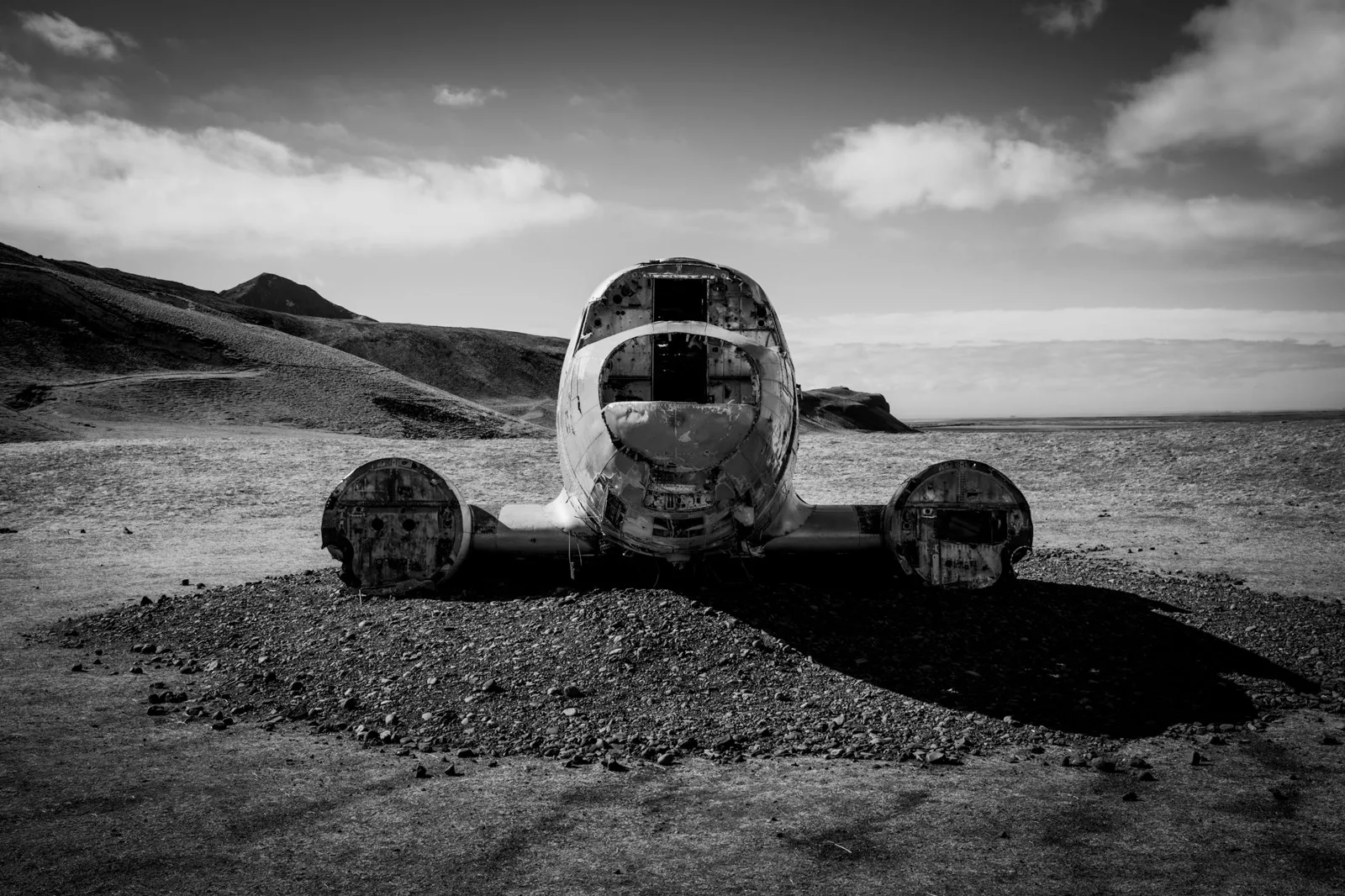
A US Navy plane ran out of fuel and crash-landed on this black-sand beach in 1973. Everyone survived; the wreck was abandoned and is now a photographers' pilgrimage.
About Solheimasandur Plane Wreck
The DC-3 came down on Solheimasandur in November 1973 after fuel starvation, possibly from the crew switching to an empty tank. All aboard survived the landing on the soft black sand. The military stripped the aircraft and left the shell, which sat largely unknown for decades until photographers and social media made it famous.
The short version
On the vast black-sand plain of Solheimasandur, on Iceland's south coast, lie the stripped silver remains of a US Navy DC-3 aircraft that crash-landed here in 1973. The fuselage sits alone in a flat black desert with no other feature in sight, and it has become one of the country's most surreal and heavily photographed locations.
“On the vast black-sand plain of Solheimasandur, on Iceland's south coast, lie the stripped silver remains of a US Navy DC-3 aircraft that crash-landed here in 1973.”
Everyone Walked Away
The plane ran out of fuel and made an emergency landing on the beach in November 1973. Every crew member survived, and the aircraft was simply abandoned where it stopped, its engines and useful parts removed. Decades later, social media turned the eerie wreck into a pilgrimage site, drawing a steady stream of visitors across the bleak sands to photograph the bare metal shell against the black ground and sky.
The Experience
Reaching it is part of the experience: a flat, exposed walk of nearly four kilometres each way across featureless black sand from the car park, with no shelter and often a hard wind. The reward is the bare fuselage standing utterly alone in a black void, an image so stark it barely looks real. A shuttle bus now runs for those who would rather not walk.
Why It Matters
The wreck has become an icon of Iceland's stark, otherworldly landscapes and a case study in how social media can turn an abandoned ruin into a major attraction. It draws thousands to a spot that, by any conventional measure, is just a dead aeroplane on an empty beach.
Why Visit
The wreck is one of Iceland's most striking and strange sights, worth the long walk for the image of bare metal alone in a black void. Go early or late for the light and the quiet, and take the shuttle if the four-kilometre trudge does not appeal.
Insider Tips
- 1
It is a 3.5 to 4 km walk each way across open black sand, so allow two hours round trip or take the shuttle.
- 2
There is no shelter or facilities on the route; dress for wind and carry water.
- 3
Go early or late for softer light and fewer people in your shots.
- 4
Do not climb on the fragile fuselage; it is steadily deteriorating.