“Built by Suleiman the Magnificent and once home to a fugitive Swedish king, this red-brick giant on the Dniester remained a closed military secret for nearly a century.”
About Bender Fortress
It began as a Moldovan customs post before the Ottomans transformed it into a world-class citadel. Sinan, the greatest architect of the Islamic world, is credited with the design of the inner castle. Throughout the 1700s, the fortress changed hands multiple times during the Russo-Turkish Wars, with the Russian general Panin finally capturing it after a brutal struggle. In the 2000s, the Transnistrian administration undertook a massive restoration project, clearing out decades of military debris and rebuilding the roofs of the towers based on historical sketches. Today, it stands as the most impressive military monument in the region, hosting festivals and historical reenactments.
Guarding the strategic bend of the Dniester River
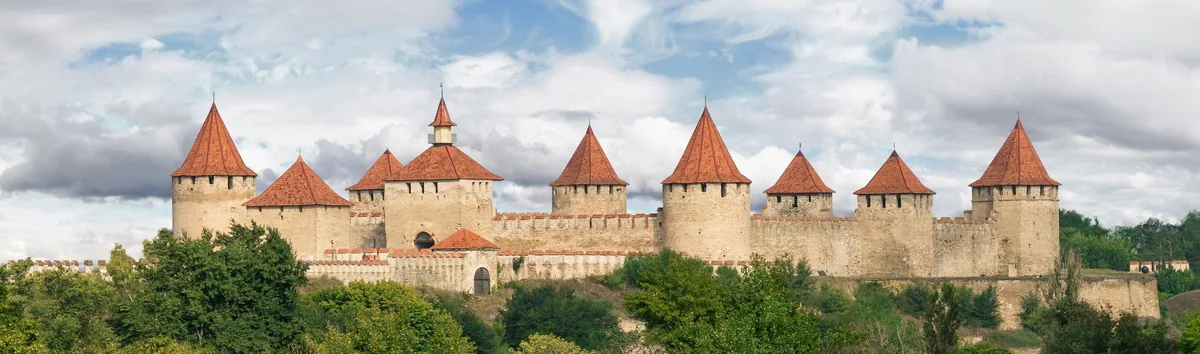
Guarding the strategic bend of the Dniester River, the Bender Fortress is a massive, multi-layered citadel that has been at the center of Eastern European power struggles for half a millennium. This is not a ruins; it is a meticulously restored complex of red-brick towers and thick limestone walls that look as if they could still withstand a siege. The fortress is a blend of Ottoman, Russian, and Swedish history, featuring a distinctive silhouette of pointed roofs and crenelated ramparts. It sits on a high bank, offering a commanding view of the river crossing that has been contested by sultans, tsars, and kings. It is a place of heavy stone and dark history, where the air smells of river mud and the sound of the wind whistling through the archery loops.
Guarding the strategic bend of the Dniester River, the Bender Fortress is a massive, multi-layered citadel that has been at the center of Eastern European power struggles for half a millennium.
The past
The fortress was built in 1538 by the Ottoman architect Sinan, under the orders of Sultan Suleiman the Magnificent, after he conquered the town from the Moldovan princes. It became a vital outpost of the Ottoman Empire, serving as a base for their campaigns against the Polish-Lithuanian Commonwealth and the Russian Empire. In 1709, King Charles XII of Sweden sought refuge here after his defeat at the Battle of Poltava, creating a bizarre 'Swedish colony' inside the Turkish walls. The fortress was eventually taken by the Russians in the late 18th century after three bloody sieges. For most of the 20th century, it was a closed military zone, used by the Soviet and later Transnistrian armies, until its recent restoration and opening to the public as a museum and tourist site.
Visiting Bender Fortress
Walking through the massive gates, the immediate drop in temperature as the thick walls block the sun. The rough, weathered texture of the Ottoman bricks, some still bearing the marks of the masons from the 16th century. The sound is a combination of your own footsteps on the wooden walkways and the distant, muffled noise of the modern city outside. Something of incline climbing to the top of the ramparts, where the wind is much stronger and the view opens up over the Dniester. The contrast between the dark, cramped interiors of the guard towers and the vast, open courtyards where cannons are still positioned at the ready. The museum inside contains a gruesome collection of medieval torture instruments and historical dioramas that explain the fortress's complex loyalties. Most visitors are struck by the 'Swedish' history of the site, a historical quirk that feels out of place in this Balkan landscape. The light in the late afternoon turns the red bricks of the towers into a deep, bloody hue, emphasizing the site's violent past.
Bender is the sister city
Bender is the sister city to Tiraspol, located just across the river. It is a fifteen-minute trolleybus ride from the Tiraspol center. The fortress is located on the edge of the city, near the riverbank. It was once difficult to access due to being on an active military base, but there is now a dedicated, well-marked entrance for tourists. You will likely have to pass through a checkpoint between Tiraspol and Bender, but for tourists, this is usually a quick formality. The fortress is large, so plan for at least two to three hours of walking to see the walls, the towers, and the multiple museums on site.
Bender is the sister city to Tiraspol, located just across the river.
The Experience
You notice the smell of cold iron and old stone in the powder magazines. The surface of the walls is a puzzle of limestone blocks and red clay bricks, reflecting the different eras of construction and repair. A sense of vertigo as you look down from the highest tower onto the river below, realizing why no army could cross here unnoticed. Audible: the river is a constant, low murmur at the base of the cliffs. Most visitors are intrigued by the 'Pantheon of Russian Glory', a row of busts of the generals who fought for the fortress. The moment you see the small mosque foundations inside the courtyard, you are reminded of the site's long tenure as an Islamic stronghold. The walk along the battlements is the highlight, providing a 360-degree view that makes you feel like the master of the Dniester.
Why It Matters
Bender Fortress is a crossroads of empires. It is the most significant Ottoman structure in the region and a key site for understanding the military history of the Black Sea steppe. It represents the meeting point of Swedish, Turkish, Russian, and Moldovan destinies, making it a place of immense historical complexity and international interest.
Why Visit
Visit this fortress for the scale of its history and the quality of its restoration. It is one of the few places in Moldova where you can walk through a truly intact medieval world. You come for the towers and cannons, but you stay for the strange stories of Swedish kings and Turkish architects that make this place feel like a historical novel come to life.
✦ Insider Tips
- 1
There are several small museums inside the towers; make sure to find the one dedicated to the 'Swedish stay' of Charles XII.
- 2
The stairs to the top of the ramparts are steep and narrow; take your time and watch your head in the low doorways.
- 3
The onsite restaurant serves traditional 'fortress-style' grilled meats that are popular with local families.
- 4
Check the schedule for the 'Knight’s Tournament' festivals, which are held once or twice a year and feature full-contact medieval combat.
- 5
Bring your passport, as Bender is technically in a high-security zone between Transnistria and the rest of Moldova.