“Two thousand years ago, this grassy ridge was a razor-sharp edge of an empire, where the civilized world ended and the vast, terrifying unknown of the steppe began.”
About Trajan's Wall
The construction of Trajan's Wall required the movement of millions of cubic meters of earth, a feat of logistics that suggests a highly organized central authority. There are actually two distinct lines: the Lower Wall, which runs from the Prut River to the Dniester lagoons, and the Upper Wall, which spans the center of the country. During the Great Migration Period, these ramparts served as the front line for the Roman-Byzantine defenses against the Huns and Avars. In the medieval era, the walls were reused by local princes as border markers and defensive positions. Even in the 20th century, the earthen ridges were occasionally used as trenches during the chaotic fighting of the World Wars, showing that the military logic of the 4th century remained sound for over 1,500 years.
What Trajan's Wall actually is
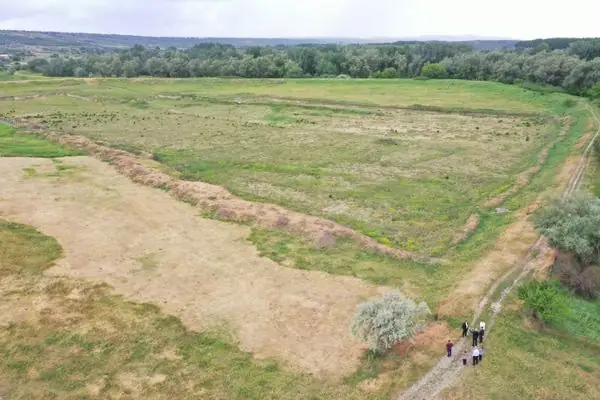
A massive, grassy ridge cuts a straight line through the undulating vineyards of southern Moldova, the ghost of a frontier that once separated the Roman world from the wild steppe. Valul lui Traian, or Trajan's Wall, is not a wall of stone but an immense earthen rampart that stretches for hundreds of kilometers across the landscape. The space on the southern plains is dry and smells of wild fennel and sun-baked dust. You walk along the top of the embankment. Notice how the elevation provides a strategic view of the surrounding valleys, a perspective once held by legionaries and Gothic warriors. The sound layer is a lonely, evocative hum of the wind through the high grass and the distant, metallic clink of a shepherd’s bell. It is a place of profound horizontal scale where the horizon feels like the only border left.
A massive, grassy ridge cuts a straight line through the undulating vineyards of southern Moldova, the ghost of a frontier that once separated the Roman world from the wild steppe.
Emperor Trajan
Historians have long debated the exact origins of these earthworks, with some attributing them to the Emperor Trajan in the 2nd century AD and others to the later Byzantine or even local Getae rulers. Most archaeological evidence suggests a massive defensive project from the 3rd or 4th centuries, designed to protect the Roman-influenced territories from the migrations of nomadic tribes. These walls were once over three meters high, fronted by a deep ditch that made a sudden cavalry charge nearly impossible. Over the centuries, the elements and the plow have softened the sharp edges of the ramparts, turning a military machine into a series of green waves. Despite the encroachment of modern agriculture, the Upper and Lower walls remain the most significant archaeological features of the region, marking the southernmost reach of structured imperial defense in the East.
Visiting Trajan's Wall
Standing on the ridge of the Upper Wall, The physical presence of the ancient world as a literal hump in the earth beneath your boots. You catch the way the light at dawn catches the subtle shadow of the ditch, revealing the true scale of the construction that is often invisible in the flat glare of noon. The sound of the wind is constant here, a rhythmic soughing that seems to carry the dust of two thousand years. There is a isolation of the frontier, realizing that for a soldier stationed here, the land to the north was an unknown and dangerous void. The small pieces of ceramic and worked flint that occasionally wash out of the eroded sections after a heavy rain. The most striking moment is following the line of the wall with your eyes until it disappears into the hazy distance, proof of a project of staggering human labor. The most impressive sections of the wall are found in the Cahul and Leova districts, several hours south of Chisinau. The journey requires a car and a good map, as there are few formal signs marking the site. The village of Vadul lui Isac offers one of the most accessible and well-preserved stretches, where the wall remains visible as a distinct geographical feature. Arriving in the late afternoon provides the best shadows for photography and a cooler temperature for hiking along the ramparts. You get no entrance fee or visitor center; the wall belongs to the fields and the sky, making it an ideal destination for those who prefer their history without the crowds or the gift shops.
The Experience
The character of the wall is one of quiet, monumental endurance. The opening note is the smell of the steppe, dry, spicy, and open, which fills your lungs as you climb the ridge. There is a height of the rampart, a small but significant advantage that would have meant the difference between life and death in a pre-gunpowder world. The light is vast and unobstructed, turning the green grass of the wall into a shimmering ribbon of gold at sunset. It becomes clear how the modern vineyards stop abruptly at the base of the wall, respecting a boundary that was drawn in the dirt before their ancestors arrived. The most evocative detail is the silence, a heavy weight that emphasizes the passage of time. It is a place that requires an imagination to fully see.
The character of the wall is one of quiet, monumental endurance.
Why It Matters
Valul lui Traian is the most significant ancient fortification in Eastern Europe and a key part of the Roman Limes system. It represents the immense effort of the classical world to stabilize its borders and the enduring impact of imperial engineering on the natural landscape. Historically, it defines the cultural and political boundaries that shaped the early history of the Moldovan people.
Why Visit
The point is that you want to see history that hasn't been put behind glass. While a museum gives you the artifacts, Trajan's Wall gives you the geography of power. You come here to stand on the edge of the Roman world and to realize that a simple pile of dirt can tell a more epic story than a marble palace. It is the only place in Moldova where you can walk for miles along a ghost.
✦ Insider Tips
- 1
Use satellite imagery on your phone to find the cleanest lines of the wall before you start hiking.
- 2
The section near the village of Copceac is particularly well-preserved and offers the most dramatic height for photographs.
- 3
Bring plenty of water and a hat; the southern plains are notoriously hot and there is zero shade on top of the ramparts.
- 4
Look for the 'gates' or gaps in the wall where ancient roads once passed through; they are often marked by a slight flattening of the ridge.
- 5
Ask a local farmer about 'The Wall of the Giants'; the folklore surrounding the site is often as fascinating as the archaeological facts.