A medieval prince spared a roe deer here in 1420, sparking the construction of a sanctuary that would eventually house the greatest library in the Romanian-speaking world.
About Capriana Monastery
Stefan cel Mare gave the monastery its first stone foundations in 1491, establishing it as a royal monument. By the 1800s, it became the burial place of Metropolitan Gavriil Bănulescu-Bodoni, whose canonization in 2016 brought thousands of pilgrims back to these hills. The architecture evolved from the traditional Moldovan style, slender and tall, to include the more ornate Russian influences of the late 19th century. Its survival through the 20th century is a minor miracle; while many churches were demolished, Capriana’s status as a 'sanatorium' kept its structural integrity intact until its rebirth in 1989.
What Capriana Monastery actually is
Deep within the ancient Codru forests, the white stone walls of Capriana rise like a persistent prayer against a sea of green. This monastic complex is the cradle of Moldovan literature and high culture, having survived the whims of princes and the suppressions of the Soviet era. Three distinct churches occupy the manicured grounds, spanning architectural styles from the medieval to the baroque. The air here smells of pine needles and beeswax, a quiet microclimate where the rush of modern Chisinau feels several centuries away. It remains the spiritual home of the nation, housing the tomb of Gavriil Bănulescu-Bodoni and a library that once held the country’s most precious chronicles.
“Deep within the ancient Codru forests, the white stone walls of Capriana rise like a persistent prayer against a sea of green.”
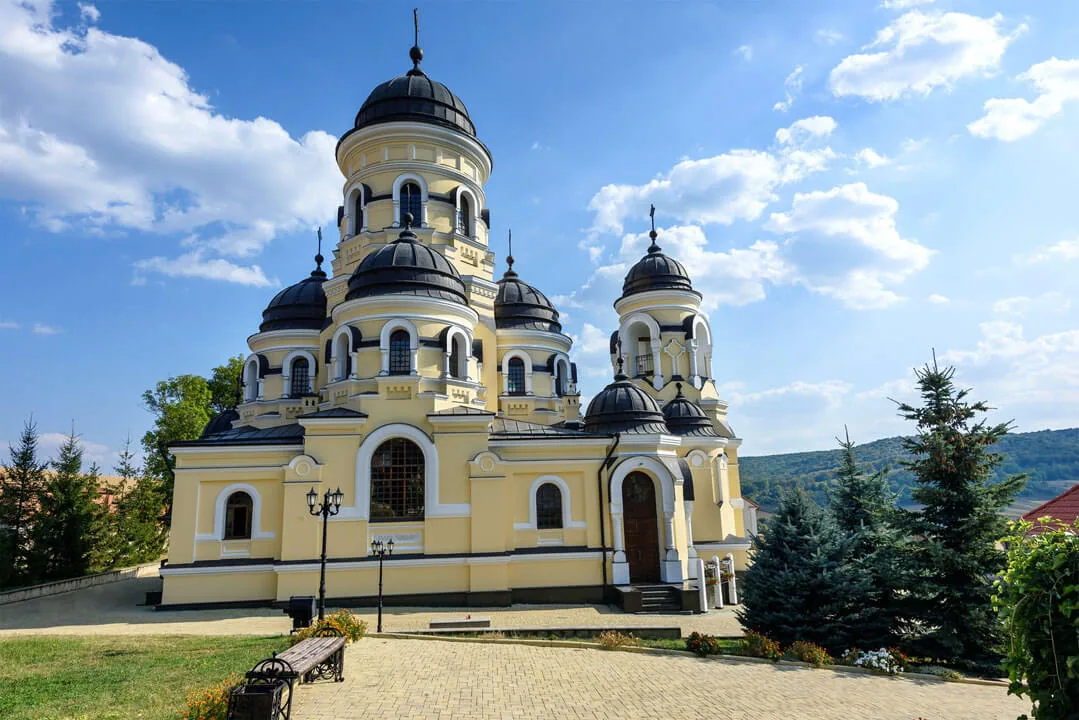
Capriana Monastery, Moldova
Legends trace the monastery’s origins
Legends trace the monastery’s origins to a 1420 land grant by Alexander the Good, though Stefan cel Mare later rebuilt it in stone after a miraculous hunting encounter with a roe deer. For centuries, Capriana functioned as the lavishly endowed residence of the Metropolitan of Moldova, benefiting from the patronage of nearly every significant ruler in the region. The 19th century saw the addition of the imposing Winter Church and the elegant St. George’s Church, creating a trio of sanctuaries that reflect the shifting aesthetic of Eastern Orthodoxy. During the Soviet period, the monks were expelled and the site was repurposed as a sanatorium for children with tuberculosis. Along the fall of the Iron Curtain, a massive national restoration project in the early 2000s revived the crumbling limestone and returned the gold leaf to its icons, restoring its status as a pilgrimage site.
Stepping through the gatehouse, the sudden
Stepping through the gatehouse, the sudden drop in temperature provided by the surrounding forest. a wooden semantron, the rhythmic striking of a board, often replaces the ringing of bells, calling the monks to prayer in a tradition that dates back to the Desert Fathers. The contrast between the intimate, dark interior of the 15th-century Assumption Church and the airy, light-filled spaces of the later Victorian-era additions. The smell of incense lingers in the heavy velvet curtains and the intricately carved wooden iconostases. On a quiet morning, you might see a black-robed monk tending to the rose gardens with the same meticulous care given to the ancient manuscripts. The courtyard feels like a shared living room for the faithful, where old women in floral headscarves sit beside tourists in silent contemplation of the valley view.
Reaching the monastery involves a forty-minute
Reaching the monastery involves a forty-minute drive northwest from Chisinau into the heart of the Strășeni district. The road winds through the Codru, the dense forest that once acted as a natural fortress for Moldovan partisans. Most visitors arrive via private car or a local 'rutiera' minibus from the Central Bus Station, which drops passengers at the edge of the village. A short downhill walk from the village center leads you directly to the monastic gates, offering a sweeping view of the complex sitting in its verdant bowl.
“Reaching the monastery involves a forty-minute drive northwest from Chisinau into the heart of the Strășeni district.”
The Experience
You notice the flickering light of handmade candles casting long shadows against the frescoes, making the saints on the walls appear to move. The grain of the old stone walls is cool and damp, even in the height of August. A sense of profound continuity when standing in the crypt, surrounded by the silence of the forest. Most visitors miss the small path leading into the trees behind the complex, where the sound of the wind in the oaks creates a natural cathedral. The evening liturgy is the most evocative time to be present, as the low chanting of the monks fills the courtyard and the golden domes catch the last embers of the sun.
Why It Matters
Capriana is the symbolic anchor of the Moldovan Orthodox Church. It represents the survival of national identity through religious tradition, serving as the cultural bridge between the medieval principality and the modern republic. Its architectural diversity makes it an encyclopedia of Eastern European ecclesiastical design.
Why Visit
Visit Capriana to understand the spiritual gravity of the Moldovan countryside. While Chisinau’s churches are grand, this forest retreat offers a raw, elemental connection to the past that you can’t find in the city. It is the best place to witness the living traditions of monastic life against a backdrop of untouched forest.
Insider Tips
- 1
Women should bring a headscarf and a long skirt, as the monastery maintains a traditional dress code for entry into the sanctuaries.
- 2
Seek out the holy spring just outside the main walls; locals believe the water has healing properties and often queue to fill bottles.
- 3
The monastery shop sells honey produced by the monks from forest wildflowers, which has a distinct, herbal flavor unlike anything in the markets.
- 4
Visit on a weekday morning to avoid the large wedding parties that often occupy the grounds on Saturdays.
- 5
Look for the ancient oak tree near the entrance, which is said to have provided shade to Stefan cel Mare himself.