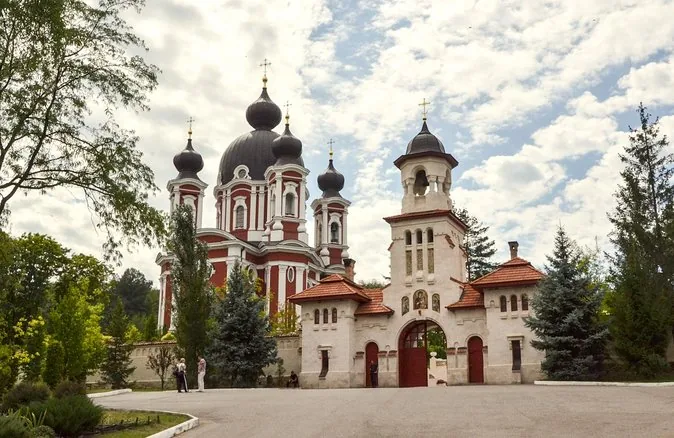
Founded by a guilt-ridden bandit in the 1700s, this scarlet cathedral now reflects perfectly in a silent pond, looking more like an Italian palace than a forest hermitage.
About Curchi Monastery
The monastery began as a collection of wattle-and-daub huts but transformed in the 19th century under the guidance of Abbot Cyril. The building of the Great Cathedral (1872) marked the height of the monastery's power, as it became a center for religious education and choir singing. After being forcibly closed in 1958, the library was burned and the icons were destroyed. The psychiatric hospital that occupied the site until 2002 left the buildings in a state of near-collapse. The subsequent five-year restoration is considered the most successful architectural recovery in Moldova’s modern history, returning the site to its 19th-century peak.
Curchi Monastery
If Capriana is the spiritual heart of Moldova, Curchi is its architectural crown. Out of the rolling Orhei hills like a crimson and white mirage, the monastery’s main cathedral is a masterpiece of the Italian Baroque style, a rarity in a landscape dominated by Byzantine modesty. The complex is centered around a perfectly still pond, where the reflection of the towering domes creates a symmetry that feels almost too perfect to be real. The grounds are a marvel of landscaping, with terraced gardens and stone paths that lead visitors through five separate churches. It is a place of visual harmony, where the boldness of the architecture is softened by the gentle, pastoral rhythm of the surrounding countryside.
Legend tells of a reformed bandit named Iordache
Legend tells of a reformed bandit named Iordache Curchi who founded a small wooden skete here in 1773 to atone for his sins. Over the next century, his humble retreat grew into one of the wealthiest and most influential monasteries in Bessarabia. The current centerpiece, the Nativity of the Virgin Mary Cathedral, was built between 1866 and 1872, inspired by the designs of the famous architect Bartolomeo Rastrelli. Its massive dome is one of the highest in Moldova, reaching over 50 meters into the sky. During the Soviet era, the monastery suffered a fate similar to many others, serving as a psychiatric hospital before falling into deep disrepair. Its restoration in the early 2000s was fueled by a massive fundraising campaign, involving everyone from government officials to local villagers, resulting in the pristine, vibrant site seen today.
Approaching the monastery, the scale
Approaching the monastery, The scale of the cathedral long before you reach the gates. The vibrant 'terracotta' red of the walls, a color that seems to change intensity depending on the angle of the sun. Audible: the bells here is particularly melodic, echoing across the water of the central pond. Inside the main cathedral, the air is bright and expansive, unlike the dim, moody interiors of older Moldovan churches. The sheer amount of gold leaf on the iconostasis and the intricate, light-colored frescoes that cover every inch of the soaring ceiling. Walking the perimeter, The softness of the grass and manicured boxwood hedges. Most visitors sit by the lake for a few minutes, where the only sound is the occasional splash of a fish or the distant murmur of a choir practicing.
Curchi is located about 45 kilometers
Curchi is located about 45 kilometers north of Chisinau, making it a perfect day trip in combination with the Orheiul Vechi archaeological complex. The final few kilometers of the drive pass through beautiful, undulating hills and traditional villages. Public transport is less frequent than to other sites, so most travelers opt for a private tour or a rental car. The monastery is clearly signposted from the main M2 highway. There is ample parking near the entrance, and a small cafe serves traditional Moldovan pies and coffee just outside the main walls.
The Experience
You notice the smell of fresh plaster and expensive incense, a sign of the monastery’s recent and lavish restoration. The grain of the grounds is a mix of smooth granite pavers and soft, velvet-like lawns. A sense of sun’s warmth reflecting off the red walls, creating a rosy glow in the courtyard. The clatter of the liturgy here is often professional-grade; the monks are famous for their singing. Most visitors miss the smaller, older Winter Church, which offers a much more intimate and traditional experience compared to the grand cathedral. Up on the far side of the pond, you get the 'postcard' view, where the silence of the water and the grandeur of the domes combine into a single, peaceful image.
Why It Matters
Curchi is the primary example of the 'Bessarabian Baroque.' It represents the 19th-century transition of the Moldovan church toward a more imperial, grand aesthetic. Culturally, it is a symbol of the nation's capacity for restoration, both of its buildings and its religious identity, after decades of neglect.
Why Visit
Visit Curchi because it is undeniably the most beautiful monastery in Moldova. While others offer more grit or history, Curchi offers pure, unadulterated aesthetic joy. It is a photographer’s dream and a perfect place to see how much pride Moldovans take in their religious heritage.
✦ Photo Gallery
Best Season
🌤 Early summer (May and June) is ideal, when the gardens are in full bloom and the pond is at its highest level, providing the best reflections.
Quick Facts
Best time to visit
Early summer (May and June) is ideal, when the gardens are in full bloom and the pond is at its highest level, providing the best reflections.
Getting there
In Orhei, Moldova; reach Orhei first, then continue to the site.
What's nearby
Cricova Winery, Nativity Cathedral and Triumphal Arch are also in the area.
Location
Orhei, Moldova
Type
attraction
Coordinates
47.3339°, 28.6535°
Insider Tips
- 1
Walk all the way around the pond to find the hidden bench that offers the perfect symmetrical view of the main cathedral.
- 2
The monastery choir often performs on Sunday mornings; even if you aren't religious, the vocal quality is world-class.
- 3
The dress code is strictly enforced here, perhaps more than at other sites, so ensure shoulders and knees are covered.
- 4
Check the basement of the main cathedral; sometimes they allow visitors to see the lower chapel, which has a very different atmosphere.
- 5
If you are driving, the small road leading to the village of Vatici just past the monastery offers some of the best sunset views in the region.