A replica of the United States Capitol Building sits unexpectedly on a Moldovan hillside, surrounded by marble palaces and silver roofs in the unofficial world capital of the Roma people.
About Gypsy Hill
Soroca has been a center for the Roma people since the 15th century, but the 'Palace Era' is a recent chapter. The transition from nomadic life to this settled, flamboyant display of wealth happened over just two generations. The architecture reflects a desire to anchor the community in stone after centuries of transience. Baron Mircea Cerari, the father of the current leader, was instrumental in turning this hill into a political and cultural center for Roma across Eastern Europe. Today, the hill faces a strange crossroads, as many of the younger generation move abroad, leaving these massive stone monuments as silent witnesses to a peak of local prosperity.
What Gypsy Hill actually is
In the northern city of Soroca, a steep incline leads to a neighborhood that defies every architectural norm of the region. Gypsy Hill, or 'Dealul Romilor,' is a surreal gallery of domestic grandeur where the homes are modeled after the Capitol Building, the Bolshoi Theatre, and even St. Peter’s Basilica. These are the palaces of the Roma elite, built with a competitive flair that turns the suburban landscape into a fever dream of marble, gold leaf, and stainless steel. It is a place of immense visual noise, where neoclassical columns meet baroque domes in a riotous celebration of wealth and cultural identity. The hill is not a museum, but a living community where the architecture is a loud, unapologetic statement of presence.
“In the northern city of Soroca, a steep incline leads to a neighborhood that defies every architectural norm of the region.”
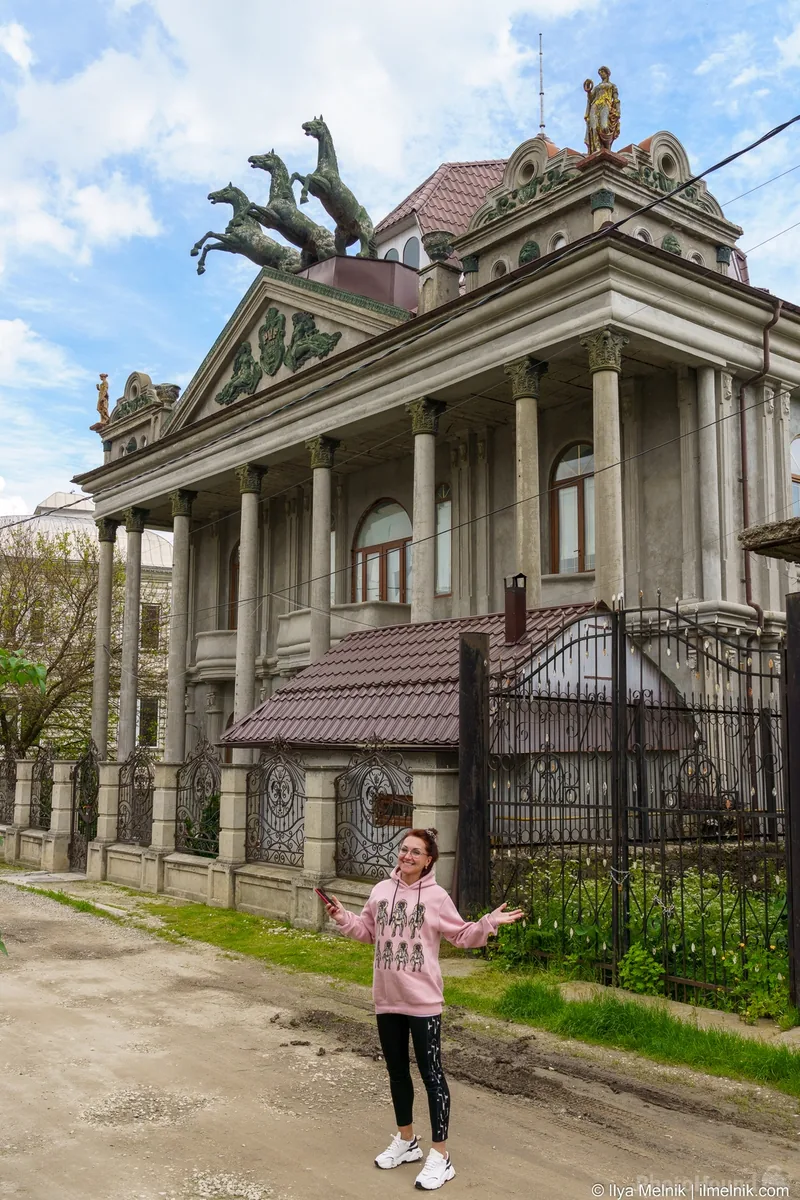
Gypsy Hill, Moldova
The phenomenon of the Soroca palaces began
The phenomenon of the Soroca palaces began in the late Soviet period and accelerated wildly in the 1990s. As the Roma community found success in international trade, particularly in the metals market, they began to invest their fortunes into their ancestral homes. The architecture is largely improvisational; owners often describe a dream or a building they saw in a magazine to local builders who then translate those images into brick and mortar. There is a deep-seated tradition of competition between neighbors, leading to ever-larger porticos and increasingly shiny roofs. This is the seat of the 'Baron of the Roma,' Arthur Cerari, a diplomat and leader who maintains a residence that functions as the neighborhood’s informal capital.
Walking up the winding streets,
Walking up the winding streets, There is a sense of sensory overload as each house attempts to outshine the last. The glint of the sun on silver-tiled roofs and the reflection of the sky in massive, tinted windows. The hum of the neighborhood is surprisingly quiet, with the occasional luxury car purring past or the distant barking of a dog. like an observer in a private gallery of aspiration. Many of the most grand structures remain unfinished, their upper floors mere shells while the families live in the comfortable lower levels. The thing you pick up on is the intricate ironwork of the fences, often featuring motifs that symbolize the nomadic history of the people. The smell of woodsmoke from the kitchens reminds you that despite the marble facades, these are family homes where traditional life continues regardless of the exterior grandiosity.
Gypsy Hill is easily reached
Gypsy Hill is easily reached on foot or by taxi from the center of Soroca. It occupies the high ground overlooking the medieval fortress and the river. Most visitors walk up from the main city market, a journey that takes about fifteen minutes and allows for a gradual immersion into the changing styles of the houses. There are no formal tours or tickets; it is a public residential area. Respectful behavior is paramount, as you are essentially walking through someone’s neighborhood. While photography of the exteriors is generally tolerated, it is polite to ask before taking close-up shots of families or private courtyards.
“Gypsy Hill is easily reached on foot or by taxi from the center of Soroca.”
The Experience
You feel the contrast between the dusty, unpaved side streets and the opulence of the facades, a mark of the community's unique priorities. The light at midday can be blinding as it bounces off the polished stone and metallic ornaments. First, the 'incomplete' nature of many homes, which locals explain as a way to avoid property taxes or simply a project that lasts a lifetime. Most visitors focus on the domes, but the detail in the gateposts and the staircases is where the true craftsmanship lies. There is a strange sense of wonder at the sheer audacity of the design, which ignores every rule of urban planning in favor of individual expression. The moment you see a horse-drawn cart pass a house with Corinthian columns, the paradox of the hill is complete.
Why It Matters
Gypsy Hill is a global center for Roma culture and an architectural anomaly without parallel. It challenges traditional Western notions of taste and urban development, presenting a visual history of a marginalized people’s rise to economic power. It is a product of the power of the 'home' as a symbol of victory over a history of displacement.
Why Visit
Visit this neighborhood to see the most creative and unfiltered architecture in Europe. It is a place that will force you to rethink what a house should look like and how a community expresses its pride. You come here for the 'kitsch' but leave with a deeper understanding of a misunderstood people's drive for permanence.
Insider Tips
- 1
If you see Baron Arthur Cerari's house (marked by a large sign), he is often open to meeting travelers if he is not busy with official business.
- 2
Hire a local guide in the city center who can explain the family histories behind the most famous 'palaces.'
- 3
Walk the back streets to see the houses currently under construction; the traditional brickwork techniques are fascinating to observe.
- 4
Bring small change for the neighborhood kids who often act as unofficial guides, showing you the best angles for photos.
- 5
Do not enter private courtyards without an explicit invitation; the gates are symbolic boundaries that are highly respected.