“Inside a pseudo-Moorish palace that looks like it drifted north from Morocco, the skeleton of a five-meter-tall prehistoric beast guards Moldova's oldest collection of hand-woven treasures.”
About National Museum of Ethnography
Founded as the Museum of Agriculture of the Bessarabian Zemstvo, the institution was intended to modernize local farming. However, the passion of its early curators quickly expanded the scope to include archaeology and folk art. Vladimir Tsyganko’s 1905 design used red and yellow bricks in a way that was revolutionary for Chisinau at the time. Despite the political upheavals of the Romanian and Soviet periods, the museum’s core mission of documenting the rural traditions of the Prut and Dniester rivers remained unchanged, preserving crafts that have now largely disappeared from daily life.
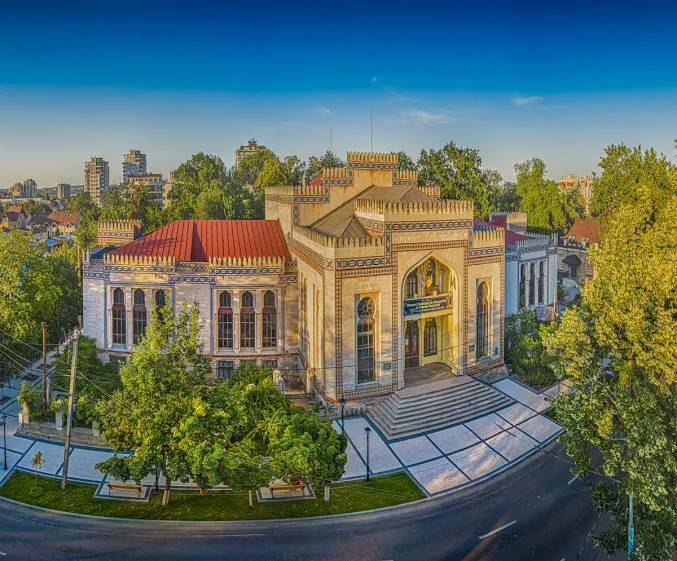
Rarely does a building’s exterior so perfectly mirror
Rarely does a building’s exterior so perfectly mirror the treasures inside as the National Museum of Ethnography and Natural History. Built in a distinct pseudo-Moorish style, the museum is an exotic architectural outlier in a city of neoclassical and Soviet blocks. Intricate brickwork and horseshoe arches suggest a palace from a different latitude, but inside, the focus is purely on the Moldovan soul. The collections span everything from the flora and fauna of the Bessarabian steppe to the intricate weaving patterns of village life. It is the oldest museum in the country, a place where the creak of floorboards and ancient wool create a sanctuary of quiet scholarship.
Rarely does a building’s exterior so perfectly mirror the treasures inside as the National Museum of Ethnography and Natural History.
Founded this institution, 1889
Baron Alexander Stuart founded this institution in 1889, originally focusing on agriculture and local industry. The current building, designed by architect Vladimir Tsyganko, was completed in 1905 and remains one of the few structures in Chisinau to survive both world wars and numerous earthquakes without significant structural changes. For over a century, scientists and ethnographers have used these halls to document the shifting borders and blending cultures of this Balkan crossroads. The museum’s most famous resident, the skeleton of a giant prehistoric deinotherium, was discovered in 1966 and has since become a symbol of the region's deep geological history, bridging the gap between the natural world and human art.
Walking into the central hall,
Walking into the central hall, the cool, hushed atmosphere of a nineteenth-century study. The light filters through stained glass and skylights, casting geometric shadows across the cases of traditional Moldovan costumes. The thing you pick up on is the overwhelming smell of old wood and beeswax, a scent that seems to have soaked into the very walls over the decades. Your own footsteps on the parquet floors follows you through rooms filled with hand-carved wooden gates and vibrant, heavy carpets. In the natural history wing, the massive skeleton of the deinotherium rises toward the ceiling, its sheer scale making the human artifacts nearby seem delicate and fleeting. Outside, the museum’s botanical garden offers a small, wild pocket of greenery where the sound of the city fades into the rustle of native plants.
The museum is situated
The museum is situated on Mihail Kogalniceanu Street, a quiet, leafy road a few blocks south of the main boulevard. It is an easy ten-minute walk from the Triumphal Arch. Several trolleybuses stop on the parallel Sciusev Street, including lines 2, 3, and 10. For those driving, parking on the narrow side streets can be a challenge, so arriving by taxi or on foot is usually the smoother option. The museum is a focal point of the historic 'Lower City,' making it a perfect anchor for a walk through Chisinau's nineteenth-century residential quarters.
The museum is situated on Mihail Kogalniceanu Street, a quiet, leafy road a few blocks south of the main boulevard.
The Experience
Temperature drops as you descend into the lower levels where the archaeological finds are kept. The feel of the hand-woven Bessarabian rugs is visible even through the glass, their thick pile and vegetable dyes speaking of winters spent at the loom. First, the quiet intensity of the curators, many of whom have spent decades in these halls. Most visitors are startled by the 'traditional wedding' diorama, which uses life-sized figures to recreate a village celebration in vivid, haunting detail. The museum doesn't feel like a modern gallery; it feels like a memory palace where every object is tied to a specific patch of Moldovan earth.
Why It Matters
This museum is the primary guardian of the Moldovan vernacular. It is the only place where the complex interplay of natural environment and human craft is displayed as a single, continuous narrative. By preserving the 'Casa Mare' (the traditional guest room) and the regional variations in weaving, it ensures that the DNA of Moldovan culture remains accessible to a generation raised in the city.
Why Visit
Visit this museum because the building itself is a masterpiece of early twentieth-century imagination. It is the best place to understand the Moldovan people before you head into the countryside, providing the visual vocabulary to appreciate the villages you'll see later. You come for the architecture but stay for the giant prehistoric elephant.
✦ Insider Tips
- 1
Pay the small extra fee for a photography permit; the Moorish architecture and natural history halls are some of the most beautiful interiors in Moldova.
- 2
Look for the display of traditional 'opincii' (leather sandals) to see the ingenious way peasants adapted to the muddy steppe.
- 3
The museum’s courtyard contains a small wooden church and a 'viviarium' with rare birds that most visitors miss entirely.
- 4
Check the schedule for temporary exhibitions, as they often showcase contemporary Moldovan artists working in traditional mediums.
- 5
Wear quiet shoes; the historic wooden floors are incredibly loud and will echo through the entire gallery.