Originally enclosed to keep grazing cows away from the city elite, this park has transformed into a shared sanctuary where chess-playing retirees and bronze poets coexist under a canopy of ancient lindens.
About Stefan cel Mare Park
Designed under the supervision of Russian military engineers in 1818, the park was a key part of the new 'New Town' layout after Chisinau became the capital of Bessarabia. The legendary Alexander Pushkin spent many hours here during his exile, and a monument dedicated to him, sculpted by Alexander Opekushin in 1885, remains one of the park’s highlights. The cast-iron fence, though seemingly delicate, was designed to survive the harsh Bessarabian winters and remains one of the finest examples of nineteenth-century industrial art in the region. After 1991, the park was rededicated to Stefan cel Mare, whose statue became the primary site for national celebrations and floral tributes.
Stefan cel Mare Park is the green
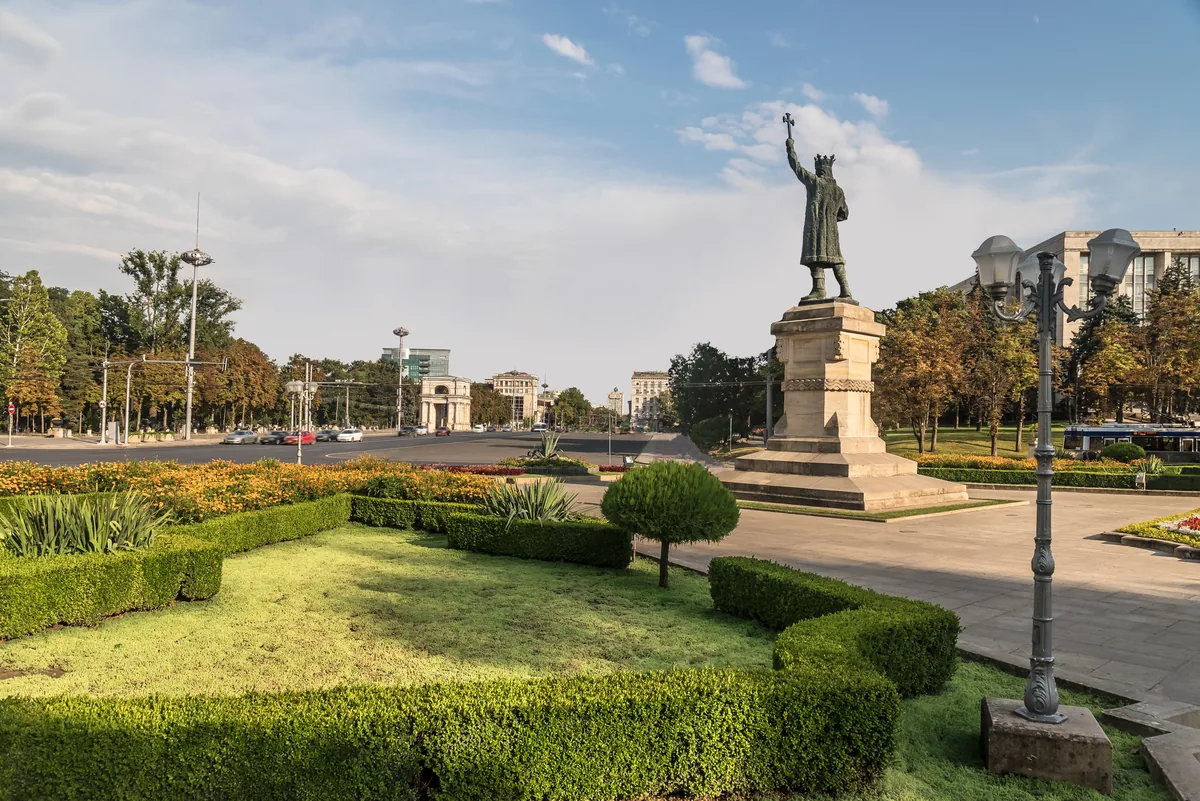
Stefan cel Mare Park is the green soul of Chisinau, a seven-hectare rectangle of order and shade in a city of restless energy. Established in 1818, it is the oldest park in the country, but it feels remarkably vibrant and lived-in. Wide avenues of linden and acacia trees provide a canopy that shields walkers from the fierce summer sun, while the bronze statue of Stephen the Great stands guard at the entrance. It is a place of ritual: the morning coffee for office workers, the afternoon chess games for retirees, and the evening strolls for young couples. Every capital has a park, but this one feels like a collective outdoor living room where the city’s history and daily life breathe in unison.
Governor Alexander Bezack first commissioned the park
Governor Alexander Bezack first commissioned the park to prevent the local peasantry from grazing their cattle in the middle of the new administrative center. Originally called the 'Public Garden,' it was a highly exclusive space where visitors had to pay an entrance fee and follow a strict dress code. In the mid-nineteenth century, the famous cast-iron fence was brought from St. Petersburg, a masterpiece of decorative ironwork that still surrounds the perimeter. The park’s most literary feature, the Alley of Classics, was added in 1958, featuring bronze busts of the greatest figures in Romanian and Moldovan literature. It survived the Soviet years as 'Pushkin Park,' but regained its original name and nationalistic focus after independence, honoring the medieval prince who is the country's most enduring hero.
Visiting Stefan cel Mare Park
Walking through the main gates, There is a sudden drop in decibels as the traffic of the boulevard is muffled by the thick foliage. The thing you pick up on is the scent of linden blossoms in late spring, a sweet, heavy fragrance that is the unofficial perfume of Chisinau. The central fountain, a mid-century gem, provides a cooling acoustic backdrop to the conversations on nearby benches. There is a feeling of smooth bronze of the literary busts on the Alley of Classics, where locals often leave fresh flowers. In the far corner, The older men hunched over stone tables, their eyes fixed on chess boards in a silence that is only broken by the sharp 'clack' of a wooden piece. The light filters through the trees in long, dusty shafts, creating a dappled pattern on the paved paths that have been worn smooth by two centuries of footsteps.
The park occupies a prime position
The park occupies a prime position at the intersection of Stefan cel Mare Boulevard and Banulescu-Bodoni Street. It is the central hub for the city’s trolleybus network, with dozens of lines stopping right at its gates. If you are exploring the city center, you will inevitably walk through it several times a day. It is bounded by the Government House to the east and the Parliament building to the west, making it the most politically charged piece of real estate in the country, even if the atmosphere inside remains stubbornly peaceful.
The Experience
You feel the transition from the sun-scorched pavement of the boulevard to the cool, moist air under the trees. The surface of the park is one of layers: the rough bark of century-old oaks, the cold bronze of the statues, and the soft moss in the less-traveled corners. First, the 'Alexander Pushkin' monument, where the poet’s gaze seems fixed on a distant horizon. The hum of the park changes with the clock, the morning is for the birds, the afternoon for the splashing fountain and laughing children, and the late evening for the quiet murmur of strollers. Most visitors miss the small, hidden patches of flowers tucked behind the Alley of Classics, which are often the most fragrant.
Why It Matters
Stefan cel Mare Park is the intellectual heart of the country. By hosting the Alley of Classics, it serves as an open-air temple to the Romanian language and culture. It is a site of political memory and daily recreation, where the survival of the nineteenth-century layout provides a sense of continuity in a city that was nearly destroyed during the Great Patriotic War.
Why Visit
Visit this park because it is the most honest reflection of Chisinau's social fabric. It is where you go to see the city relax. Whether you want to pay homage to the giants of literature or simply escape the summer heat with a cup of 'kvass,' the park offers a refined, historic environment that no modern mall can replicate.
✦ Photo Gallery
Best Season
🌤 Late May is the peak experience, as the linden trees are in full bloom and the entire park is enveloped in their intoxicating scent, while the temperatures are perfect for long walks.
Quick Facts
Best time to visit
Late May is the peak experience, as the linden trees are in full bloom and the entire park is enveloped in their intoxicating scent, while the temperatures are perfect for long walks.
Getting there
In Chisinau, Moldova; reach Chisinau first, then continue to the site.
Location
Chisinau, Moldova
Type
attraction
Insider Tips
- 1
Bring a few small coins to buy a 'kvass' from the street vendors at the park entrance for an authentic local refreshment.
- 2
Look for the 'Lions of Pushkin,' the stone statues near the poet’s monument that have been polished by generations of children sitting on them.
- 3
The free Wi-Fi in the park is surprisingly good, making it the best 'outdoor office' in the city center.
- 4
Check the fountain schedule; it usually operates with music and lights on weekend evenings.
- 5
Visit the Alley of Classics to see how many authors you recognize, it’s a great way to start a conversation about Moldovan literature with a local.