“Soviet flags still fly over a perfectly manicured square where a bronze general on horseback guards the heart of a country that isn't on most world maps.”
About Suvorov Square
The square was originally a parade ground for the Tiraspol fortress, but its modern layout was finalized in the 1970s. The 1992 conflict between Moldova and Transnistria saw the square become a staging ground for the local volunteer guards. Since then, it has been renovated multiple times to host the massive military parades held every September 2nd. The monument to the 'Defenders of Pridnestrovie' near the riverbank adds a modern layer of memory to the 18th-century foundations, ensuring that the square remains a site of active, contemporary political ritual.
What Suvorov Square actually is
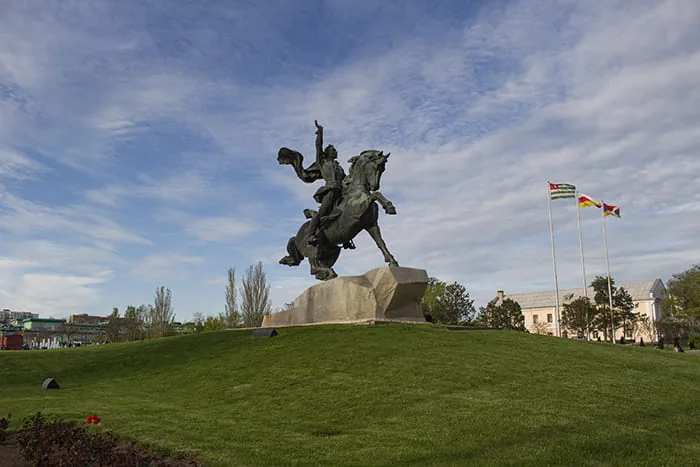
In the center of Tiraspol, Suvorov Square functions as a massive, open-air stage for a country that officially does not exist. This vast expanse of concrete and granite is the heart of Transnistria, a breakaway strip of land between the Dniester River and the Ukrainian border. The square is dominated by a towering equestrian statue of Alexander Suvorov, the Russian general who founded the city in 1792. It is a place of rigorous order and immense scale, where the aesthetics of the Soviet Union have been preserved in a state of pristine, defiant perfection. The square is not just a civic space but a political statement, a meticulously maintained relic of a bygone empire that remains very much alive in this corner of the world.
In the center of Tiraspol, Suvorov Square functions as a massive, open-air stage for a country that officially does not exist.
Tiraspol was established
Tiraspol was established as a strategic fortress by Suvorov under the orders of Catherine the Great, following the Russian-Turkish war. The square grew around this military origin, eventually becoming the focal point for the Soviet Moldavian Republic's regional administration. When Transnistria declared independence in 1990, the square became the primary site for the parades and rallies that defined the new state's identity. The equestrian statue, designed by Valentin and Victor Adamov, was erected in 1979 and has since become the most recognizable symbol of the city. Every flag, flowerbed, and monument here is designed to reinforce a connection to Russia and a heritage of military strength, creating a time-capsule effect that is unique in Europe.
Walking across the square, the sheer
Walking across the square, The sheer exposure of the space; it is designed for tanks and massed troops, making the individual pedestrian feel remarkably small. The absolute lack of litter or graffiti, a product of the local administration’s obsession with order. The sound is a combination of the wind whipping across the open concrete and the patriotic music occasionally broadcast from speakers near the government buildings. A weight of history passing the T-34 tank monument, a memorial to the soldiers of the Great Patriotic War. First, the crispness of the Transnistrian flags fluttering against the grey sky, their green-and-red stripes a vivid contrast to the monochromatic granite. The light in the late afternoon stretches the shadow of Suvorov’s horse across the pavement, creating a dramatic, cinematic atmosphere like a scene from a Cold War thriller.
Tiraspol is a ninety-minute journey
Tiraspol is a ninety-minute journey from Chisinau. Most travelers take a 'rutiera' from the Central Bus Station, which involves a border crossing into the Transnistrian territory. Suvorov Square is the central landmark of the city, located on the main October 25th Street. It is impossible to miss, as all major roads lead to this open expanse. Walking from the bus station takes about twenty minutes through the quiet, tree-lined streets of the capital, allowing you to see the transition into the highly polished center.
Most travelers take a 'rutiera' from the Central Bus Station, which involves a border crossing into the Transnistrian territory.
The Experience
You notice the intense pride of the local police and guards, whose uniforms and posture reflect the square's disciplined atmosphere. The grain of the space is hard and unyielding, granite, bronze, and concrete, softened only by the remarkably vibrant rose gardens that line the perimeter. Something like a sense of surrealism when you see the 'I Love Tiraspol' sign positioned just steps away from a battle-hardened tank. You hear the changing of the guard is sharp and rhythmic, echoing off the surrounding administrative blocks. Most visitors spend their time at the Suvorov statue, but the true interest lies in the small chapel nearby, which offers a rare moment of softness in an otherwise martial landscape. The moment you cross the bridge into the park across the river, the square’s intensity suddenly gives way to the gentle flow of the Dniester.
Why It Matters
Suvorov Square is the ideological core of Transnistria. It is where the region’s complex history, Imperial Russian, Soviet, and modern separatist, is physically layered into a single space. It represents the survival of Soviet-era civic planning and remains one of the last places in Europe where that aesthetic is maintained as a living, functioning reality rather than a museum.
Why Visit
Visit this square to experience a geopolitical paradox. It is a masterclass in the use of public space as a tool for state-building and identity. You come here not for traditional beauty, but for the rare chance to step into an alternate history that is still being written on the ground.
✦ Insider Tips
- 1
Carry your passport at all times, as the square is surrounded by government buildings and ID checks are common for foreigners.
- 2
The T-34 tank is a popular photo spot, but be respectful and avoid climbing on it during busy times.
- 3
Exchange some Moldovan Lei for Transnistrian Rubles at the kiosks near the square; the 'plastic coins' are a unique souvenir you can only get here.
- 4
Walk to the nearby riverfront park to see the contrast between the hard square and the relaxed beach life of the locals.
- 5
Photography of the Suvorov statue and the memorials is encouraged, but avoid pointing your camera directly at the security personnel or the entrance of the Presidential Palace.