“The capital’s most famous monument only exists because a 13,000-pound bell proved too heavy for the local church, forcing an architect to build a gate just to hold it up.”
About Triumphal Arch
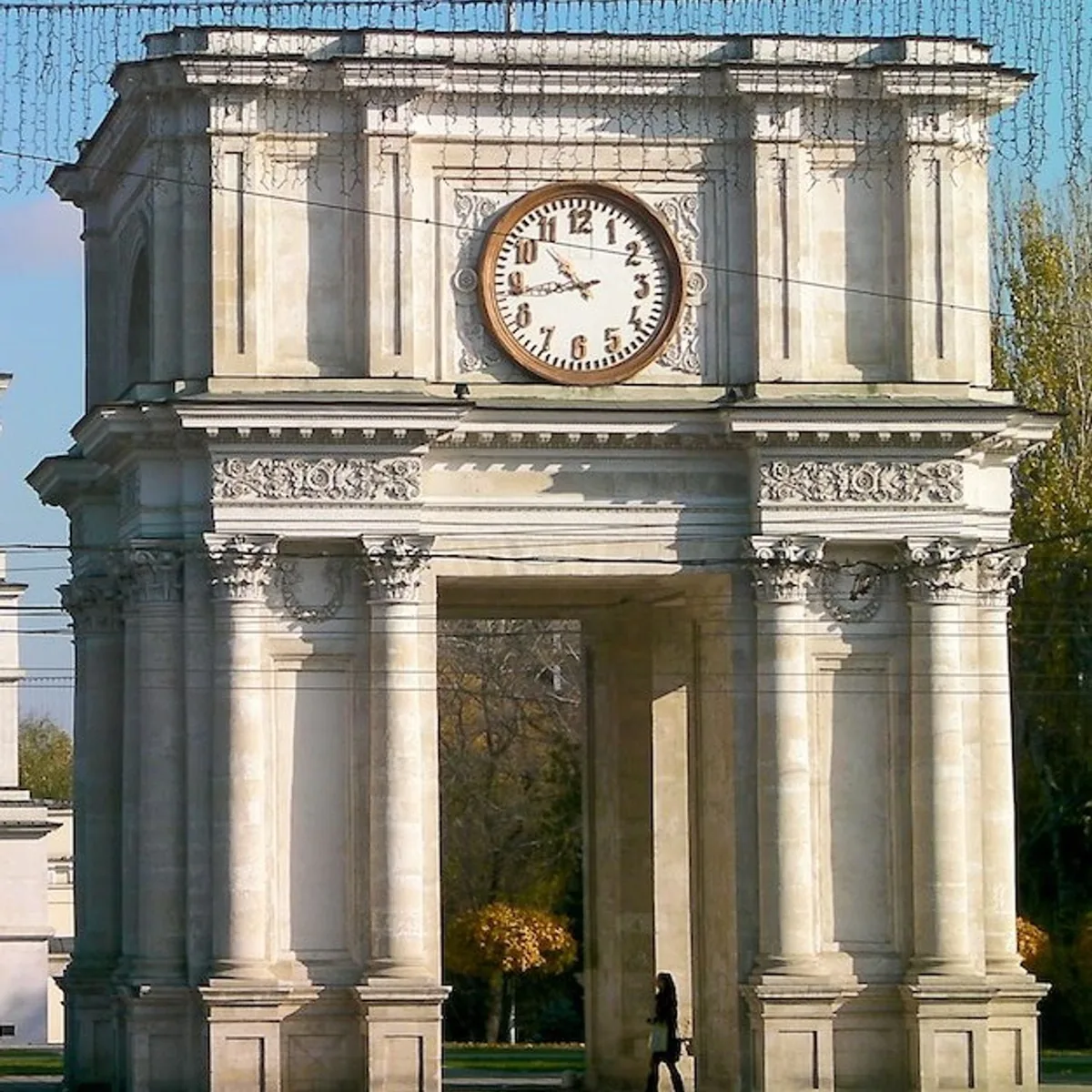
Completed in 1840 to commemorate Russia’s victory over the Turks, the arch was designed by Luca Zauskevich. The stone was hauled from local quarries, and the clock mechanism was originally brought from Austria. During the 1940s, the city suffered immense damage, but the arch remained one of the few central structures to survive relatively unscathed. In the post-Soviet years, it transitioned from a military symbol to a civic one, now marking the symbolic heart of a sovereign Moldova.
What Triumphal Arch actually is
Chisinau's center feels like a deliberate balance between Soviet grandiosity and classical European elegance, with the Triumphal Arch serving as the delicate fulcrum. White stone catches the low Eastern European sun, gleaming against the backdrop of the massive Government House. While smaller than its Parisian cousin, this monument possesses a localized intimacy. It stands alone on the Great National Assembly Square, acting as a gateway that no longer leads to a walled city but instead points the way toward the Nativity Cathedral. It remains the most photographed spot in the capital, a stubborn piece of history that has survived empires and ideologies with its bells still intact.
Chisinau's center feels like a deliberate balance between Soviet grandiosity and classical European elegance, with the Triumphal Arch serving as the delicate fulcrum.
Origins
Victory over the Ottoman Empire prompted the construction of this gate in 1840, but the real story involves a logistical mishap. A massive bell, cast from captured Turkish cannons in Izmail, proved too heavy for the belfry of the nearby Cathedral. Architect Luca Zauskevich proposed building a dedicated structure to house the 6.4-ton giant, resulting in the Corinthian-style arch we see today. Throughout the twentieth century, the arch witnessed the changing of flags and names, standing firm as the city around it was leveled and rebuilt during the Second World War. It was originally called the Holy Gate, a nod to its spiritual alignment with the church, but the secular 'Triumphal' moniker took hold during the Soviet era and remained after independence.
Standing beneath the coffered ceiling,
Standing beneath the coffered ceiling, The vibration of the city’s trolleybuses as they rattle past on Stefan cel Mare Boulevard. The smell of roasted chestnuts or simmering coffee usually wafts from nearby kiosks, mixing with the scent of rain on old limestone. What registers is the rhythmic tolling of the clock, a mechanism that feels charmingly analog in a digital world. High above the archway, the heavy bell remains visible, a silent metal giant that gave the building its purpose. Locals often meet here, leaning against the cool stone pillars while pigeons flutter between the decorative friezes. The evening light is particularly kind to the white stone, turning the monument into a glowing lantern as the square empties of workers and fills with strollers.
Finding the arch is impossible to get wrong
Finding the arch is impossible to get wrong if you are in the city center. It occupies the main artery of Chisinau, Stefan cel Mare Boulevard, directly opposite the Government House. Most travelers arrive on foot while exploring the central park systems. Trolleybuses 1, 4, 5, and 8 stop just a few dozen meters away. If you are staying in the Riscani or Botanica districts, any 'rutiera' headed for the center will drop you within sight of the four-faced clock.
Finding the arch is impossible to get wrong if you are in the city center.
The Experience
There is a weight of the massive stone blocks above you, a sensation of permanence in a city that has seen so much change. The hum of the clock striking the hour provides a steady heartbeat to the otherwise chaotic traffic of the boulevard. First, the fine details of the Corinthian capitals, often ignored by commuters rushing toward the government offices. Most people forget to look up at the intricate floral carvings on the underside of the arch. The space between the pillars serves as a natural wind tunnel, offering a cool breeze on the humid afternoons typical of Moldovan summers.
Why It Matters
The Triumphal Arch is the physical anchor of Moldovan national identity. It aligns perfectly with the Cathedral and the Belfry, creating a symbolic axis of faith and history. It represents a rare architectural bridge between the nineteenth-century Russian Empire and modern-day Moldova, surviving the massive Soviet-era urban redesign of Chisinau.
Why Visit
Visit this arch because it offers a sense of scale and history that anchors the entire city. It is the best starting point for any walk in the capital, providing a clear visual reference that connects the spiritual parkland with the political center. You come here to see the bell that was too big for God but just right for the people.
✦ Insider Tips
- 1
Stand exactly in the center of the arch at noon to hear the heavy resonance of the bell vibrating through the stone.
- 2
Photographers should visit at sunset when the lights of the Cathedral and the Arch balance with the fading blue of the sky.
- 3
The small flower market nearby stays open late, and the scent of lilies often carries over to the monument at night.
- 4
Check the clock face; it is one of the few in the city that still uses a mechanical weight system to keep time.
- 5
Avoid the square during major protests if you want a quiet photo, as this is the primary gathering spot for national demonstrations.