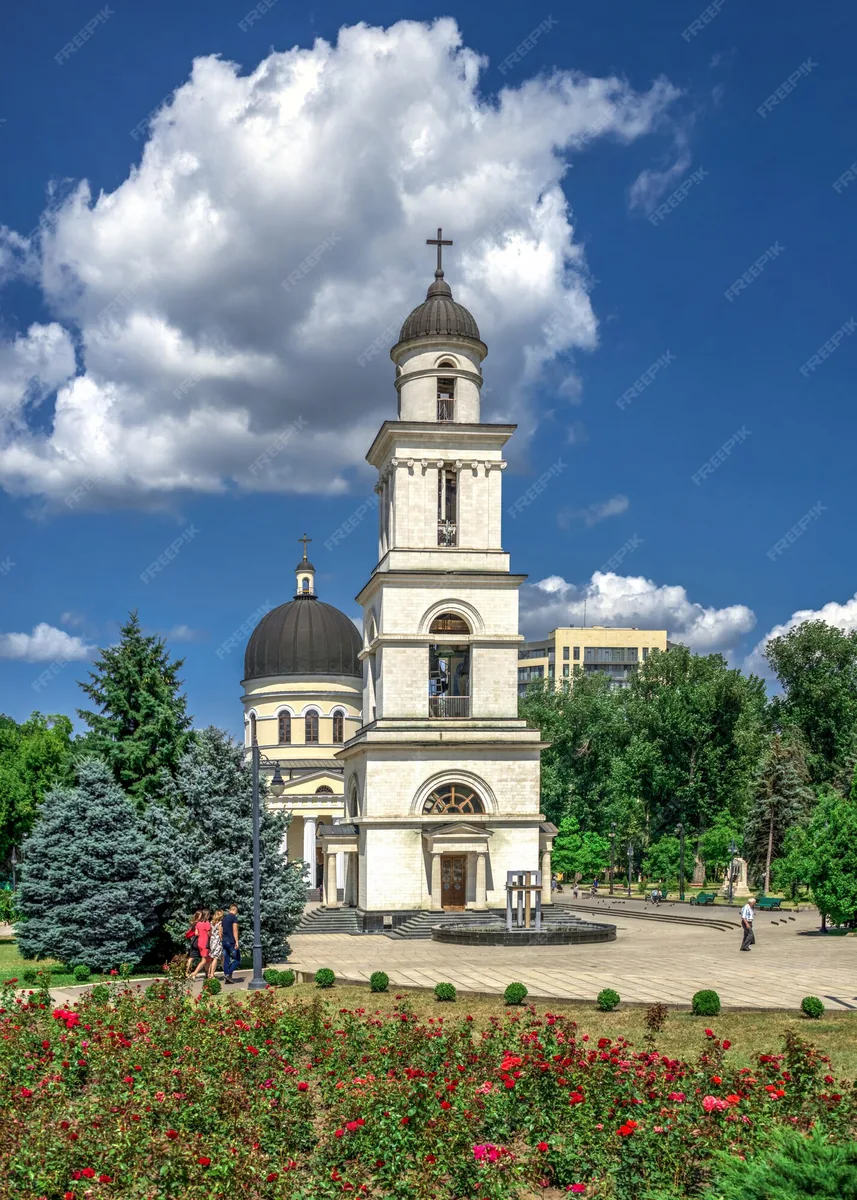
Soviet dynamite once silenced these bells for thirty years, yet today the silver domes gleam as the undisputed heart of a nation that refused to forget its faith.
About Nativity Cathedral
Completed in 1836, the cathedral was part of a larger urban master plan to modernize Chisinau under the Russian Empire. Melnikov utilized a Greek cross plan that emphasized symmetry and light, a stark departure from the smaller, darker wooden churches common in the region at the time. During the Second World War, the building suffered significant damage during the heavy shelling of the city, but it was the post-war ideological shift that nearly erased it. After being converted into a gallery in the 1960s, the church lost its bells and its soul until the 1990s revival. The current bell tower is a meticulous replica, symbolizing the rebirth of Chisinau's architectural identity after the long winter of the 20th century.
What Nativity Cathedral actually is
Yellow walls and silver domes rise with Neoclassical poise from the green heart of Chisinau, creating a sanctuary of incense and icons amidst the city's Soviet-era concrete. The Cathedral of the Nativity of the Lord is the spiritual anchor for Moldova, its presence shaped by resilience after decades of state-enforced secularism. Within, the space the nave is thick and cool, carrying the heavy perfume of beeswax and the metallic tang of silver-clad icons. The walk across polished floors where the flickering light of hundreds of slender candles reflects off gold-leafed frescoes. Overhead, transitions from the low hum of traffic on Stefan cel Mare Boulevard to the ethereal, multi-layered harmonies of an Orthodox choir that seem to vibrate the very air in your lungs.
Prince Mikhail Vorontsov
Prince Mikhail Vorontsov commissioned the architect Avraam Melnikov to design this cathedral in the 1830s, intending to gift the Bessarabian capital a centerpiece of Imperial Russian grandeur. It stood as the city's pride until the brutal night of 1962, when Soviet authorities dynamited the bell tower under the cover of darkness. For the next thirty years, the cathedral was stripped of its religious purpose and repurposed as a public exhibition hall, its frescoes whitewashed and its bells silenced. Along the collapse of the Soviet Union, a fervent restoration project began, leading to the reconstruction of the bell tower in 1997. Today, the building has been reclaimed by the faithful, its interior once again a riot of Byzantine-style color and Orthodox tradition.
Standing beneath the central dome,
Standing beneath the central dome, The physical weight of the silence as a gray-bearded priest swings a censer, sending plumes of blue smoke into the shafts of afternoon light. The first thing you register is the deep, weathered lines on the faces of the elderly women in floral headscarves who move from icon to icon with practiced devotion. Audible here of a metal snuffer dousing a candle provides a sharp, percussive punctuation to the whispered prayers of the congregation. Something of the coolness of the stone walls against the warmth of the humid Moldovan summer outside. First, the intricate detail of the new iconostasis, where the gold leaf appears almost liquid under the soft glow of the chandeliers. The most resonant moment occurs when the heavy bronze bells begin to toll, their deep vibration felt more in the chest than heard in the ears. The cathedral occupies the center of Great National Assembly Square Park, directly across the street from the Government House and the Triumphal Arch. It is easily accessible on foot from any central hotel or via any trolleybus that runs along Stefan cel Mare Boulevard. Entry is free, though visitors should arrive before or after the mid-morning liturgy to explore the interior without interrupting services. The park surrounding the cathedral is a favorite spot for locals to share a coffee or play chess, providing a gentle transition from the spiritual intensity of the church to the daily rhythm of the capital city.
The Experience
The atmosphere inside the cathedral is one of timeless, candle-lit gravity. The first thing you register is the smell of ancient wood and burning tallow, a scent that seems to have soaked into the very mortar of the walls. The collective focus of the worshippers, a silent energy that makes the vast space feel intimate. The light enters through high windows in dusty beams, illuminating the swirling incense smoke like ghostly pillars. Right away, the way people kiss the icons with a tenderness that suggests a deep, personal relationship with the divine. The most striking detail is the contrast between the rigid, classical exterior and the exuberant, golden warmth of the interior. It is a place that feels simultaneously like a museum of art and a living, breathing lung of the city.
Why It Matters
The Nativity Cathedral is the metropolitan cathedral of the Moldovan Orthodox Church and a masterpiece of Neoclassical architecture. It serves as a potent symbol of Moldovan national survival and the restoration of cultural heritage following the Soviet era. Historically, it marks the 19th-century transformation of Chisinau from a provincial town into a major regional capital.
Why Visit
The pull is that you need to witness the persistence of tradition. While other European cathedrals can feel like chilly monuments to the past, the Nativity Cathedral is vibrantly, almost aggressively alive. You come here for the Melnikov architecture, but you stay for the atmosphere of genuine devotion that turns a beautiful building into a sacred space. It is the only place in Chisinau where the 1830s and the 2020s exist in perfect harmony.
✦ Photo Gallery
Best Season
🌤 Easter is the most profound time to visit, as the cathedral is packed with thousands of people holding candles during the midnight service, creating a sea of flickering light.
Quick Facts
Best time to visit
Easter is the most profound time to visit, as the cathedral is packed with thousands of people holding candles during the midnight service, creating a sea of flickering light.
Getting there
In Chisinau, Moldova; reach Chisinau first, then continue to the site.
What's nearby
Triumphal Arch, Water Tower and Cricova Winery are also in the area.
Location
Chisinau, Moldova
Type
attraction
Coordinates
47.0261°, 28.8345°
Insider Tips
- 1
Women should bring a light scarf to cover their heads out of respect, and men should ensure they are wearing long trousers rather than shorts.
- 2
The best time for photography is during the golden hour when the sun hits the yellow facade, though photography inside is generally discouraged during services.
- 3
Look for the small shop inside the cathedral gate that sells handmade honey and church-made wine, which are often better than the commercial versions.
- 4
Stay for the evening service to hear the choir; the acoustics of the central dome are world-class and designed for unamplified voices.
- 5
The benches in the park behind the cathedral are where the city's best chess players congregate; it's the most authentic place to people-watch in Chisinau.