“This white stone monolith was finished in 1990, just as the Soviet Union collapsed, standing as a final, bold statement of high culture in the northern plains.”
About Vasile Alecsandri Theatre
The Vasile Alecsandri Theatre was part of a larger plan to modernize the urban fabric of Bălți. Its design was controversial at the time for its rejection of traditional neoclassical forms in favor of an abstract, sculptural look. The building’s completion was a major triumph for the local artistic community, providing them with one of the most technologically advanced stages in Eastern Europe. Since its inauguration, the theatre has maintained a repertoire that focuses on the national identity, becoming a crucial institution for the preservation of the Romanian language in the region. It has hosted international festivals that have brought performers from as far as France and Japan to the Bălți stage.
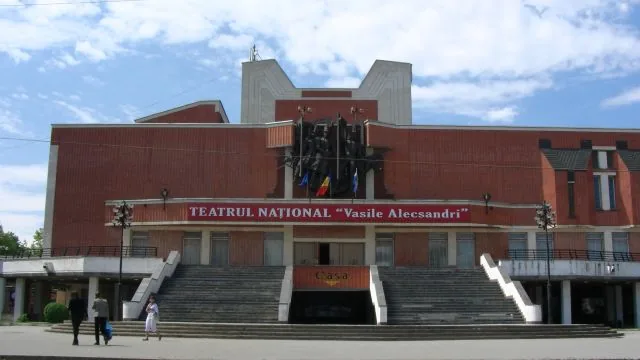
The Vasile Alecsandri National Theatre in Bălți
The Vasile Alecsandri National Theatre in Bălți is a striking architectural anomaly, a postmodernist temple dedicated to the performing arts. Its facade, a dramatic composition of stark white stone and sharp angles, suggests a structure that was carved rather than built. Named after the legendary Moldovan poet and playwright, the theatre is the cultural heartbeat of the north. The building manages to feel both futuristic and deeply rooted in local tradition, using the famous white limestone of the region to create a landmark that is impossible to ignore. Inside, the red velvet seats and warm wood accents provide a classic contrast to the cold, modern exterior. It is a place of high drama, even before the curtain rises.
The Vasile Alecsandri National Theatre in Bălți is a striking architectural anomaly, a postmodernist temple dedicated to the performing arts.
Soviet period, completed, 1990
While the theatre company itself dates back to 1957, the current building is a product of the late Soviet period, completed in 1990 just as Moldova was gaining its independence. It was one of the last great cultural projects of the era, designed by Janina Galperina with a bold, expressive style that departed from the rigid socialist realism of previous decades. The theatre was established to promote the Romanian language and Moldovan culture in a city that was historically very diverse. Over the decades, it has staged everything from classical Shakespearean tragedies to modern experimental works by local writers. The building has become a symbol of Bălți’s intellectual life, surviving the economic hardships of the 1990s to remain a premier destination for actors and directors from across the Balkans.
On site
Walking up the wide stone stairs toward the entrance, The monumental scale of the architecture. Pay attention to the way the sharp edges of the building create deep, dramatic shadows against the white walls, a visual effect that changes constantly throughout the day. The lobby is a busy mix of excited chatter and the clink of glasses from the cafe during intermission. Inside the auditorium, The smell of fresh floor wax and the faint, dry scent of stage makeup. The plush texture of the velvet seats, which absorb the sound and create a focused, intimate environment for the performance. Most visitors are surprised by the height of the stage and the complexity of the lighting rigs, which allow for world-class productions. The moment the lights dim and the massive curtain pulls back, There is a collective hush fall over the crowd, a shared breath that connects the audience to the performers in the dark.
The theatre is located on Vasile
The theatre is located on Vasile Alecsandri Square in the center of Bălți. It is a central point for the city’s public transport, with almost all trolleybus lines passing nearby. If you are arriving in Bălți by bus, it is a ten-minute walk from the central station. The square itself is a popular meeting spot, surrounded by fountains and benches, making it the perfect place to people-watch before a show. Tickets can be purchased at the box office on the ground floor, which is open daily.
The theatre is located on Vasile Alecsandri Square in the center of Bălți.
The Experience
You notice the crispness of the acoustics as soon as you enter the main hall; even a whisper on stage can be heard in the back row. The light in the foyer is bright and airy, filtered through large glass panels that offer a view of the busy square outside. There is a sense of ceremony when the bell rings to signal the start of the performance. What most skip is the intricate plasterwork on the interior walls, which features abstract patterns inspired by traditional Moldovan weaving. The surface of the lobby’s marble floor is smooth and polished, reflecting the ceiling lights like a still pond. The moment the actors take their bows and the house lights come up, the transition back to the modern city feels abrupt and startling.
Why It Matters
The Vasile Alecsandri Theatre is the premier cultural institution of northern Moldova. Architecturally, it is a rare and successful example of late-20th-century postmodernism in the region. Culturally, it is the primary defender of the Romanian theatrical tradition in Bălți, acting as a bridge between the historical literary past and the modern artistic future.
Why Visit
Visit this theatre to see where the soul of Bălți expresses itself. Even if you don't speak the language, the sheer visual power of the building and the intensity of the local performances are worth the trip. It is a chance to see a world-class architectural landmark that most international travelers never even hear about.
✦ Insider Tips
- 1
Check the schedule for 'International Theatre Day' in March, when the theatre often hosts special behind-the-scenes tours.
- 2
The onsite cafe is a great place to meet local artists and students after a performance.
- 3
Even if you don't see a show, walk around the building at night when the lighting highlights its sharp, geometric silhouette.
- 4
Buy tickets a day or two in advance for weekend shows, as the theatre remains a very popular local pastime.
- 5
Look for the commemorative statue of Vasile Alecsandri nearby, which is a common spot for locals to leave flowers.