A single night of fire destroyed a city, but it left behind a blank canvas for a group of dreamers who rebuilt an entire town in a riot of stone-carved flowers and dragons.
About Art Nouveau Center
The 1904 fire was the defining event in Ålesund’s history, but the subsequent reconstruction was a masterclass in urban planning. Over 350 buildings were constructed between 1904 and 1907, a speed that would be impossible by modern standards. The architects were given a rare opportunity to create a unified aesthetic, blending the flowing lines of Parisian Art Nouveau with the sturdy, mythic imagery of the North. The Jugendstilsenteret was established in 2003 to protect the Swan Pharmacy and serve as a national center for the style. It preserves the original laboratory and sales room of the pharmacy, which were in use for nearly a century before becoming a museum.
What Art Nouveau Center actually is
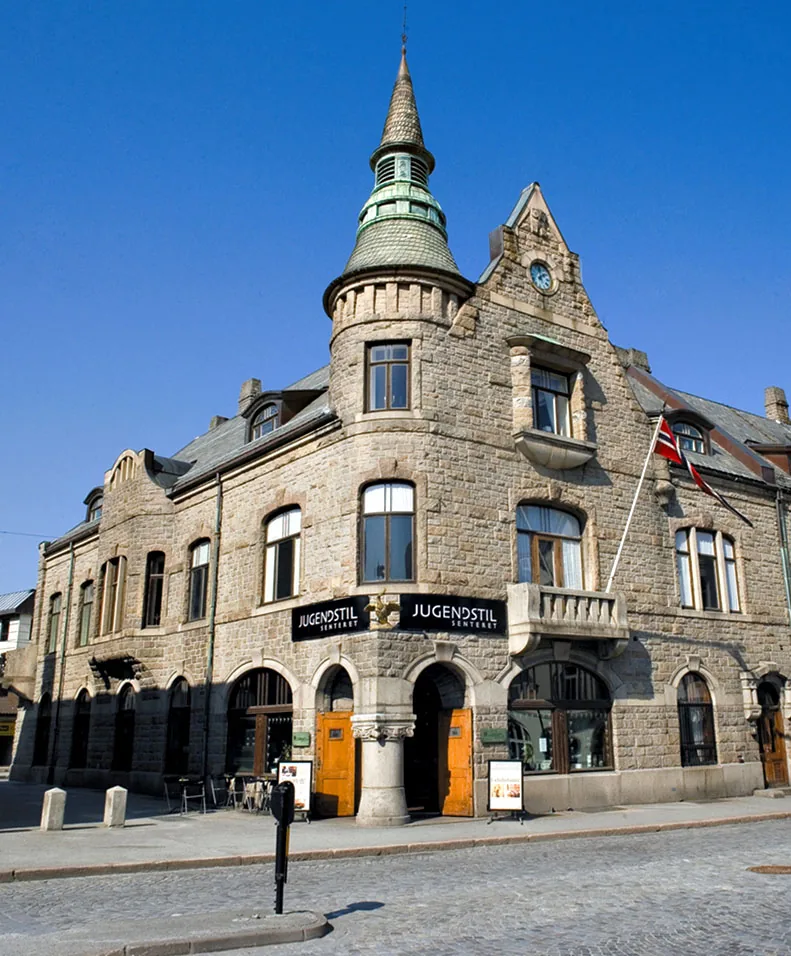
Pastel facades adorned with stone owls, floral motifs, and Viking-inspired towers line the streets of Ålesund, a city that looks as though it was built from the sketches of a dreamer. At the center of this architectural marvel sits the Jugendstilsenteret, the National Art Nouveau Center. Housed in the old 'Swan Pharmacy,' the building is a preserved jewel of the style that swept across Europe at the turn of the 20th century. While most of Norway's coastal towns are defined by simple wooden structures, this city is a stone-carved fantasy of curves and organic shapes. The center is a time capsule, exploring how a tragic fire led to the creation of one of the world's most cohesive and beautiful urban landscapes.
A catastrophic fire on a stormy
A catastrophic fire on a stormy night in January 1904 leveled the wooden city of Ålesund in less than 24 hours, leaving 10,000 people homeless. The response was a massive, international effort supported by Kaiser Wilhelm II of Germany. Over the next three years, a team of young, visionary Norwegian architects rebuilt the town from scratch using brick and stone to prevent another disaster. They were heavily influenced by the Jugendstil (Art Nouveau) movement, but they added a distinctively Norwegian twist, incorporating dragons and medieval motifs from the Viking Age. The Swan Pharmacy building, completed in 1907, was designed by Hagbarth Schytte-Berg and remains the most authentic representation of this era, featuring original interiors that were miraculously preserved.
Stepping into the old pharmacy , the shift from the breezy, salt-crusted harbor to an interior of dark, polished mahogany and etched glass. Inside, the space is still and carries the faint, nostalgic scent of beeswax and old paper. What registers is the 'Time Machine' exhibit, a multi-media experience that uses light and sound to recreate the terrifying night of the 1904 fire and the rapid rebirth that followed. First, the intricate door handles and the stained-glass windows that filter the coastal light into soft greens and ambers. The spiral staircases and curved walls make the building feel like it grew from the ground rather than being constructed. A meticulous craftsmanship in the hand-painted ceiling beams and the custom-made cabinetry. The upper floors house rotating galleries that connect the Art Nouveau movement to modern design, showing how the obsession with nature still influences Norwegian aesthetic today.
Location and access
The center is located in central Ålesund, overlooking the Brosundet canal. It is an easy walk from the cruise terminal or the city's bus hub. Ålesund itself is served by its own airport (Vigra), with frequent connections to Oslo and Amsterdam. Most people find that the best way to arrive is on foot, winding through the pedestrian streets to fully appreciate the gargoyles and towers that lead to the museum's ornate entrance.
The Experience
The light in the pharmacy's sales room is dim and golden, making the brass fixtures and glass jars glow with a quiet, antique energy. The thing that hits is how every detail, from the window latches to the floor tiles, follows the same organic, flowing logic. A sense of relief when you step into the 'Time Machine' and witness the city rising from the ashes, born from human resilience. What gets your attention is the stone owls perched on the exterior corners of the building, guarding the entrance with a whimsical authority. The element that lingers is looking out from the upper windows at the surrounding city, realizing that you are inside the heart of a giant, living work of art.
Why It Matters
Ålesund is one of the few places in the world where the Art Nouveau style was applied to an entire city center. The center is culturally significant as it preserves the history of the 1904 fire and the unique 'National Romantic' variation of the movement. It serves as an educational hub for architecture and design, connecting Norway’s heritage to the broader European art scene.
Why Visit
Check out this center because it is the key to understanding the city's strange beauty. Without the context of the fire and the reconstruction, Ålesund is just a pretty town; with it, the city becomes a miraculous story of survival and artistic ambition. It is a rare chance to see Art Nouveau in its original, functional setting rather than a sterile gallery.
✦ Photo Gallery
Best Season
🌤 May is the best time, as the spring flowers in the city's gardens mirror the floral motifs carved into the stone facades.
Quick Facts
Best time to visit
May is the best time, as the spring flowers in the city's gardens mirror the floral motifs carved into the stone facades.
Getting there
In Ålesund, Norway; reach Ålesund first, then continue to the site.
Location
Ålesund, Norway
Type
attraction
Insider Tips
- 1
The 'Swan Pharmacy' still has its original, 1907 interior; spend time looking at the intricate wood carvings behind the main counter.
- 2
Your ticket often includes entry to the KUBE Art Museum across the street, which focuses on contemporary regional art.
- 3
Ask the staff about the 'Dragestil' details, the Viking dragon motifs, as they are a unique Norwegian addition to the Art Nouveau style.
- 4
The museum cafe has a lovely view of the canal; it’s a perfect spot to sit and sketch the buildings across the water.
- 5
Take a guided walking tour starting from the center to learn the specific stories of the families who rebuilt the street you are standing on.