“Sixty-two wooden houses lean into each other for support, surviving eight centuries of fires and the relentless Norwegian rain to guard the secrets of the North Sea's cod trade.”
About Bryggen
The foundations of Bryggen date back to the 11th century, but its era of power began in 1360 when the Hanseatic League established an 'Office' here. These German merchants held a monopoly on the fish trade, bringing grain from the Baltic in exchange for Norwegian stockfish. The community was a world apart, with its own laws and social structures. Following the great fire of 1702, the district was meticulously reconstructed according to the old patterns. By the 1900s, many wanted to tear down the 'dilapidated' wood, but a fire in 1955 revealed ancient archaeological layers that proved the site’s immense historical value, leading to its permanent preservation.
What Bryggen in Norway is
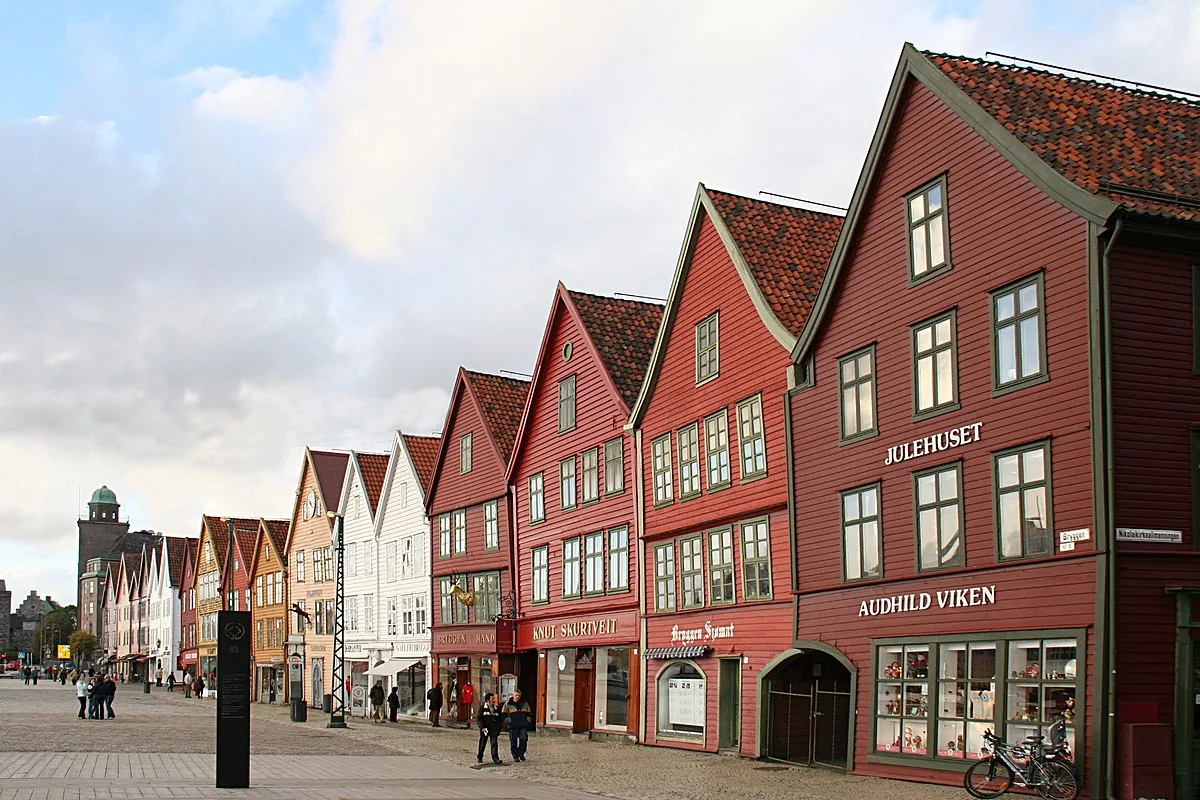
Leaning against one another like tired old sailors, the colorful wooden warehouses of Bryggen are the skeletal remains of Bergen's merchant past. These sixty-two buildings, with their pointed gables and vibrant ochre, red, and white facades, have stood on the Vagnen harbor for centuries, surviving fires, decay, and the pressures of modern development. To walk past them is one thing, but to step into the narrow, dark alleys between them is to enter an array of warped timber and history. The ground here is uneven, the wood is soft from the perpetual Bergen rain, and the entire structure seems to groan under the weight of its own stories. It is the last remnant of a time when dried cod was more valuable than gold.
Leaning against one another like tired old sailors, the colorful wooden warehouses of Bryggen are the skeletal remains of Bergen's merchant past.
History
The Hanseatic League, a powerful guild of German merchants, took control of Bryggen in the 14th century, turning Bergen into a dominant hub for the North Sea trade. They didn't just build warehouses; they established a monastic-like community of men who lived by strict rules, forbade marriage, and spent their days grading mountains of stockfish from the north. Fire was the constant enemy; the wooden city burned to the ground repeatedly, most notably in 1702. Each time, the merchants rebuilt on the same foundations, using the same medieval layout. Even after the Hanseatic influence faded in the 18th century, the buildings remained, eventually becoming a symbol of Bergen’s resilience and earning a place on the very first UNESCO World Heritage list in 1979.
Stepping off the modern pavement of the harbor into the alleys of Bryggen feels like the volume of the city has been suddenly turned down. The interior smells of old tar, damp sawdust, and a hint of salt. The gravity of the springy, slightly unstable sensation of the wooden boardwalks beneath your feet. The light in these passages is dim, filtered through the high, overlapping roofs, creating an atmosphere of secrecy. What gets your attention is the large wooden pulleys still hanging from the gables, used for centuries to hoist heavy sacks of grain and fish. Occasionally, you’ll find a small artist’s studio or a boutique tucked into a crooked corner, where the warmth of a modern lamp glows against the centuries-old beams. The back of the complex opens up into a small courtyard where the scale of the timber construction becomes overwhelming.
Bryggen is the undeniable center
Bryggen is the undeniable center of Bergen, located just a few minutes’ walk from the famous Fish Market. It is easily reached on foot from anywhere in the city center. If you are arriving from the airport, the Light Rail (Bybanen) drops you at Byparken, leaving you with a scenic ten-minute stroll along the harbor toward the iconic row of gabled houses.
Bryggen is the undeniable center of Bergen, located just a few minutes’ walk from the famous Fish Market.
The Experience
The noise of your own footsteps on the wooden slats echoes in the narrow galleries, a hollow, rhythmic beat. What hits is how the walls aren't quite vertical; years of settling into the soft harbor soil have given the buildings a whimsical, drunken tilt. The smell of the wood, dry in the summer and deep, earthy in the winter, is the defining sensory memory of the place. Beginning with the intricate carvings on the doorways, often featuring cod or merchant crests, worn smooth by millions of passing hands. What lingers with you is looking up from the narrowest alley and seeing just a sliver of the grey Bergen sky, realizing how effectively these walls once shut out the rest of the world.
Why It Matters
Bryggen is the only surviving example of a Hanseatic 'Kontor' (trading post) in the world. It is a physical record of the trade networks that built Northern Europe and a reflection of the durability of traditional wooden architecture. Beyond trade, it represents the cultural exchange between Scandinavia and the Germanic world that shaped Bergen's unique dialect and character.
Why Visit
Visit Bryggen because it is a living ruin. Unlike many heritage sites that feel sterile, this is a place where you can feel the floorboards move and smell the history of the timber. It is the perfect antidote to the glass-and-steel architecture of modern cities, offering a visceral connection to the medieval maritime world.
✦ Insider Tips
- 1
Go behind the front row of famous houses; the most atmospheric and quietest parts of Bryggen are the deeper courtyards and secondary alleys.
- 2
Visit the Hanseatic Museum at the end of the row to see how the young apprentices actually lived in their tiny, windowless sleeping bunks.
- 3
Look for the stone building at the back called Schøtstuene; it was the only place merchants were allowed to have a fire for cooking and warmth.
- 4
The wooden boardwalks can be incredibly slippery when wet; wear shoes with good grip even if you aren't hiking.
- 5
Have a coffee at 'Kafé Spesial' nearby to watch the local life pass by the harbor while admiring the gables from a distance.