“One thousand years of darkness in the blue clay of the Oslofjord preserved three oak masterpieces that prove the Vikings were as much artists as they were conquerors.”
About Bygdøy Viking Ship Museum
The excavation of the Oseberg ship in 1904 was a sensation that galvanized Norwegian national pride just as the country was seeking independence. It took experts nearly twenty years to dry the waterlogged wood and reassemble the thousands of fragments like a giant jigsaw puzzle. The ships were found with an incredible array of burial goods, including a fully carved chariot and fine textiles, providing a total view of Viking life and death. The current architectural expansion was triggered by the discovery that the ships were slowly collapsing under their own weight, requiring a new, state-of-the-art facility to suspend them in a stable environment.
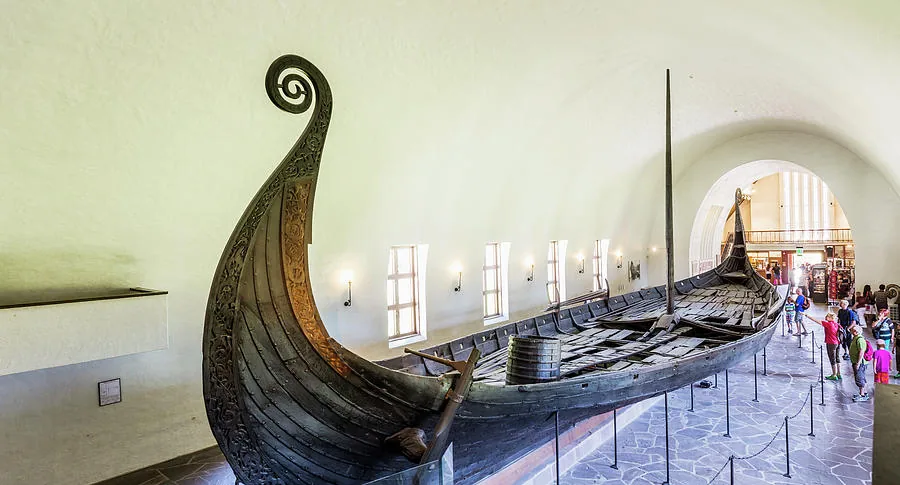
Bygdøy Viking Ship Museum in Norway
Three skeletal oak giants, once the pride of the Norse seas, now rest within the white, vaulted halls of the Viking Ship Museum on the Bygdøy peninsula. These vessels, the Oseberg, Gokstad, and Tune, are the best-preserved Viking ships in the world, having spent a millennium buried in the oxygen-free blue clay of the Oslofjord. The museum is a cathedral of maritime history, where the sweeping curves of the hulls reveal the sophisticated engineering that allowed the Vikings to reach the shores of North America and Byzantium. It is a somber, silent space where the smell of ancient wood and tar lingers in the air, connecting modern visitors to the warriors and queens who once walked these decks.
Three skeletal oak giants, once the pride of the Norse seas, now rest within the white, vaulted halls of the Viking Ship Museum on the Bygdøy peninsula.
The ships were not lost
The ships were not lost at sea; they were intentionally buried as part of elaborate funeral rites for the Viking elite. The Oseberg ship, discovered in 1904, was a royal burial chamber for two women of high status, filled with wagons, sledges, and intricate wood carvings. The museum building itself was designed by Arnstein Arneberg and built in stages between 1926 and 1957, with the cross-shaped hall specifically tailored to display the ships’ elegant lines. Currently, the site is undergoing a massive transformation into the new Museum of the Viking Age, a project designed to better preserve these fragile treasures for the next thousand years. These ships were once the high-tech vehicles of their age, representing the peak of Norse power and artistic expression.
Visiting Bygdøy Viking Ship Museum
Walking into the main hall, the temperature drop and the light soften, focusing all attention on the blackened oak of the Oseberg ship. The place is thick with a dry, dusty scent mixed with the ghost of the pine tar that once kept these planks watertight. You register the incredible detail of the 'clinker' construction, where overlapping planks are held together by iron rivets, giving the hulls a flexible, snake-like strength. The carvings on the prow of the Oseberg, intertwined animals and mythic creatures that seem to pulse with a dark energy. The sound in the gallery is a hushed, reverent murmur, as if the visitors are afraid of waking the history. The scale of the ships; they are smaller than you imagine for such legendary voyages, yet their lines are so perfect they seem almost modern. The 'Viking Alive' film projected onto the vaulted ceiling occasionally fills the room with the sounds of crashing waves and Viking chants, bringing the silent hulls back to life. The museum is located on the Bygdøy peninsula, a short ferry ride from the Oslo City Hall pier (Rådhusbrygga) or a twenty-minute trip on the number 30 bus. The ferry is the most atmospheric way to arrive, mirroring the approach the Vikings themselves would have taken to the harbor. Please note that as of 2026, the museum is in a period of transition and expansion, so check for specific accessibility and preview gallery hours.
The Experience
The shadows cast by the ships' prows against the white walls are as dramatic as the vessels themselves. The first thing you register is the rhythmic pattern of the iron rivets, each one a tiny point of strength that once held the North Atlantic at bay. A sense of awe standing beneath the Gokstad ship, realizing its size and the power it must have had when forty oarsmen were pulling in unison. The cracks and the warped texture of the wood, a reminder that these are organic objects that have survived against all odds. The most moving moment is seeing the smaller personal items, the combs, the shoes, the kitchen tools, that turn the mythic Vikings into real, vulnerable people.
The shadows cast by the ships' prows against the white walls are as dramatic as the vessels themselves.
Why It Matters
The Bygdøy ships are the most important archaeological finds from the Viking Age. They are culturally significant as the primary evidence for the shipbuilding techniques that changed the course of European history. Beyond the ships, the museum houses the world's most extensive collection of Viking-era tools and art, making it the global center for Norse research.
Why Visit
See this museum to see the real thing. While there are many replicas and CGI recreations of Viking life, nothing compares to the physical presence of these ancient hulls. In their shadow gives you an immediate, visceral understanding of the bravery and skill it took to sail into the unknown in a wooden boat.
✦ Insider Tips
- 1
Check the status of the 'Museum of the Viking Age' expansion before you go; parts of the collection may be moved or temporarily closed for the new building's completion.
- 2
The ferry from City Hall pier is much more scenic than the bus and drops you just a short walk from the museum's door.
- 3
Look for the 'Oseberg Cart' in the side wing; the level of detail in the wood carving is unlike anything else from that period in Europe.
- 4
Visit the nearby Kon-Tiki and Fram museums while on Bygdøy to see the full arc of Norwegian maritime exploration from the Vikings to the Arctic explorers.
- 5
Bring your own headphones for the museum's digital guide to hear the detailed stories behind the two women found in the Oseberg burial.