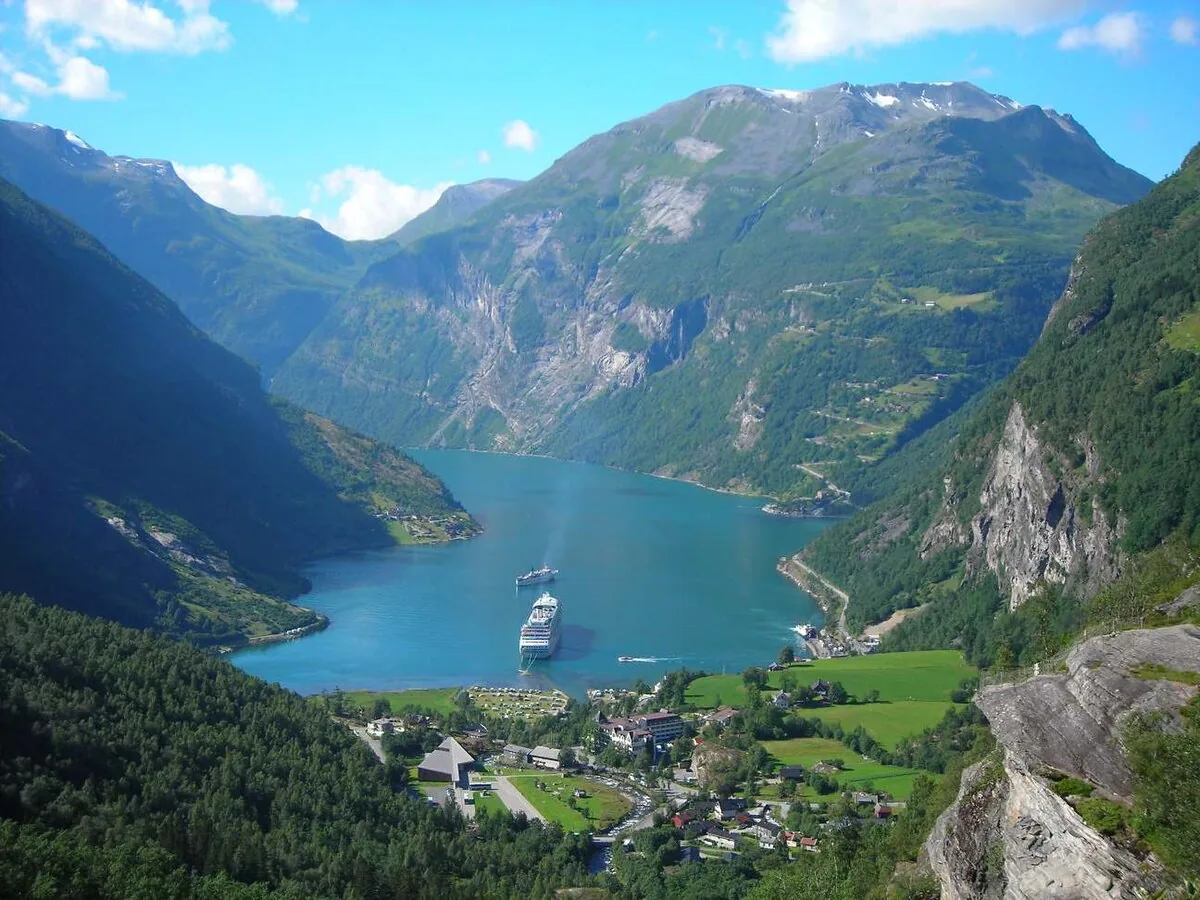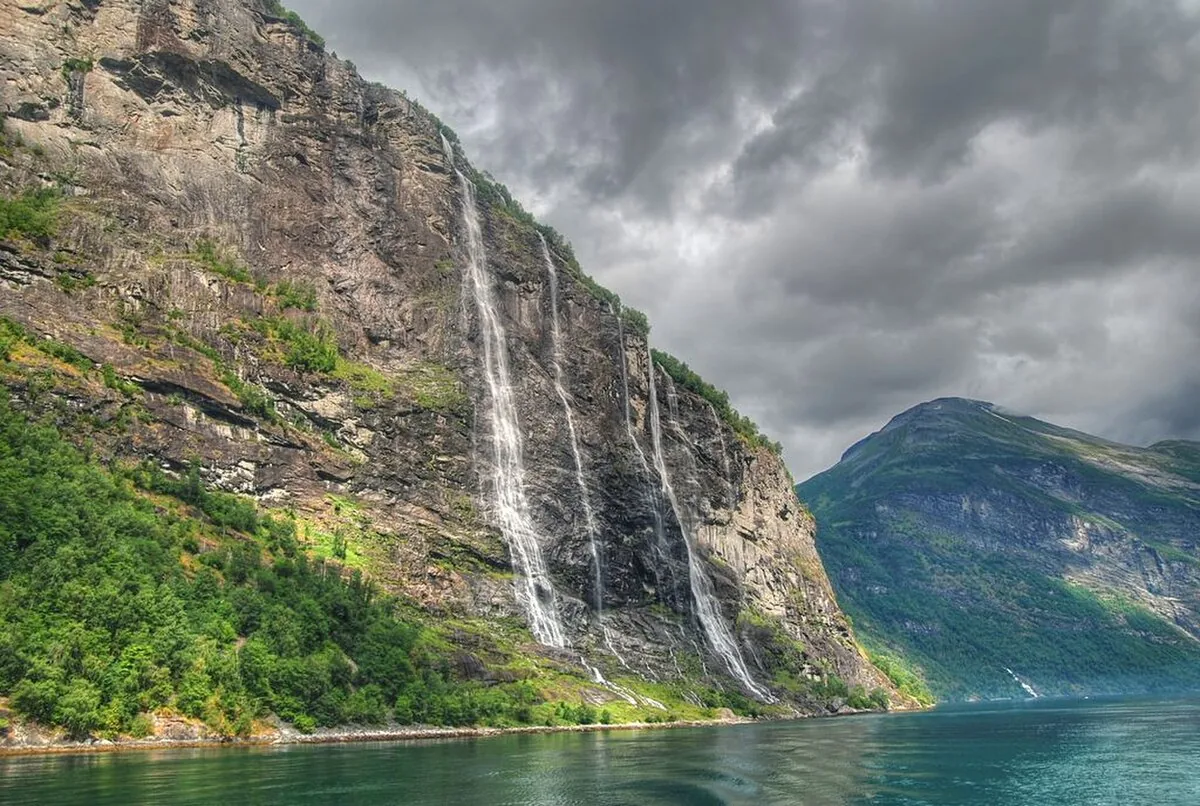
Seven distinct ribbons of water tumble down a sheer granite wall into an emerald abyss, surviving only because the glaciers of the last ice age were relentless enough to carve a path through solid rock.
About Geirangerfjord
The fjord was sculpted by the Quaternary glaciers that once covered the entirety of Northern Europe. As the ice retreated roughly 10,000 years ago, the sea flooded the deep valleys, creating the landscape we see today. Norwegian pioneers settled the steep banks in the Viking Age, surviving on meager grazing land and fish. By the mid-19th century, the first cruise ships arrived, marking the beginning of Geiranger as a destination. The construction of the Geiranger Road in 1889 was considered a masterpiece of engineering, earning a gold medal at the World Exhibition in Paris for its innovative use of stone masonry and hairpin bends.
What Geirangerfjord actually is
Gliding deep into the Sunnmøre region, the Geirangerfjord represents the ultimate victory of ice over stone. This fifteen-kilometer branch of the Storfjord is a narrow, winding alleyway of emerald water hemmed in by cliffs that rise nearly vertically toward the sky. It feels like a cathedral carved by glaciers, where the walls are perpetually weeping with the spray of a dozen waterfalls. The scale here mocks human architecture; the cruise ships that navigate its depths appear like bath toys against the granite monoliths. While other fjords offer breadth, Geiranger offers a claustrophobic, magnificent intimacy that forces you to crane your neck until the clouds feel within reach.
Formed over successive ice ages
Formed over successive ice ages, the fjord was a landscape shaped by the slow, crushing weight of mile-thick glaciers carving out the bedrock. Across centuries, this was a place of extreme isolation where hardy farmers clung to the mountainsides on precarious ledges. These families built the 'Skageflå' and 'Knivsflå' farms, accessible only by ladders that they would pull up when the tax collector came calling. The early 1900s saw the arrival of the first steamships, bringing curious European aristocrats who were eager to witness the Seven Sisters, a series of waterfalls that tumble from a height of 250 meters. The locals responded by building the Eagle Road, a serpentine marvel of eleven hairpin turns that finally connected this watery abyss to the rest of the world.
Standing on the deck of a ferry or a small kayak, the air hits you with a sharp, cold purity that smells of snowmelt and wet moss. The rhythmic thunder of the Suitor waterfall, its white veil crashing into the deep blue surface across from the delicate strands of the Seven Sisters. The light here is elusive, often filtered through a silver mist that clings to the pine trees, creating a monochromatic world of greys and greens. When the sun finally breaks through, the water transforms into a polished mirror of liquid jade. The vibration of the boat’s engine echoing off the cliffs, a low hum that emphasizes the heavy silence of the surrounding wilderness. Looking up, you might spot a lonely, abandoned farmhouse perched on a ridge that seems physically impossible for any human to have inhabited.
Reaching the fjord is a passage
Reaching the fjord is a passage through some of Europe's most dramatic mountain passes. Just about everyone arrive via the town of Ålesund, followed by a three-hour drive that culminates in the descent of the Eagle Road. Alternatively, the ferry from Hellesylt offers the most cinematic entrance, slowly peeling back the layers of the fjord until the village of Geiranger appears at the very end like a tiny, colorful afterthought in a landscape of giants.
The Experience
The mist from the Seven Sisters falls often reaches the water in a fine, cool spray that feels like silk on your skin. What hits is how the shadows of the mountains move rapidly across the water, turning the emerald surface to charcoal in seconds. The silence is profound, interrupted only by the distant, hollow roar of water and the occasional cry of a seagull. Something like a strange sense of vertigo looking upward, as the sky is reduced to a narrow strip of blue between the dark, towering walls. The most haunting moment is seeing the abandoned farms; they look like small scars on the mountain, reminders of a life defined by gravity and grit.
Why It Matters
Geirangerfjord is a UNESCO World Heritage site, recognized as one of the most archetypal fjord landscapes on the planet. Beyond its geology, it represents the human spirit of adaptation, the ability of Norwegian farmers to thrive in a vertical world that seems designed to repel them. It is a living laboratory of glacial geomorphology and a cultural icon of the Nordic wilderness.
Why Visit
Visit Geirangerfjord if you want to feel truly insignificant in the best way possible. While the Sognefjord is longer, Geiranger is more concentrated and dramatic. It offers a sensory saturation of water and rock that resets your perspective on what the natural world is capable of building.
✦ Photo Gallery
Best Season
🌤 June and July are the only months when the 'Seven Sisters' are at their full, snowmelt-fueled power and the high-altitude mountain roads are guaranteed to be open.
Quick Facts
Best time to visit
June and July are the only months when the 'Seven Sisters' are at their full, snowmelt-fueled power and the high-altitude mountain roads are guaranteed to be open.
Getting there
In Geiranger, Norway; reach Geiranger first, then continue to the site.
Location
Geiranger, Norway
Type
attraction
Coordinates
62.1210°, 7.1290°
Insider Tips
- 1
Take the early morning ferry from Hellesylt to avoid the cruise ship crowds and witness the fjord at its most ethereal and misty.
- 2
Hike the trail to Skageflå farm; it’s steep and challenging, but looking down at the cruise ships from the farmers' perspective is a life-changing view.
- 3
The Eagle Road lookout point has a small, cantilevered platform that offers the perfect angle to photograph the fjord's famous 'S' curve.
- 4
Bring a waterproof jacket even on a sunny day; the spray from the Suitor waterfall can soak the deck of the ferry in seconds.
- 5
Look for the 'Fjord Center' in the village to understand the constant threat of rockslides that locals live with every day.