Ten thousand wild reindeer navigate a treeless expanse so vast and silent that the sound of your own heartbeat becomes a rhythmic intrusion against the mountain air.
About Hardangervidda National Park
Prehistoric hunters left behind arrowheads and trapping pits across this plateau nearly 8,000 years ago, proving that humans have always been drawn to this harsh bounty. The area served as a treacherous but necessary bridge between the eastern valleys and the western fjords for medieval pilgrims and merchants. In 1943, the plateau provided the perfect cover for Operation Gunnerside, where saboteurs skied across the wilderness in sub-zero temperatures to destroy the Telemark heavy water plant. This rugged heritage led to the 1981 declaration of the national park, which now protects 3,422 square kilometers of vital Arctic-alpine ecosystem. Today, it remains a living laboratory for biologists studying how flora adapts to extreme northern altitudes.
Overview
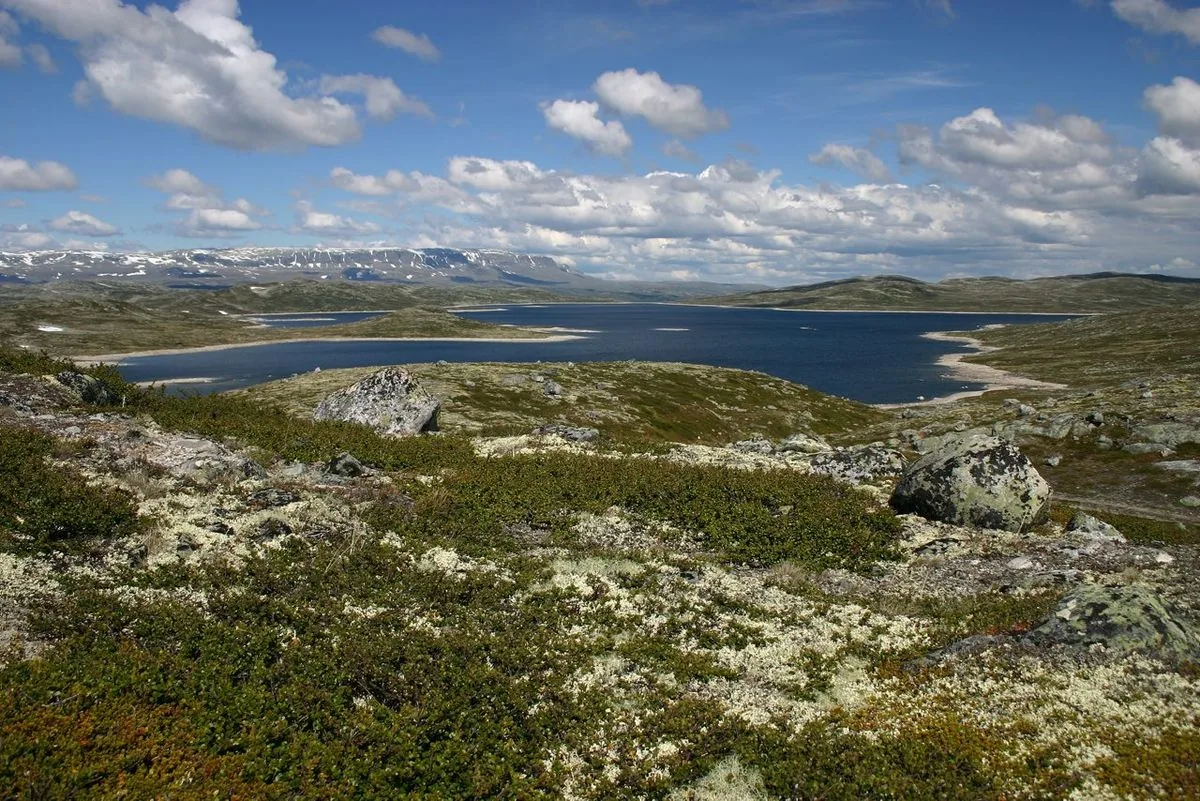
Europe’s largest mountain plateau stretches across the horizon like a frozen ocean of stone and lichen. This high-altitude wilderness sits well above the tree line, where the weather dictates the terms of survival and the landscape feels older than time itself. Unlike the narrow, dramatic fjords that define the Norwegian coast, Hardangervidda offers a sense of infinite space. It remains a sanctuary for the continent’s largest herd of wild reindeer, animals that have roamed these mossy plains since the ice age. Here, the scale of the earth becomes humbling, and the silence is so heavy it rings in your ears.
“Europe’s largest mountain plateau stretches across the horizon like a frozen ocean of stone and lichen.”
Hardangervidda National Park, Norway
Glaciers carved this massive tableland over millions of years, leaving behind a network of thousands of small lakes and rivers that glint like scattered glass. Across centuries, this was a vital thoroughfare for brave traders and hunters who traversed the plateau on foot or skis, following ancient cairns through the fog. During the Second World War, the plateau became a theater of high-stakes sabotage. Norwegian resistance fighters hid in remote stone huts, surviving on reindeer moss and grit as they plotted the famous heavy water raid at Rjukan. These mountains were not just a backdrop but a character in the fight for freedom. Modern protection arrived in 1981, establishing the national park to ensure that the delicate tundra remains untouched by industry or permanent roads.
Standing on the plateau in late August, you
Standing on the plateau in late August, the wind tugging at your layers, smelling of damp earth and crowberries. The ground beneath your feet feels spongy, a thick carpet of sphagnum moss and low-lying shrubs that turn a fiery crimson as autumn approaches. Right away you see how the light changes every few minutes; a passing cloud can turn a sapphire lake into a sheet of polished slate. Sound travels differently here, and you might hear the distant whistle of a golden plover long before seeing it. The absence of vertical lines, which makes the sight of the distant Hårteigen mountain, a flat-topped monolith, feel like a beacon. The evening air brings a sharp, metallic chill that forces you to move toward the warmth of a mountain hut, where the smell of burning peat and dried fish offers a primal comfort. Most people miss the tiny, alpine flowers that hug the rocks, survivors of a climate where the sun never quite warms the soil.
Access points ring the plateau, but the most
Access points ring the plateau, but the most iconic approach is via the Bergensbanen railway. Stepping off the train at Finse, a station with no road access, places you immediately into the wilderness. Alternatively, the Hardangervidda National Tourist Route (Rv7) cuts across the northern edge, offering viewpoints like Vøringsfossen. Local buses run from Geilo or Eidfjord during the summer months, though true immersion requires a multi-day trek on the well-marked DNT trails that spiderweb across the interior.
“Access points ring the plateau, but the most iconic approach is via the Bergensbanen railway.”
The Experience
The light here possesses a clarity that makes distant mountains look close enough to touch. The first thing you register is the way the reindeer moss crunches like dry coral under your boots, a texture that feels alien compared to the soft forests below. The isolation settle in after just a few kilometers of walking, a weightless sensation of being the only human in a thousand-acre view. The erratic weather shifts where a sunny afternoon can dissolve into a white-out fog in less than twenty minutes. The most memorable moment comes at twilight, when the horizon glows with a bruised purple light and the silence becomes absolute, broken only by the trickle of glacial meltwater.
Why It Matters
Hardangervidda represents the last great wilderness of Southern Norway. It is a critical habitat for the wild mountain reindeer, a species that is a living link to the post-glacial era. Culturally, the plateau is woven into the national identity as a place of testing and resilience, a landscape that shaped the Norwegian spirit of 'friluftsliv', the philosophy of outdoor living.
Why Visit
Visit Hardangervidda to escape the vertical claustrophobia of the fjords and experience true horizontal infinity. While most tourists cluster at the edges of the mountains, venturing into the center of the plateau gives you a perspective of the earth as it was before the arrival of modern infrastructure. It is a place for the seeker of solitude.
Insider Tips
- 1
Fill your water bottle directly from the fast-flowing glacial streams; the water is as pure and cold as any bottled source on earth.
- 2
Book a bed in a DNT cabin in advance if you plan to stay overnight, as these historic huts are the only shelter in the interior.
- 3
Pack a pair of high-quality binoculars; spotting the reindeer herds requires patience and a way to scan the distant, rolling ridges.
- 4
Never rely solely on a phone for navigation; the cold drains batteries rapidly and the lack of signal makes a paper map and compass essential.