“Thirteen floors of psychological intensity lean precariously over the Oslofjord, housing the world’s largest collection of a man who painted the sound of a scream.”
About Munch Museum
Munch's bequest was an act of gratitude to the city that often misunderstood him during his life. The collection includes not just his paintings, but his sketches, letters, and personal effects, providing a total view of his creative process. The construction of the new museum was a decade-long saga of political infighting and architectural ambition, eventually costing over 2.7 billion NOK. Its location in Bjørvika symbolizes the 'new Norway', moving away from its shipping and industrial roots toward a future defined by design and high culture. The building itself is designed to be carbon-neutral, utilizing the fjord's water for cooling.
About Munch Museum
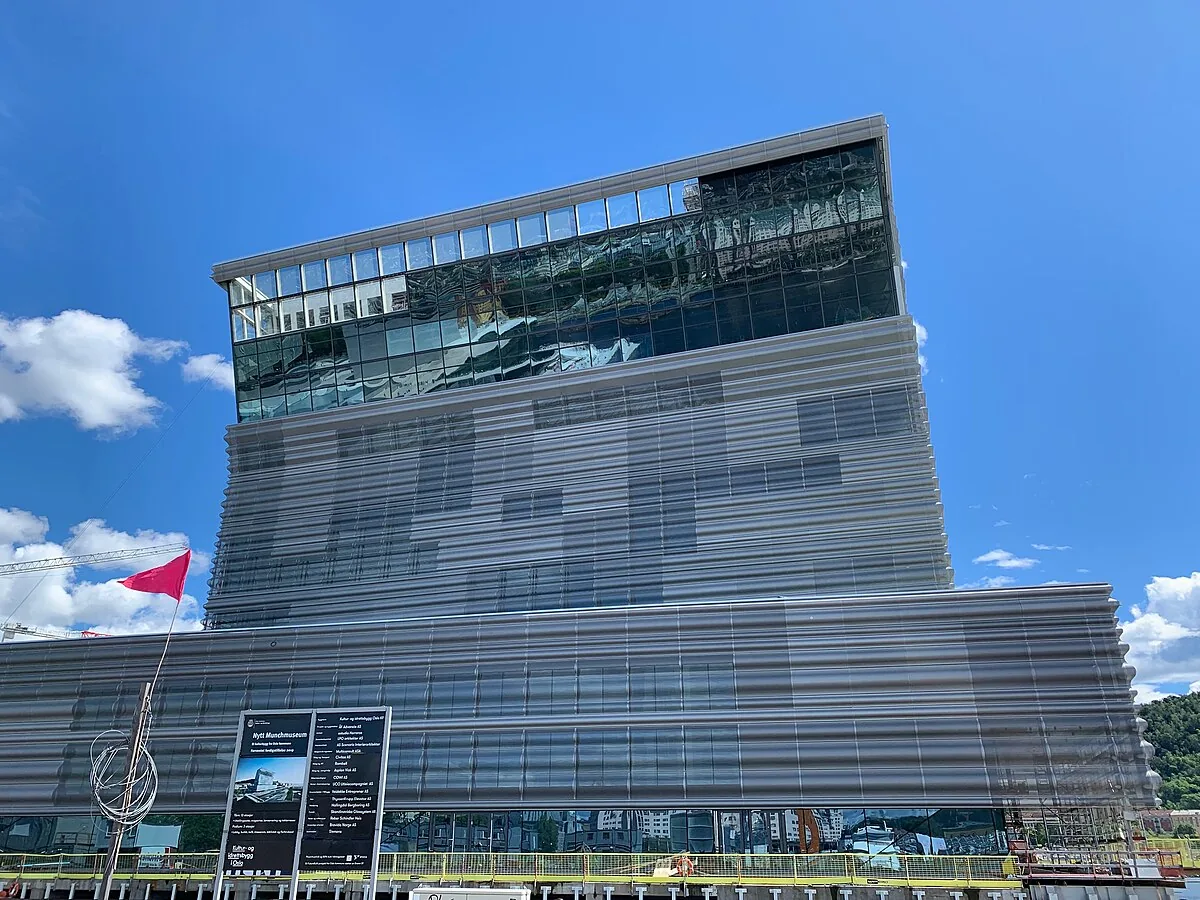
Rising like a stack of tilted silver books on the edge of the Oslofjord, the new MUNCH Museum is a defiant statement of modernism. Designed by the Spanish architectural firm Estudio Herreros, the building’s upper floors lean out over the water as if peering toward the horizon. It is a vertical gallery, a radical departure from the sprawling museum complexes of the past. Inside, thirteen floors are dedicated to the life and psychological landscapes of Edvard Munch, Norway's most famous and troubled artistic son. The perforated aluminum skin of the building shimmers in the coastal light, reflecting the shifting moods of the sky, a fitting shell for an artist who spent his life painting the internal weather of the human soul.
Rising like a stack of tilted silver books on the edge of the Oslofjord, the new MUNCH Museum is a defiant statement of modernism.
Edvard Munch bequeathed his entire collection
Edvard Munch bequeathed his entire collection to the city of Oslo upon his death in 1944, a staggering gift of over 28,000 works. For decades, these were housed in a modest building in the Tøyen district, but as the artist’s global stature grew, the need for a world-class facility became undeniable. The decision to build on the Bjørvika waterfront was controversial, sparking years of debate about the 'kinked' design and the building's height. Opened in 2021, the museum is the foundation of Oslo's Fjord City project, a massive urban renewal effort that has transformed a former industrial port into a cultural hub. It stands just steps away from the Opera House, creating a dialogue between the white marble of music and the grey metal of visual art.
The experience begins with a series of high-speed
The experience begins with a series of high-speed escalators that whisk you through the heart of the building, offering glimpses of the city through the translucent metal skin. The interior is hushed and temperature-controlled, a sterile environment designed to protect delicate canvases and woodcuts. The intensity of the work long before you reach 'The Scream.' The galleries are organized thematically, moving from Munch's early, realistic portraits to the raw, visceral explorations of anxiety, jealousy, and death. First, the texture of the paint, thick, aggressive strokes that seem to still be vibrating with emotion. The top floor offers a stark contrast; a wide, glass-walled observatory where the beauty of the Oslofjord provides a necessary breath of air after the emotional weight of the exhibits.
The museum is a five-minute walk from Oslo
The museum is a five-minute walk from Oslo Central Station (Oslo S), making it perhaps the most accessible major landmark in the country. It is perfectly positioned for those arriving by train or the Airport Express. If you are already in the city center, you can reach it by walking along the harbor promenade, passing the floating saunas and the Opera House on your way to the museum's glass-encased entrance.
The museum is a five-minute walk from Oslo Central Station (Oslo S), making it perhaps the most accessible major landmark in the country.
The Experience
The movement through the vertical galleries feels like a ascent through Munch's own mind. What hits is the silence in the room containing the three versions of 'The Scream,' where visitors tend to whisper as if in a cathedral. The lighting is low and focused, making the vibrant oranges and deep blues of the canvases pop against the dark grey walls. The physical size of the 'Sun' mural, a massive work that fills an entire hall with an explosion of light. The piece that stays with you is the view from the 13th floor at sunset, when the orange sky mimics the colors of Munch’s most famous sunset, blurring the line between the art and the world that inspired it.
Why It Matters
The MUNCH Museum is one of the world's largest museums dedicated to a single artist. It cements Oslo’s place as a global art capital and provides a home for the foundational works of Expressionism. More than that, it is proof of the power of a single individual's vision and the city's commitment to preserving a difficult, beautiful cultural heritage for future generations.
Why Visit
Check out this museum because it is a raw, emotional journey that goes far beyond a single famous image. While 'The Scream' is the draw, the thousands of other works reveal a master of light and human connection. It is a rare chance to see a complete artistic life laid bare in a building that is an architectural wonder in its own right.
✦ Insider Tips
- 1
The museum displays three versions of 'The Scream' (painting, drawing, and print) on a rotation every hour to protect them from light; check the timing so you don't miss the one you want.
- 2
Head straight to the 13th-floor bar for a coffee before you start; the view helps you get your bearings on the city's geography.
- 3
The museum shop is world-class, selling high-quality prints and local Norwegian design items that aren't just kitschy souvenirs.
- 4
Look for the 'Munch’s House' exhibit, which reconstructs his actual living quarters and studio to show the humble environment where he created his masterpieces.
- 5
The area around the museum is famous for its floating saunas; consider a soak in the fjord after your visit to decompress from the art's intensity.