Five thousand pipes of a massive organ roar beneath a stone roof that has stood as the northernmost frontier of Christendom for nearly a thousand years.
About Nidaros Cathedral
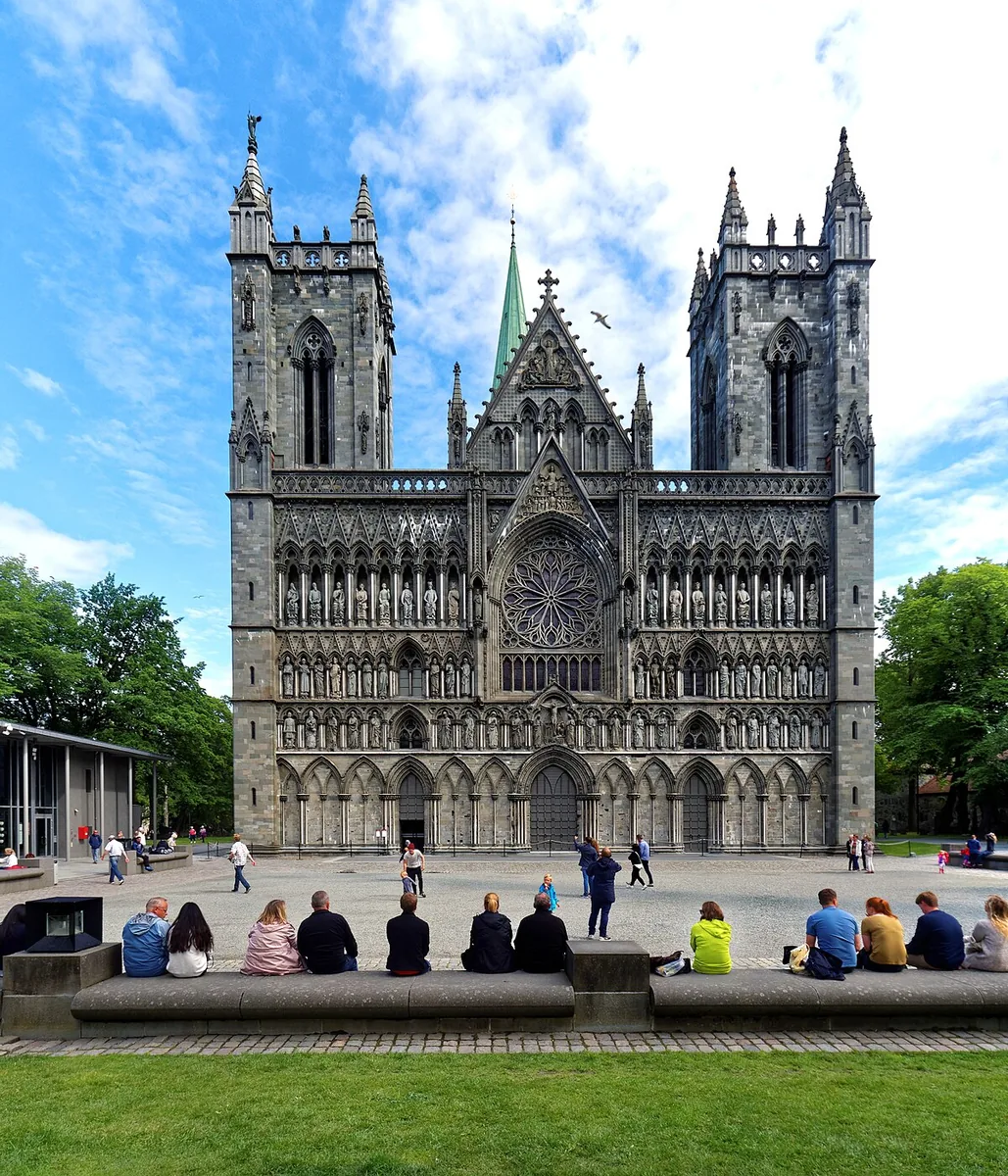
The cathedral is a palimpsest of European architectural history, blending Romanesque foundations with the soaring height of English-inspired Gothic. After the fire of 1708, only the stone walls remained, and the building was used partially as a parish church for over a century. The 19th-century revival was sparked by the discovery of the original plans and a desire to create a monument that reflected the 'Golden Age' of Norway. The sculptures on the West Front were largely created by modern artists between 1905 and 1983, each carving a unique face into the soapstone, including a depiction of the Archangel Michael that reportedly bears the likeness of Bob Dylan.
Green soapstone walls rise in a dense thicket
Green soapstone walls rise in a dense thicket of Gothic arches and delicate carvings at the northernmost medieval cathedral in the world. Nidaros Domkirke is the spiritual heart of Norway, built over the burial site of Saint Olav, the king who brought Christianity to the Vikings. The building is a massive, somber presence in the city of Trondheim, its intricate West Front covered in stone sculptures of kings and saints that seem to watch the pilgrims arrive. It is a masterpiece of light and shadow, where the cool grey stone contrasts with the vibrant, jewel-toned stained glass that tells the story of a nation's conversion and its resilience through the ages.
Construction began, 1070
Construction began in 1070, shortly after the death of Olav Haraldsson at the Battle of Stiklestad, whose tomb became a site of reported miracles. Across centuries, Nidaros was the most important pilgrimage destination in Northern Europe, drawing travelers from across the continent who walked the 'Saint Olav's Ways.' The building suffered through several catastrophic fires and fell into a state of ruin after the Reformation. A massive restoration project began in 1869, lasting over a century and involving the finest craftsmen in Norway. This 'restoration' was as much a rebirth of national identity as it was an architectural project, coinciding with Norway's journey toward independence from Sweden. Every Norwegian monarch since the Middle Ages has been crowned or consecrated within these walls.
Entering the nave, the temperature drops and the air takes on the scent of ancient stone and beeswax. The massive weight of the pillars that support the vaulted ceiling, a soaring space that makes the human form feel small. The first thing you register is the 'Rose Window' on the west facade, where the blue and red glass casts a kaleidoscopic light across the floor during the long afternoon. The sound is dominated by the low hum of the organ or the echoes of footsteps on the stone tiles. What catches you is the Octagon, the most sacred part of the cathedral, which houses the high altar and marks the traditional spot of St. Olav's grave. The light here is dim and atmospheric, inviting a sense of quiet contemplation that feels removed from the modern city outside. The climb up the narrow, winding stairs of the tower reveals a view of Trondheim's colorful wooden wharves and the winding Nidelva River.
The cathedral is the centerpiece of Trondheim
The cathedral is the centerpiece of Trondheim and is easily reached on foot from any part of the city center. It is situated at the end of the Munkegata, the city's main boulevard. Trondheim is a major stop on the Dovre Railway from Oslo and the Nordland Line to the north, and the cathedral is a fifteen-minute walk from the central train station.
The Experience
The silence in the crypt is heavy, a tangible layer of history that feels separate from the grandeur above. What emerges is how the soapstone changes color from blue-grey to green depending on the moisture in the air and the angle of the sun. The vibration of the bells in your chest when they ring for service, a deep, resonant bronze sound that has defined the city's rhythm for generations. First, the small, modern touches, a contemporary sculpture or a flickering votive candle, that show this is a living place of worship, not just a museum. The most poignant moment is seeing a modern pilgrim reach the end of their hundred-mile walk, touching the stone walls with a look of exhausted relief.
Why It Matters
Nidaros is the traditional coronation church of Norway and a symbol of national continuity. It bridges the gap between the Viking era and the modern state, serving as the ultimate monument to the transition from Norse mythology to the Christian faith. It remains the most important Gothic structure in all of Scandinavia.
Why Visit
Visit Nidaros because it is the only place where you can see the raw, dark power of Northern Gothic architecture on such a massive scale. It lacks the lightness of French cathedrals, replacing it with a sturdy, stoic beauty that perfectly matches the Norwegian landscape. It is a masterclass in stone masonry and a deeply moving experience regardless of your personal beliefs.
✦ Photo Gallery
Best Season
🌤 Late July is the most significant time to visit, as the St.
Quick Facts
Best time to visit
Late July is the most significant time to visit, as the St.
Getting there
In Trondheim, Norway; reach Trondheim first, then continue to the site.
Location
Trondheim, Norway
Type
attraction
Coordinates
63.4267°, 10.3962°
Insider Tips
- 1
Look for the 'cathedral builder' carving on the west front; it's a small, subtle tribute to the masons who spent their lives on the restoration.
- 2
Visit the Archbishop's Palace next door to see the original sculptures that were too fragile to remain on the exterior of the cathedral.
- 3
The tower climb is steep and narrow, but the view of the Nidelva River's loop is the best perspective of Trondheim you can find.
- 4
Attend an evening organ recital if possible; the acoustics are so complex that the music seems to come from the walls themselves.
- 5
If you have time, walk the last few kilometers of the Pilgrim Path into the city to understand the scale of the journey historical visitors undertook.