A perfectly flat square of granite hangs 600 meters over the Lysefjord, severed from the mountain by ancient ice and left as a stage for those brave enough to look down.
About Pulpit Rock
For centuries, the plateau had no name and was simply part of the grazing land for local sheep. It was only when modern tourism took hold in the early 20th century that the name 'Preikestolen' was coined due to its resemblance to a church pulpit. The path was significantly improved in recent years by Nepalese Sherpas, who hand-laid thousands of stone steps to prevent erosion and make the climb safer for the hundreds of thousands of annual visitors. Despite its fame, the site remains intentionally wild; the Norwegian authorities have resisted installing fences, believing that people must take responsibility for their own safety in nature.
Preikestolen, or Pulpit Rock,
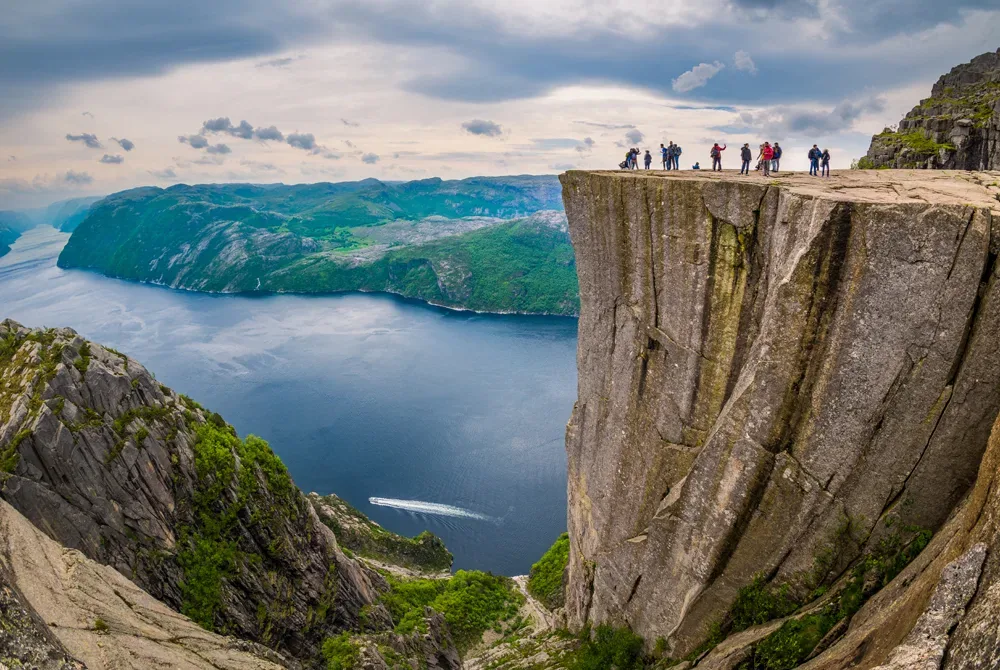
Preikestolen, or Pulpit Rock, is a massive square plateau that looks as if it were sliced from the mountain with a giant’s knife. It juts out 604 meters above the Lysefjord, offering a flat, twenty-five-meter square platform with no railings and a terrifyingly sheer drop. While Trolltunga is about the journey, Preikestolen is about the sudden, remarkable arrival. The rock face is a pale, fractured granite that seems to glow against the dark water of the fjord below. It is one of the most accessible of Norway's great heights, making it a place where hikers of all ages gather to peer over the edge into the abyss.
“Preikestolen, or Pulpit Rock, is a massive square plateau that looks as if it were sliced from the mountain with a giant’s knife.”
Pulpit Rock, Norway
Like much of the Norwegian coast
Like much of the Norwegian coast, Preikestolen was formed by the massive glaciers that carved the Lysefjord about 10,000 years ago. The ice wedged into the cracks of the rock, and when it melted, the pressure released, causing the mountain to split. A massive, deep crack still runs across the plateau today, though geologists assure visitors that it is stable. The rock was discovered for tourism in the late 1900s by an athlete named Thomas Peter Randulff, who spotted it from a boat and climbed it out of curiosity. Since then, it has transformed from a local secret into a global icon, famously serving as the backdrop for the climactic helicopter fight in 'Mission: Impossible – Fallout.'
The hike is a well-maintained path of stone stairs and gravel that winds through bogs and over ridges. The humidity of the forest give way to the crisp, dry air of the granite heights. The hum of the crowd is constant, a polyglot murmur of excitement, but as you round the final corner and the rock comes into view, the sheer scale of the Lysefjord usually strikes people silent. A strange, magnetic pull toward the edge, where the wind blows upward from the fjord, smelling of salt and pine. Beginning with the tiny boats on the water below, which look like white specks on a dark blue silk. The rock itself is warm to the touch if the sun is out, a massive, solid stage for the drama of the landscape. The trail begins at the Preikestolen Mountain Lodge (Preikestolen Fjellstue), which is easily reached from the city of Stavanger. Since the opening of the Ryfylke tunnel, the drive takes only about forty minutes. There are also frequent 'Pulpit Rock' buses that run from the city center during the hiking season. The hike itself is 8 kilometers round-trip and usually takes between 4 and 5 hours, making it an ideal day trip for most visitors with moderate fitness.
The Experience
The first view of the fjord from the 'crag' is the moment that stays with you; the water stretches out like a long, winding ribbon between the mountains. It becomes clear how the plateau is actually tilted slightly inward, which provides a small, psychological comfort when you are standing near the edge. The feel of the lichen on the rock, a rough, dry skin that clings to the granite. What hits is people sitting with their legs dangling over the side, a sight that induces a sympathetic jolt of fear in your own stomach. The light in the afternoon is particularly beautiful, illuminating the opposite side of the fjord in a warm, honey-colored glow.
Why It Matters
Preikestolen is the most visited natural attraction in Norway and a symbol of the country's commitment to 'Friluftsliv' (open-air life). It represents the accessibility of the sublime, where a few hours of walking can lead to one of the most dramatic views on earth. Historically, it was a landmark for sailors, but today it is a cultural touchstone for the global hiking community.
Why Visit
Visit Preikestolen if you want the maximum reward for a manageable effort. It is the perfect introduction to the Norwegian fjords, offering a view that is just as spectacular as the more difficult hikes but without the 10-hour commitment. It is a place to confront the scale of the earth and feel the wind of the North Sea on your face.
Insider Tips
- 1
Go for a 'sunrise hike'; leaving at 3 AM with a headlamp allows you to have the rock almost entirely to yourself as the first light hits the fjord.
- 2
Do not stand near the edge if it is extremely windy; the gusts can be unpredictable and powerful enough to knock a person off balance.
- 3
Take the 'hill path' rather than the main cliff-edge path on your way back; it offers a higher perspective looking down on the Pulpit Rock itself.
- 4
Check the webcam at the lodge before you leave Stavanger; if the rock is shrouded in clouds, you won't see a thing from the top.