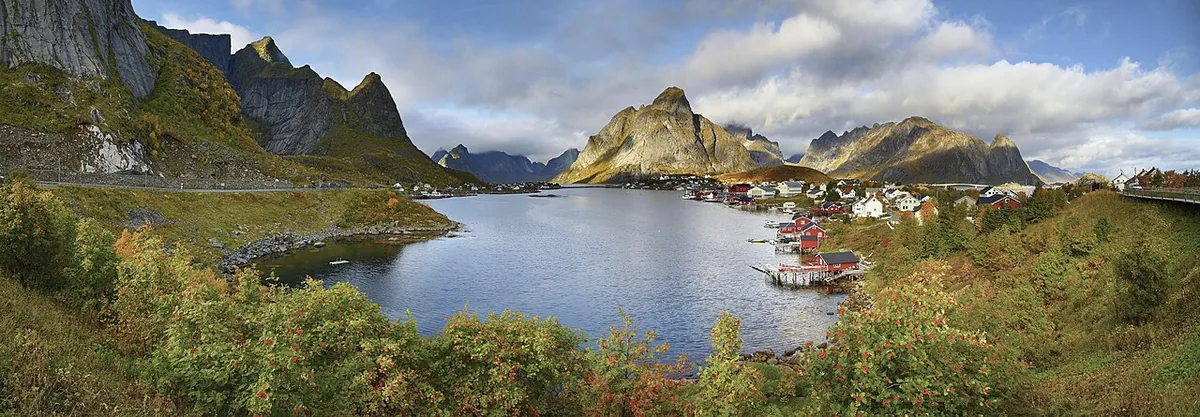
A handful of wooden cabins painted in oxblood red sit at the feet of granite mountains that look like the teeth of a giant, surviving on the edge of the Arctic Sea.
About Reine
Reine became an official trading post in the mid-18th century, serving as a vital link for the isolated communities of the Moskenesøya island. The village was the site of the first telegraph station in Lofoten, connecting the remote fishing fleet to the mainland markets. During the 19th century, the local merchants, known as 'nessekonger' or 'cape kings,' amassed great wealth by controlling the supply of salt and gear to the fishermen. Despite the technological shifts in the fishing industry, Reine has avoided the industrial scars seen in larger ports, preserving a scale that feels perfectly in harmony with the surrounding peaks.
What Reine actually is
Jagged granite peaks rise directly from the sapphire waters of the Reinefjord, cradling a cluster of red and white fishing huts that seem to cling to the shoreline for dear life. Reine represents the visual soul of the Lofoten Islands, a place where the mountains appear too steep to be real and the sea too clear to be cold. This tiny village, located well above the Arctic Circle, has remained remarkably true to its roots despite its global fame. It is a landscape defined by verticality, where the Reinebringen mountain looms over the town like a silent sentinel. Here, the rhythm of life is still dictated by the tide and the seasonal arrival of the Arctic cod.
a commercial center, 1743
Established as a commercial center in 1743, Reine thrived on the back of the stockfish trade, exporting dried cod to the rest of Europe for centuries. The 'rorbuer', the iconic red cabins, were originally built to house the thousands of fishermen who flocked here during the winter months, sleeping head-to-toe in cramped, unheated quarters. These men braved the treacherous Vestfjorden in open wooden boats, creating a culture of maritime resilience that persists today. While the village has modernized, the visual architecture remains proof of that era. The granite walls surrounding the village are part of the Lofoten Wall, a geological formation so ancient that it predates the arrival of the first humans in Scandinavia by millions of years.
Visiting Reine
The air in Reine carries the unmistakable, sharp scent of salt spray and drying fish, a smell that becomes more intense walking near the wooden drying racks. The crunch of gravel under your boots as you wander between the cabins, many of which are now cozy retreats for travelers. The way the light changes with dizzying speed; a dark, moody storm can give way to a brilliant, neon-pink sunset in the span of an hour. During the winter, the village is bathed in the ethereal blue of the polar night, often topped by the flickering green curtains of the Aurora Borealis. The hum of the wind whistling through the mountain crags is a constant reminder of the wilderness pressing in from all sides. Below, into the water from the bridges, you can see every pebble on the sea floor, distorted only by the occasional ripple of a passing fishing boat. Reine sits near the southern tip of the Lofoten archipelago along the E10, the main road that connects the islands. People generally arrive via a ferry from Bodø to Moskenes, followed by a short ten-minute drive north. Alternatively, flying into Leknes and driving south offers a two-hour walk through some of the most dramatic coastal scenery on the planet. Public buses serve the village, but having a car is essential for those who want to chase the light at their own pace.
The Experience
The silence in Reine during a calm morning is so profound that you can hear the wings of a sea eagle flapping overhead. What hits is how the red paint of the cabins glows with an almost supernatural intensity against the deep green of the fjord. A sense of prehistoric scale when looking up at the Reinebringen ridge, where the rock faces are scarred by millennia of frost and wind. The most memorable moment occurs at midnight in the summer, when the sun hangs low on the horizon, painting the entire village in a surreal, golden light that never fades. Beginning with the small details of local life, the neatly stacked firewood, the woolen sweaters hanging on porches, and the sturdy boats bobbing in the harbor.
Why It Matters
Reine is the living embodiment of the Norwegian coastal heritage. It represents the perfect marriage of extreme geology and human persistence. Culturally, it serves as an inspiration for generations of artists and photographers who seek to capture the essence of the Arctic. It is a reminder that even in the most hostile environments, humans can create a home that is both functional and profoundly beautiful.
Why Visit
Visit Reine if you want to see the version of Norway that exists in your imagination. While other villages in Lofoten are beautiful, none possess the sheer, vertical drama of the mountains surrounding this harbor. It is the best place to witness the midnight sun or the northern lights while feeling the pulse of a real, working fishing community.
✦ Photo Gallery
Best Season
🌤 February and March are magical for those who want to see the traditional cod fishing in action under the winter stars, while late August offers the best hiking weather without the peak summer traffic.
Quick Facts
Best time to visit
February and March are magical for those who want to see the traditional cod fishing in action under the winter stars, while late August offers the best hiking weather without the peak summer traffic.
Getting there
In Lofoten, Norway; reach Lofoten first, then continue to the site.
Location
Lofoten, Norway
Type
attraction
Coordinates
67.9324°, 13.0887°
Insider Tips
- 1
The hike up Reinebringen is now much safer thanks to a new stone staircase, but it is still a grueling climb that should only be attempted in good weather.
- 2
Stay in an actual rorbu (fisherman's cabin) rather than a hotel to experience the sound of the tide rushing directly beneath your floorboards.
- 3
Bring a high-quality polarizing filter for your camera to cut through the water's surface reflection; the underwater world here is as photogenic as the mountains.
- 4
The local grocery store is the social heart of the village; stop by for 'tørrfisk' snacks and a chat with the locals.
- 5
Take the small ferry from the harbor deep into the Reinefjord to see the isolated hamlets of Bunes and Vinstad, where the mountains feel even more imposing.