Sri Lanka's famous fishermen who balance on single poles above the surf now mostly pose for photos; the real fishing tradition has nearly vanished.
About Stilt Fishermen Coast
Stilt fishing is a relatively recent tradition, said to have arisen around the mid-1900s when fishermen, short of space, took to poles set in the shallows to cast over the waves. The perches were valued and passed down through families. As fish became scarcer and tourists more numerous, the practice shifted from livelihood to spectacle, with many of today's stilt fishermen posing for paying photographers.
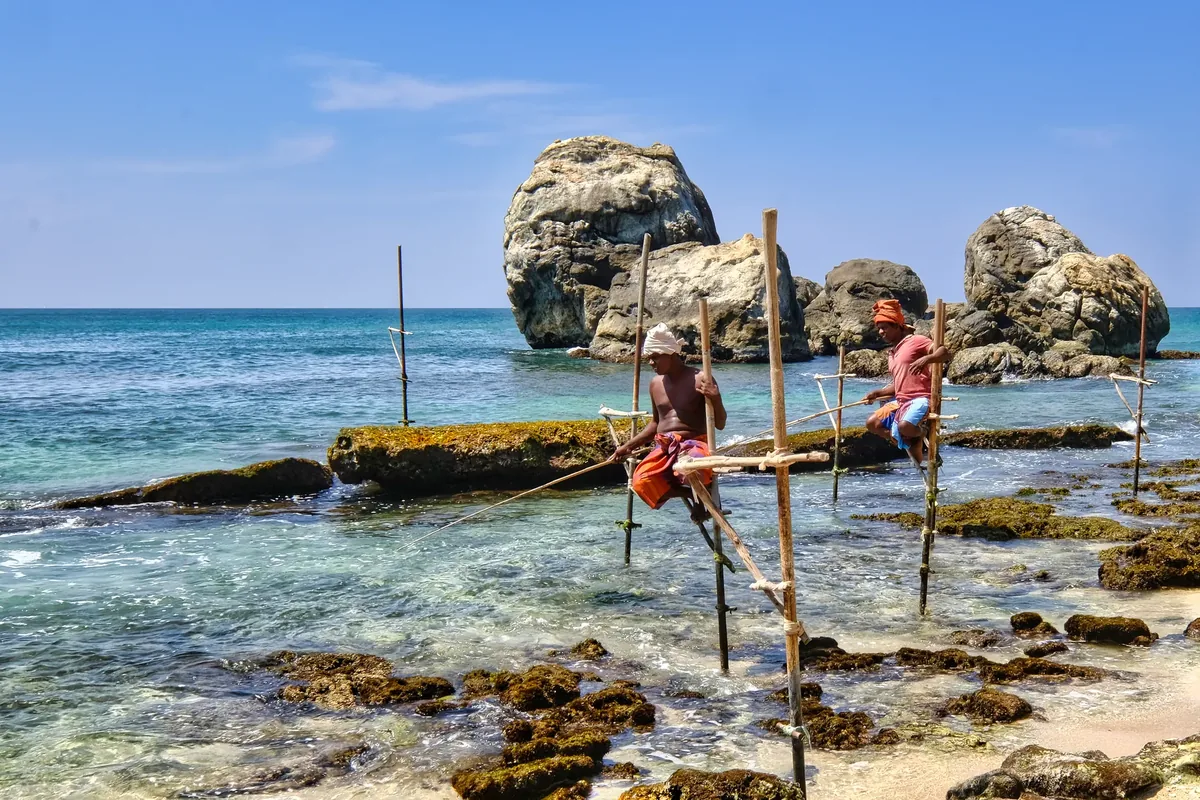
Along a stretch of Sri Lanka's south coast , around Koggala, Ahangama and Weligama, you may still see the island's iconic stilt fishermen, perched on single wooden poles planted in the shallows, casting their lines above the breaking waves. This distinctive and improbable fishing method became one of the most famous images of Sri Lanka.
A Vanishing Tradition, Now a Performance
Stilt fishing developed in the mid-20th century, reportedly after the Second World War, when crowded fishing spots and a shortage of room led fishermen to balance on poles over the water to reach fish without disturbing the shallows. Each perch, with its crossbar seat, was a prized and inherited position. Today, with fish stocks reduced and tourism booming, much of what visitors see is performed for photographs and a fee, as the genuine livelihood has largely faded.
The Experience
You watch, usually from the shore or roadside, as figures balance on slender poles above the surf with rod in hand, a scene that has graced countless photographs of Sri Lanka. Many will pose for a fee, and it is worth understanding that this is now largely a performance rather than a working catch. The image remains striking and uniquely Sri Lankan, especially at sunrise or sunset.
Why It Matters
The stilt fishermen are one of the most recognisable cultural images of Sri Lanka, even as the authentic practice declines. Their story reflects wider changes on the island's coast, where traditional livelihoods have given way to tourism, and they remain a poignant, photogenic symbol of the south.
Why Visit
The chance to see Sri Lanka's iconic stilt fishermen balancing above the surf, one of the island's most famous images, along the south coast near Koggala and Weligama.
✦ Photo Gallery
Best Season
🌤 The south coast is best from about November to April. Sunrise and sunset offer the most atmospheric light for photographs of the silhouetted fishermen on their poles.
Quick Facts
Best time to visit
The south coast is best from about November to April. Sunrise and sunset offer the most atmospheric light for photographs of the silhouetted fishermen on their poles.
Getting there
In Weligama, Sri Lanka; reach Weligama first, then continue to the site.
Location
Weligama, Sri Lanka
Type
attraction
Insider Tips
- 1
Expect to pay a fee if you photograph the fishermen up close.
- 2
Understand that it is now largely posed rather than real fishing.
- 3
Sunrise and sunset give the most dramatic silhouettes.
- 4
Look for them along the coast near Koggala and Weligama.